Let's roll - Finescale of a sort

Peter Insole

Western Thunderer
Thank you Giles, as soon as I saw Zach Bond's version I too was utterly smitten!

My main hope though is that whilst it's proportions may also be a delight to other eyes, the overall construction might at the same time appear to be sturdy enough to encourage a few more of our "mature" visitors to get in and have a ride.

Pete.
 

Peter Insole

Western Thunderer
Further apologies are due for not posting lately, but again I feared that multiple images of a myriad holes might become a bit of a boring subject?!

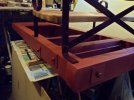
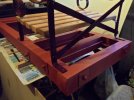
With no practical information for the originals to hand, other than a few inconclusive photographs, the precise design of the carriage footwell has been vexing me throughout the process. The most significant problem for me is that the floor slats, (surprisingly narrow, though sensibly gapped to permit free flowing drainage) appear to be simply hung from the bottom edge of the timber side and end walls... and with the whole structure suspended very close to the rail heads, there does not seem to be anywhere near enough clearance for additional support beneath.

While the single drawing suggests that those originals were to be provided with side walls made from wide, but fairly shallow timber planks, (something similar in proportion to old fashioned floorboards?) the lack of availability, let alone suitability of most current material equivalents led me to accept plywood sheet as a viable alternative. That decision may, or may not prove to have been a wise one?!

Nevertheless, the thought of a fully grown adult, even momentarily placing their entire weight on a single point during each entry or egress, and relying solely on the vertical grip of a couple of screw threads filled me with foreboding. A solid piece of grained timber might just suffice - for a while at least, but driving in from the edge of cheap ply is effectively "end grain", and will therefore certainly not!

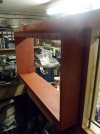
After much deliberation, I eventually came to the conclusion that my only realistic option in this case was to break with the prototype, (visually anyway) and fit steel angles along the inside of slightly extended (depth wise) walls... and upon which the floor planks could firmly rest. The fixing screws would only then be required to act as retainers.

Amongst so many other pending tasks, attaching such steel sills with sufficient screws - and as invisibly as practically possible has proved to be a rather tiresome trial!

Whew"
hztSAM_2696.JPGhztSAM_2698.JPG

I do admit to making a bit of a song and dance of the construction methodology... (huh?) but leopards and spots spring to mind!

My "jammy" account - as well as the pecuniary - seems to have become seriously depleted; as whilst I already carry some appropriate thickness of plywood in stock... this time not one piece was of sufficient proportion or quantity. I had to... gulp... and this makes me feel wobbly just thinking about it... go out and buy some more!

Oooh 'eck!

All I could get was a great big sheet - which wouldn't fit in anyone else's car... or a small one that would.

Incorrigible as always aren't I?

Unfortunately, that small one was still not quite big enough though!

After dividing equally and cutting the sheet into three long strips, I found that I was a quarter of an inch short on depth.

"No matter" I thought; as I still have some square strip wood left over from forming the tramline flangeways... and besides, it would surely be a damned good idea to have a clean, non splintering top edge to the footwell anyway?!

It turned out... you guessed it... that I didn't have quite enough to go all the way round.

Yep!

I had to get on the bus and go right back... sigh... to buy some more!

And it came in only one length... that wouldn't fit in that "someone else's" car!

......................

All that before it even got to the point of drilling umpteen holes...

My last hacksaw blade went bang while I was cutting the angle to length... and in the process almost launched me across the workbench.

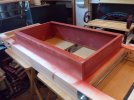
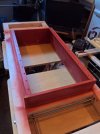
I still wanted the exterior of the well to appear plain and smooth, so the sills were to be fixed by using short, countersunk M5 machine screws - driven through the ply and into the steel. As I did not want any ends and nuts interfering with the wooden floor slats, I decided to tap each of the twelve holes in the angle... and then once firmly fitted, grind off the protruding threads.

One M5 tap (and nearly me) was completely wrecked doing that!

Then there were twenty four holes to drill through the angle for the six slats... each requiring to be countersunk so that nothing can catch or otherwise snag under the floor.

No less than two countersink bits utterly destroyed, a new one severely damaged, plus several wounds were accumulated before victory could finally be declared!
hztSAM_2702.JPGhztSAM_2704.JPG


I just hope this will all be worth it for next season, and no-one will end up falling through?!

Pete.

 

daifly

Western Thunderer
If there are four thousand holes you could well be in Blackburn.
Earlier this year I had the pleasure of meeting a long-retired journalist who, as a 20-year old reporter, worked for the Stockport Express. Filling the paper with stories of local interest was part of his duties and the 4000 holes story was one of his. It was subsequently appropriated by some musicians into musical history. The journalist went on to buy and run an Italian vineyard as his appropriately named autobiography "Going to Press" describes.

Dave
 

Peter Insole

Western Thunderer
Now I really do need to apologise, but this time going off-grid and not replying for a whole fortnight! Time for a rather belated thank you to all for your kindly comments.

I have been struggling a bit during these last couple of weeks, not least because of a nagging fear that I might have created a bit of a monster?!

With the footwell and floorboards finally fitted, the beast has become almost impossible to manoeuvre around the work areas in our already cramped little house! It is now abundantly clear that due to the scale alone, it was hardly a wise move to take it on as a winter project?! Just setting the frames up in a usable space to apply some of the gloss finish paintwork to the inside of the footwell, especially around the angles to provide a weatherproof joint under the floorboard ends was a nightmare enough... and without being able to open windows and doors sufficiently to expel the appalling fumes arising. The only saving grace is that the current Humbrol pong seems to go off a bit quicker these days?

hztSAM_2713.JPGhztSAM_2716.JPGhztSAM_2717.JPGhztSAM_2720.JPG

Enough light in the room for my old camera to take hand held photographs was something of a problem on that occasion too... so further apologies are due for the grainy and blueish tinted images posted above!

With everyone being so busy I didn't want to ask for assistance with hoiking the whole caboodle outside for some outdoor shots once the floors were in - and then bring it back!

I have reached the stage where a really troubling issue is the absolutely vital matter of bogies:

hztSAM_2660comPXL_20251108_114702401.jpg

As previously mentioned in an earlier post, the carriage had been tested by temporarily attaching (or rather lashing up) our experimental pair of bogies... and whist they rolled extremely freely - with even the lightest form of motive power available having little difficulty providing traction...

hztSAM_2660com20251108_133615.jpg

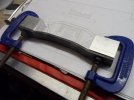
Unfortunately however, the flat steel bar bolster proved to be simply incapable of tolerating the weight of both the carriage (still far from finished at that point) and one, let alone two adults! It may be noted in the above view that the beam has already bowed downwards in the centre at the nearest, unladen end.

Right from the beginning I fully intended build a pair of far more robust bogies for this vehicle, including some serious suspension in the design. In the mean time, I was hoping to keep the first set reserved for Rich's stalled "Gun trolley" job - so I am rather keen to ensure that any replacement, or new bolsters for the former are sturdy enough for their demanding task. With that in mind, and being aware that "Mackays of Cambridge" will be moving to an out-of-town location early in the new year, (and being slightly more awkward for me to get to by bus) I decided on a trip last Friday afternoon.

The company carry a useful stock of varying steel sections, and are also happy to cut and sell short lengths at very reasonable prices... but quoting numbers at me being a complete waste of breath, I have to personally see what they have to offer - more frequently in the hope of inspiration. Yet again, the splendid fellows did not disappoint, and I returned home with a really nice chunk of heavy duty, rolled and varnished, 20 x 40mm channel.

Lovely stuff... that I can be utterly confident will only bend in the event of a major disaster?! The problem is working out how in hell I manage to modify the first set of bogies to fit it properly... and will it do for the new set too?

After carefully studying so very many pictures of commercial, past, present and plenty of home-made, 5 and 7 1/4 inch versions, I just cannot seem to be able to work out in my mind the best methods to adopt!

The channel bolster did at last get me thinking a bit more positively yesterday though:

hztSAM_2723comBogie zpoint 081.jpg


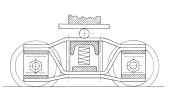
I hasten to add that the full size drawing done yesterday is only for assessing an idea that it might, just might be possible to fabricate a genuinely working version of the prototypical, 1925, Bassett-Lowke carriage bogies.

There would be an awful lot of work involved... and I'm not entirely convinced that they would be durable enough?

I know it is completely bonkers, but I am almost irresistibly tempted to have a go though...!

Pete.
 
Last edited:

Peter Insole

Western Thunderer
Now the festivities are over I have at last managed to fight my way back to the workbench! That might sound like a strange statement, but it does make sense. So much "stuff" got moved around for the celebrations that the area immediately in front of the cellar door became something of a temporary storage space! The trouble is that the original homes for the displaced items have subsequently become occupied by something else... hence the battles for access!

Prior to the otherwise lovely, but silly season, I had spent some time searching for appropriate materials, and modifying the bogie design to suit what became available. In terms of both cost, and workability, I eventually decided upon ordering a minimum length of 20 x 30, solid aluminium bar for the axleboxes.

I had to be careful ensuring that there was enough metal in each block cut from the bar to allow for the fixing bolts to pass either side of the axle bores, so it was going to be a tight exercise in every way!

hztSAM_2841.JPG

Some good marks, a thoroughly decent blade (for once) and a shedload of patience eventually got the jolly job done!

hztSAM_2844.JPGhztSAM_2846.JPG

It will seem to be an odd mix of media, but I am assured that as quite a few commercial bogie manufacturers over the years have utilised cast aluminium for side frames, and even bolsters, this choice should be adequate for the task.

Yesterday, I also found out just how tight the measurements actually were:

hztSAM_2848.JPG

Whew! That was almost down to a bacon slicer sliver left over at the end?!

My next door neighbour has changed his shift after the holiday, so I now have full permission to start "bish-bashing" on the bench again too...

hztSAM_2850.JPG
hztSAM_2851.JPG

It is going to be a bit of fun bending the next two pieces into a tight fit to set up the first frame.

I have decided that, in much the same fashion as the previous seat frames, it might be marginally easier to use the drawing for this one to get everything aligned, and then copy it thrice times over for the remainder.

It had damn well better work... and all the while I am trying not to think too much about any potential failures at this point?!

Pete.
 
Last edited:

Peter Insole

Western Thunderer
Gosh Simon, I'm sure they could, and that would be most welcome... Thanks for the suggestion, but I would be very surprised if any such tradesmen could be found operating in my neck of the woods!

Meanwhile, just before I became joyfully sidetracked by Brian's bus pictures yesterday:

NOPE..!

hztSAM_2852.JPG
hztSAM_2853.JPG

All the bends were in the right order and direction... but not necessarily in the right positions!

TRY AGAIN!!

It is slowly beginning to dawn on me why nobody else has been daft enough to try something like this?!

Pete.
 

ovener

Western Thunderer
Good morning Peter.
It looks like your are boldly going to the outer limits.
Those blocks are beautifully done. I would end up with them all missshapen and undersize due to
"just a bit more off that side should do it" syndrome.
Looking forward to seeing the next stage.

Richard
 

Peter Insole

Western Thunderer
"That's a bit more betterer" - as we tend to say round here!

hztSAM_2854.JPGhztSAM_2856.JPG

It's not perfectly shaped as per the plans, but when clamped in the middle - at least the axleboxes stay put!

I think this is a good moment to sit down, post this and reward myself with tea and a wad?!

Oh, by the way Richard, thank you... and yes, I can do that all too easily as well! "Just a little bit more" was exactly what happened first time around!

Pete.
 

Peter Insole

Western Thunderer
Last message for today! The first set has at last been beaten into some sort of recognisable shape?!

hztSAM_2857.JPGhztSAM_2858.JPGhztSAM_2859.JPG

There is still a bit of tweaking and straightening to do.

At least I now have some clear marks to follow, and although I am prepared to admit that the bends on each subsequent set will likely be somewhat variable at the end of the process, I do hope that would be of little consequence if I drill out the axle bores in clamped pairs?

Then I trust the only person that might notice any errors will be, heaven forbid it, somebody we have just run over!

Pete.
 

Peter Insole

Western Thunderer
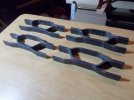
Working up the following three sets of frames has been every bit the trial I could have expected.

At the close of play last Friday I had become quite excited by progress, and would have gleefully carried on, but for the problematic "noise window"! It was, in retrospect, probably a good thing that I was obliged to desist over the weekend, as it not only provided my good neighbours a bit of peace, but enabled my aching arms and ringing ears a reasonable chance to recover!

I did try to pace myself... honestly, and frequently remember to just "let the tools do their job", but sometimes the desire to push on while the available time remained on each day proved almost irresistible! I thought the best way to limit the problem was to start later in the afternoons... and while I would like to convince myself that was a deliberate and sensible policy decision, in truth; I was still exhausted by the exertion of the previous session!

Slowly, the parts came together:

hztSAM_2860.JPG

While it was very satisfying to see all four base plates sitting in a row - after a fair bit of effort... but I was only too aware that the next batch of braces to do would be absolutely horrible:

hztSAM_2861.JPGhztSAM_2862.JPG

They were... in every part!

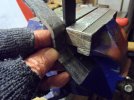
Trying to start each reverse angle at precisely the right point to accommodate the tendency of the curves to form slightly differently each time was a nightmare. The thickness and strength of the metal also meant that there was very little room for adjustment once the bend had revealed how far it seemed determined to go!

hztSAM_2865.JPG

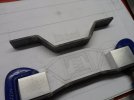
Although it is not so obvious in the above image, you might otherwise observe that I have very successfully managed to beat hell out of my poor old vice jaws in the process! Hopefully, the sacrifice will be worthwhile in the end?

hztSAM_2867.JPGhztSAM_2871.JPG

Mercifully, the final set of cover plates did not have to be anywhere near as critical dimensionally; as they are merely required to complete the triangular reinforcement between the axleboxes at either end of the frames.

Having said that; I do remain rather concerned that I am putting an awful lot of work into a sort of "Tay Bridge" structure here; in the sense that while the firmly braced construction might appear to be sound enough in principle... it might yet fail spectacularly, and far too soon once placed under load in service?!

Pete.
 

David B

Western Thunderer
My money is on your new bogies being a complete success Pete. From what I can see, you’re channelling the robust, simple and reliable design philosophy of Robert Urie of Eastleigh ‘battleship’ construction fame - as with everything else you’ve created for your remarkable, wonderful railway, the bogies are looking the business. Thank you for the continuing inspiration you share with each update.
 

Peter Insole

Western Thunderer
Thank you so much for your most encouraging and helpful reply David. I suppose I am just an habitual worry pot by nature really?!

A degree of determination is just about keeping me going throughout this project though... and at the same time I can draw a little comfort from holding a "plan B" in reserve... not that I am terribly keen to resort to it mind you!

I recall a student at an Art School I worked for many years ago, who confided in me that he was seriously considering abandoning his course. He qualified that statement by saying:

"I think I'm just wasting my time, yours and everyone else's by carrying on."

"Oh no, no, no, you're definitely not!" I replied, then continued to explain:

"At least by sticking it out, you will know for certain at the end what you might, or might NOT want to do with the rest of your life... and that alone cannot possibly be a waste... whereas, if you do give up now, you will forever be left wondering; what if...!"

He stayed... but what become of him I have no idea. That does matter of course, but I doubt I shall ever find out?

The point is, it will bother me all the way until the job is finished... but will keep trying to remind myself that if these bogies do fail, at least I had a damn good stab at it! Besides, in such event I could always re-purpose them for use on another "lighter-duty/distinctly small persons only" type vehicle? After all, we can never have enough stock to hang on the drawbar!

Pete.
 

Peter Insole

Western Thunderer
It took me a while to get going today as I kept wondering if the plan of drilling and tapping holes for fitting the frames was the right one. In the end I had to just bite the bullet... and make a start!

Although the main bends are done in general outline on all the bars now, there remains a fair amount of fine tuning to do before any of the axleboxes will sit down without any daylight showing at the joints. I had decided to start at the bottom and spent quite a bit of time ensuring that the lower bar was absolutely square and even before setting it up in the drill press.

Yet again, I am not at all comfortable with relying on being able to accurately mark and machine multiple holes. In some cases, having to open out the odd one here or there is a jolly nuisance, but usually of little consequence. However, with every section of the geometric structure likely to come under equally significant stress on this particular design of bogie I really don't think I can afford a single misaligned fixing. Therefore, I will attempt to clamp firmly and drill through as many parts as practically possible.

Eventually, I got the first two axleboxes solidly mounted on one bar:

hztSAM_2873.JPG

The order was to mark and drill out the four holes in the steel bar to the minimum size for tapping M6. It was a bit awkward setting everything up in the drill press vice, but I was then able to clamp one box at a time to the bar and continue the holes through for a short distance into the axlebox with the original bit.

After the clamps were removed I went on to drill through each box, then tap them for the M6 set-screws with a reasonable degree of confidence. The final act was to carefully open out the holes in the bar with a 6mm bit to fit.

hztSAM_2875.JPGhztSAM_2876.JPG

That seems to have worked... this time anyway!

Bringing the upper pair down together (for the first frame) will I fear be a great big bundle of fun to come?! However it goes, it will certainly take some time... so I may be away for a while!

Pete.
 

Peter Insole

Western Thunderer
Well, I was going to just knuckle down to the long task in prospect, and only post again once I had a nice little advanced pile of assemblies to show off. The trouble is I repeatedly forget there is such a thing as "weekends", and that they have a frustrating tendency to keep coming around with increasing rapidity!

I am informed, in no uncertain terms, that the thrumming noise of my drill press on the cellar workbench is a repetitive, and potentially annoying sound that carries through at least two other properties on either side - so I have to be mindful of other folk's sensitivities. On weekdays I have made a habit of first checking outside to see what cars are on the driveways before doing an even quick whizz or bash job, but for working on something repetitive like these bogies, I prefer to seek my neighbours approval directly if they happen to be home at the time.

A brief "window" presented itself yesterday afternoon when anyone likely to be affected were out and about, so I took full opportunity to try and practically work out the best means and methods for joining up all the accumulated bits of bent metal by completing the initial frame! I discovered that the complex bending process was even less accurate than I had hoped, and it turned into a somewhat greater trial than expected when it came to obtaining all the alignments necessary for drilling! It seemed to happen every time I managed to get two bars to settle nicely over one axlebox - the other end would pop up... sort that out, and guess what?! There was much grumbling, grunting, and the odd wallop required before all points were in place! If I had for a moment considered using a batch technique for the remaining three frames... it is now evidently quite impossible!

It wasn't much less of a faff actually drilling the things:

hztSAM_2884.JPG
hztSAM_2885.JPG

The trick (for me) with maintaining accurate holes through the top two bars, axlebox and baseplate was to start with the latter.

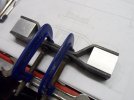
I had started by clamping each axlebox in turn onto the baseplate, (I could only do one at a time) then bore the first two holes through the steel - and part way into the aluminium box at the size for tapping M6. When they were separated I was able to continue the bore down to just over halfway through the box. (I could have gone all the way, but have suffered far too often with cheap, wandering bits to feel confident). I then opened out the holes in the baseplate to the full M6, (That move was necessary as both the boxes need to be fitted firmly in order to make the aforementioned adjustments!).

The baseplate was removed again so that the existing holes - now slightly awkwardly M6 of course, could be used carefully as guides for finding the centres, and drilling down from the top of the axleboxes. Doing it that way there was still a fractional misalignment within the box... but at least that was perfectly within limits for tapping either end, and fixing with separate top and bottom machine screws - instead of the preferred single, long bolts passed all the way through. Then by clamping the baseplate to the centre (diagonal brace) bar, it was used again to act a positive guide for another set of M6 holes in that steel section. I still couldn't go through all three bars at a time as a result of the bend directions, thus making it impossible to clamp them together in the correct orientation!

Finally (!) the middle plate was clamped to the top plate, (right way up this time!) and for the last time used as a guide - to complete the set.

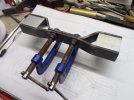
As you can see in the above images; I don't possess appropriate clamping devices of the right proportions for the job! I did consider - and even got as far as enquiring about purchasing some, but baulked at the additional cost, so decided to carry on "making do"! To that nefarious end, I would pop temporary M6 screws through each fresh hole... thus hopefully ensuring that the bars remained in perfect alignment for the next one?!

It was an enormous relief, and with more than a little surprise to find that the first frame bolted up cleanly:

hztSAM_2889.JPG

So far, it feels rock solid... and even appears to be pretty much square to boot!

I just hope to be able to repeat the whole/hole exercise... thrice times more... and yet still maintain either a similar level... or indeed a grip on my vaguely remaining sanity over the next few days?!

Pete.
 
Last edited:

Peter Insole

Western Thunderer
Things seemed to be going well in the early part of last week when the second frame matched the first quite nicely... but later, and for some unknown reason, the last two fought back at every stage. It turned out to be rather a struggle getting the two sides to finally align as anything like an acceptable pair!

hztSAM_2899.JPG

After much rummaging about amongst the various bags and boxes of screws on, under, or anywhere else come to that, I couldn't find any suitable M6 bolts to complete the sideframe structural elements.

Ideally, the vital, centre spacers within each frame should be formed as a right-angled box - or at the very least be built up from squared columns if mounted separately. However, as there is a severe restriction of having to keep the wheelbase to the barest minimum in order to negotiate the dreaded "top curve" on our little railway, the design is therefore somewhat condensed. When considering each element of an arch-bar frame, I realised that when the axleboxes are subjected to load, a pivotal bending action at the lower vee joints applies significant compression forces on the upper bar, and if not constrained, could lift the bar. The central "box" must therefore be in tension, and it's primary function is of preventing any upward, distorting movement. A secondary benefit of the twin uprights is to act as guides, or horns, for the sprung bolster beam to slide vertically between.

After much thought about clearances, and various other issues, I eventually decided that using 6mm smooth round rod, tapped at each end would have to suffice... instead of a more "prototypical" approach. I chose M6 as an absolute maximum hole size to drill through the bars - purely out of concern that all four connections are terribly close to the bends, and to maintain sufficient surrounding metal at those points.

In retrospect also, it might have been a better idea to have increased the angles of that upper bar and thus allow enough room for fixing nuts underneath... but I had committed myself to tapped holes for the uppers - and using single locking nuts on the top instead.

Nuts indeed... and that can now be confirmed - as if there was any doubt in the first place!

I fancied I was being clever by acquiring (for the magnificent, bank breaking sum of £2. 20p) enough perfectly sized long bolts - with a handy portion of smooth shanks, chopping off the hex heads and then cutting short sections of new thread in their place.

.hztSAM_2901.JPG

Ha! It all got rather silly... and messy... as I clearly hadn't thought the task through properly?

I did get some nice, clean threads in the end... but at the awful price of more than a few mole grip "nibbles"!

Fortunately, some swipes with a needle file, plus something a bit more vigorous with a strip of emery cloth has reduced the worst of the damage. The remaining, fainter marks will hopefully disappear later under plenty of thick, lumpy coats of "underframe protection" paint?!

hztSAM_2904.JPGhztSAM_2906.JPG

It was a fiddle having to take the top bar off in order to screw the bolts (or what was left of them anyway!) in from underneath, lock 'em in place, and then remember to apply both "inner" nuts... as well as the original orientation, before dropping the assemblage back in place.

"Easy-peasy", run of the mill stuff surely Mr. I...?

Not so when your ability to drill holes precisely in the right place seems destined never to improve, despite either increasing age or experience!

hztSAM_2913.JPGhztSAM_2914.JPG

Mercifully for all and any concerned, the hurling of toys, tools and appalling verbiage was interrupted by my good lady wife; yelling (err, well calling really) down the cellar stairs; and informing me that my attendance was required in the matter of dining.

It was perfectly timed... as the first pair were (at last) actually coming together... so I was about to submit anyway!

Pete.
 

Osgood

Western Thunderer
Just fabulous.

An option for the next coach(es) - :eek: :D - might be to use a length of thick tube as a spacing sleeve for the long bolts?
Something decent like hydraulic tube if that is available at 6mm bore?
That way threaded rod ( or those long bolts) could be used, the diestock holder and mole grips given a day off, and the nut inventory sustained. :)

An admission - I would have been tempted to drill / bore out the axlebox blocks before bogie assembly, only to discover once assembled that the axle centres were not quite right.
Unlike you, who can now mark out the requisite centres and end up with a highly accurate result………:rolleyes: :thumbs:
 
Last edited:
Top