Let's roll - Finescale of a sort

simond

Western Thunderer
there are loads of calculators on line. I found this one


I guessed that the total weight on the springs was 100kgs (if you're lighter than me, assume the rest is the weight of the wagon :))) , which is ~ 1000 Newtons, and as you have 4 springs per axlebox, that makes 125N per spring. Of course, they are not all equal, as your centre of gravity won't be exactly in the middle of the truck!

I played with the height L1 and it is difficult to get something that works - it looks like your loaded height L1 is basically the same as your solid height and that means that when you get on, the springs are fully compressed, and that will give a harsh ride, which is clearly bad for the truck, the track and the posterior.

At a quick guess, it looks like it needs either longer free length - ie more travel before it becomes coil bound, or more springs. To try it out, can you temporarily fit a spring (without a screw) between the axlebox and frame like the orange one in this sketch? That should give you a millimetre or so of additional travel, which might well mean that you don't close the coils just getting on board.

If you do this, beware the un-fixed springs "getting away" as they might hurt!

A better alternative might be to make some plates that allow 4 springs per axlebox.

1718021088355.png

good luck!
Simon
 

Giles

Western Thunderer
You can turn your axle box assembly (U bolt and grip plastic plate) upside down, ans use longer bolts - that would give you room for springs almost twice the length - or two springs in series......
 

simond

Western Thunderer
You can turn your axle box assembly (U bolt and grip plastic plate) upside down, ans use longer bolts - that would give you room for springs almost twice the length - or two springs in series......
yes, but then they'll both be coil bound...

same load, same compression!
 

Peter Insole

Western Thunderer
Thank you both Simon and Giles for taking the time to reply. I do always appreciate fresh eyes on whatever challenge arises!

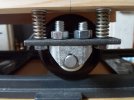
I'm afraid there is not enough room to try additional springs above the axle centres, as the following view shows:

zsSAM_9801.JPG

I could turn the "axleboxes" to be able to fit longer springs as you suggest Giles, but I would be worried that in the event of a derailment, (unfortunately an all too common occurrence when excitable children are playing trains!) the metal bar and "u-bolt" studs could drop down onto the rail - with any potential impact damage being far greater than any contact with the rounded bottom of the box!

zsSAM_9806.JPG

I may end up adding an extra pair of springs in line, by replacing the four hole steel bars with six!

Then again, trying some alternative springs might be a good idea too? It is only me doing the usual thing, and trying to make do with what I've already got to hand that is the real problem here!

Pete.
 

Peter Insole

Western Thunderer
Thanks Michael, that would work! The tails do indeed seem long enough to ensure that there would be little risk of the additional springs making any unscheduled departures?!

Now thinking about it, I could carefully drill holes in the solebars to the same depth as the U-bolt nuts - to both contain the same springs at the top, and ensure that compression rates are practically equal?

Pete.
 

simond

Western Thunderer
the four hole steel bars with six!
I think this will help, but only by a millimetre or two, which may justify the work, or not…?

putting the springs in series will not really help, though it will increase the droop when a wheel is unloaded, so they are more likely to stay on the track.

I fear the springs you have won’t fit the protruding ends of the u bolt. - our posts crossed. If they will fit, then your holes in the solebars are a good idea!

The ideal solution would be a spring with a free length of around 25-30mm, and a coil bound length of around 15mm, and a rate of about 15-20N/mm. Eight of these would sag about 6mm with a static 100kg load, and would have the same and a bit more travel to absorb the bumps.
 

Pencarrow

Western Thunderer
What about adding a couple of extra slightly shorter springs over the protruding bolts ?
Michael

Just had exactly the same thought. Lengthen the protruding bolts enough to retain the spring. Job done?

Probably not reading Simon's more technical considerations.

Perhaps go all French and go for air suspension?!
 

Peter Insole

Western Thunderer
Having returned from a brief escape to the seaside, and while the locomotive driving wheel conundrum is still at the "wait and see/discussion with friends" stage, (over on the main thread) I have decided to make a start on yet another vital project.

Our current, complete carriage and wagon stock available for service is made up of only five, four wheelers, (including both driving trucks!) but as a result of the infamous "top curve" all have a severely restricted maximum wheelbase of a mere nine and a half inches. Most of our juvenile passengers, and even some of the adult ones as well (ahem, dare I say that and live?!) are getting bigger, so capacity, and an increasingly alarming fore and aft stability issue is becoming an awkward and regular problem.

I cannot help feeling that a bogie passenger carriage has now become a matter for urgent consideration.

Recently, I discovered the online postings of a Cambridge Professor, Mr. Zach Bond, who had a (distinctively) minimal five inch gauge, ground level railway in the tiny back garden of his rented, city accommodation. One point of particular interest for me was his quite thorough documentation of an experimental twin seat bogie car... in this case designed to be suitable for the carriage of adults! By all accounts, it would seem that it had proved to be a reasonably successful exercise.

He had chosen to create a slightly reduced scale representation, based on a batch of Bassett-Lowke carriages built in 1924 for a 9 1/2 inch gauge miniature railway at the Wembley British Empire Exhibition. Very few details of the originals survive it would seem, but I did manage to discover a published copy of a rather vague general arrangement drawing - although that only resembled the equally few photographs of the prototype in part.

A pair of those carriages have survived more or less intact - reputed to be the ones that King George V and Queen Mary rode in, but they are presently in private ownership... somewhere in the Crewe area:

hzq ride-in rp1b2 Crewe and Weston Rly 2015 image02.jpg
(Copyright image shown here for illustrative purposes only)

Unfortunately, I have no idea how to contact the owner, and even if did manage to do so, let alone receive a kindly invitation, the distance and lack of transport is far too great for me to be able to visit for an inspection!

Mr. Bond of Cambridge constructed his version using a composite, welded steel angle structure, whereas for our purposes I would prefer to build a closer replica, relying on the original trussed timber frames. I think I have just enough information, and to that end have started to prepare a set of drawings.

Calculating the dimensions and quantity of materials required should be a fairly straightforward process in the main, but the delightfully curly iron armrests on the open seat frames have had me rather flummoxed...

Using some stock - plus an additional batch of short strips picked up from our local B&Q, I peculiarly (as usual?) decided to tackle them first:

hztSAM_2488.JPGhztSAM_2490.JPGhztSAM_2494.JPG

It was a bit of a faff trying to work out where to start, and precisely how to follow up using only the vice jaws for each subsequent bend!

The exhausting result was not exactly as drawn at every point, but under the circumstances I am quite happy with how it turned out. The real test came when having to match it with the second attempt...

hztSAM_2495.JPGhztSAM_2498.JPG

Whew!

Not quite... but close enough not to be noticeable I hope?!

Anyway, that's two done... but two more still to do though!

Pete.
 

Peter Insole

Western Thunderer
When bending the second pair of armrests I did myself a mischief, and subsequently had to take several grumbling days off!

Making the aforementioned four items had not only cleared my own bar stock, but that of my local B&Q store as well! At least the wait for a home delivery order to arrive allowed my soreness a bit of time to settle down. I also decided that it would be preferable to take the opportunity of obtaining two of the longest lengths available to avoid as much offcut wastage as possible for the rest of the seat construction.

Whilst the seat base/leg sections appear on the face of it to be rather less geometrically complex than the arms, in reality they were not much less so to work on. It goes without saying that it was critical to ensure that every one of the sixteen bends were in precisely the right place to ensure the finished seats would sit squarely on the frames when assembled.

Once again, the first bends only needed to match the drawing "within reasonable tolerances"... but each of the subsequent frames had to follow exactly.

hztSAM_2499.JPG

Ugh!

Frankly, that was a bit of a horrible exercise... with lots of loud, naughty words and many blows from a heavy hammer having to be deployed far more times than I (and other good folks nearby) would have liked!

This time, feeling that I just wanted the nightmare to be over quickly... I foolishly carried on without a break...

hztSAM_2501.JPGhztSAM_2502.JPG

Although I still have to trim all the feet to the same length, and then drill a myriad holes for fixing the timber slats and backs, our supplier of hardwood states that the section I require is out of stock!

Groan!

Having to wait for replenishment, or search for an alternative will at least give my new collection of agonies some more time to subside!

Pete.
 

Peter Insole

Western Thunderer
I am rather keen to ensure adequate back support for the seats on this carriage... despite the fact that in all likelihood I will only rarely get the opportunity to be one of it's passengers!!

hztSAM_2503.JPG

At least the worst of the bending jobs are over now - save a bit of tweaking adjustments that will inevitably be necessary during the final assembly stage.

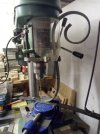
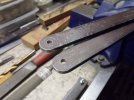
I'm afraid that as a result of bitter experience, and perhaps being a rather meanly compulsive user of cheap drill bits, (?) I simply cannot trust myself to align multiple holes sufficiently accurately - so wherever possible I prefer to clamp pieces together and do each bore right the way through. Whilst that may be a particularly sensible approach with these parts, this time it did prove to be a bit of "fun" trying to get at the centre-punch marks in a relatively small, bench mounted drill press...

hztSAM_2505.JPGhztSAM_2507.JPG

I did find myself thinking it could have been a useful genetic aberration to possess forearms slightly more akin to a that of a species of Gibbon... the better to reach round all the twangy bits of metalwork for the power switch or lever handles!

It might appear to be a slightly cack-handed way of going about things, but my reasoning (ha!) was that as there are slight variations between each bent section, I wanted to be able to match the bolted up assemblies into the most similar pairs before proceeding any further. Now that I am quite happy with the result, I intend to stamp identifying codes in subtle locations on each part, thus ensuring that I can dismantle it all again - something that will be essential for drilling the rest of the awkwardly located holes... as well as applying thoroughly weatherproofing coats of paint anyway - and have a marginally less stressful reassembly job at the finish?!

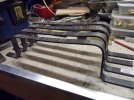
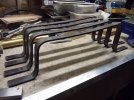
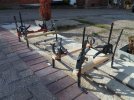
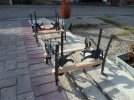
At the close of play, I couldn't resist setting up the two sets of frames with some waste wood and taking them out into the lowering sunlight for a "progress" photo shoot:

hztSAM_2515.JPGhztSAM_2516.JPGhztSAM_2517.JPGhztSAM_2518.JPG

Throughout the whole process I have continued to be concerned that this carriage project might yet be fundamentally flawed by my desire to shoehorn adult bottoms into a scaled down version of an already miniature prototype... (!) and all the while maintaining the hope of a reasonable degree of stability once it is in service!

Indoors, the seat assemblies seem to be notably so much wider than anything else built for our railway to date... but after laying them out on the tramlines I could draw some comfort from being able to visually confirm that we are still within the generally accepted maxim that rolling stock can operate quite safely up to, and even slightly greater than track gauge on either side of the rails. It seems to have worked well enough on the Vale of Rheidol and L&BR, with locomotives and stock at 6ft on 2ft (nominal) gauge - with the former even having (potentially heavy when fully laden) coal bunkers extending further to almost 8ft!

Not really a good comparison though?

I suppose that in truth, the correct application of scale means that by comparison, neither of the aforementioned companies would regularly have to contend with a completely unrestrained cargo of highly caffeinated Elephants... on a sugar rush!

Well... at least in normal, day-to-day operations anyway!

Pete.
 
Last edited:

Peter Insole

Western Thunderer
The seat frames for this carriage did at first sight appear to be fairly simple, straightforward, bend and bolt together affairs... but I am now discovering that they are somewhat otherwise!

Although I cannot yet prove who designed the originals for Bassett-Lowke, (to fulfil a commission for the Canadian Pacific Railway just over one hundred years ago) but having previously read accounts of Henry Greenly's involvement with the former company, and the legend that his engineering drawings, whilst beautifully executed, frequently lacked vital details, the only copy that I have found seems to suggest that he may indeed have been, or at least in part responsible?!

I may be quite wrong about all this, but I rather get the impression that "whomsoever" simply trusted the engineers on the shop floor to be able to work out for themselves what was intended?!

In this case, the drawing specified two, flat bar, cruciform bracing struts to be rivetted or bolted to the outside of the seat back uprights... and evidence reveals that such were thus provided:

hztqSAM_2486com zq ride-in Royalty7b Prince and Princess image crop.jpg(Cropped part of copyright image, shown here for illustrative purposes only)

Easily accomplished one would assume?

Oh dear, oh dear! I found myself feeling some respect for the chaps that sweated away in their smithy, all those very many years ago, as they had to make up enough sets for nine carriages... while I only have a measly, single item to wrestle with! Theirs was after all a one-off order, so it was likely to be down to individual skills alone, without the benefit of jigs or tools for large scale production!

Quite apart from the tedium of having to very accurately measure out each strut, then drill and shape eight ends...

hztSAM_2519.JPG
hztSAM_2521.JPG

Where incidentally I though there might be a saving with two bolted together and shaping them simultaneously... only to discover that it took twice the amount of physical effort to achieve the same end result!

The real fun was however to come:

The original specification was perfectly clear - and indeed entirely sensible. In common with general chair design principles, the front legs are, to keep them out of the way, vertical, while the rear pair are angled outwards to provide a greater degree of stability for the sitter. As the human body is not particularly relaxed when sitting bolt upright, the backrest is normally also inclined toward the rear. Commonly, the leg and support are made as one piece... and usually formed by a continual, gentle curve. However, the Bassett-Lowke designer didn't appear to have been bothered to consider the subtleties of geometry involved when deciding that diagonal braces might be appropriate?

Rather obviously, each bar, just to be able to cross over one another at the centre would need to be "joggled" in some way... but at the same time, each end, where it meets the uprights required angle adjustment. Just to make it more awkward, the individual bars even had to be "handed" because the degree of sweep on the curved leg/backs was different at top and bottom! It also goes without saying that the slightest error of alignment at each bend - if that were not hard graft enough - will potentially cause the rest of the structure to become distorted!

Down in my cellar it became jolly tiresome having to keep offering up one at a time... adding or attempting to counter bend after bend until I thought I was satisfied... only to watch in utter desperation as a front leg rose off the bench surface each time the bolts were tightened!

"Arrrrgghhh!" is the only polite version suitable for publication here!

I'm afraid that one complete bar had to be frustratingly consigned to the bin as I tried to work out the best approach to bending... and it rapidly and irreparably became a reminder of Nora Batty!

In the end, they all eventually settled in reasonably well:

hztSAM_2523.JPGhztSAM_2527.JPG

That was a truly, truly horrible job... the worst part being the aforementioned subtlety of it!

It should be barely visible - and indeed it turned out to be impossible to satisfactorily photograph for this thread, but each bar has not only a slight "dihedral" or "anhedral", depending on whether it is to be laid over or under, but is gently rotated from the centre by differing degree according to orientation, into an (unequal) airscrew form... albeit with an additional turn out or back at the tips to counter the fore and aft "vee"!

"Whew!"

I did originally try to be logical and apply all the geometric compensation at the tips only... but that effort required a much greater angle to be pulled... that not only looked distinctly untidy... and as it happens, non-prototypical as far as I can tell, but was also the least "adjustable" version during the course of play!

I am so glad that particular task is done... although there is still quite a bit of work to do:

The majority of the screws are only temporary, as while I am not afraid to apply genuine rivets - I would prefer to be able to paint each part fully prior to final assembly... as well as making it a bit easier to dismantle again for repairs in future. There are several problematic moisture traps in the design where I am keen to avoid corrosion, especially as it will have to spend seasonal time in outdoor storage due to the overall size of the vehicle!

hztSAM_2531.JPG

Now all the timber has arrived, the opportunity of laying it out in our front room floor clearly demonstrates even more potential domestic disruption than anything previously tolerated.

I really don't know how I have been getting away with it all these years?!

Pete.
 

Peter Insole

Western Thunderer
Thank you so much Giles for your continued encouragement and great generosity.

I must admit that after the "big push" to extend the railway earlier this summer, and with all the tremendous excitement that came with being able to run trains all the way to the garden limits for the first time, there followed a form of hiatus - where at times I found myself feeling almost completely overwhelmed... and even on a couple of occasions wondering if it was all worth carrying on?!

Something you said recently had been just the prompt I needed to keep going! I felt more able to immerse myself in this latest part of the project, and that in turn has added quite a bit of additional momentum!

I am really hopeful that the new carriage will be ready in time for some running trials - while there is still a little bit left of the season?!

Pete.
 

ovener

Western Thunderer
Peter, I love those curly brackets you've managed to create. Seeing the photo of them puts me in mind of one of those troika sleighs in the snow.
I see a Christmas Santa Express opportunity here... Reindeer to pull it would perhaps be a step too far, although with your famed inventiveness, who know? Anyway, nice to see your project coming along.
Richard
 

Peter Insole

Western Thunderer
Thank you Richard and Tim.

My wife laughed when I mentioned the Santa's sleigh suggestion... although my own whiskers are not white enough yet to quite get away with it methinks!

Meanwhile; I am still doing battle with that lovely ironmongery: Several sections of the varnished steel bar used for the frames have rather more unpleasantly rough surfaces than usual, and really need a lot of additional prep work on them before I can even start the priming and painting process.

I would also like to finish the carriage in what I assume to be a prototypical representation of the Canadian Pacific Railway (1924) "Tuscan red" livery.

Surprisingly, the specific shade in coach enamel is a currently listed product... but perhaps rather inevitably, it is only available subject to a minimum order... and that also comes with an absolutely eyewatering price tag! The old days of seeking out reasonable matches in automotive spray paints are long gone... so it looks like I might have to take the fussy route of mixing my own (again) from whatever 50ml tins of Humbrol I can get hold of?!

Pete.
 

jcm@gwr

Western Thunderer
Pete,
I've just looked at Tuscan Red, I would suggest that it's not far off Freight Bauxite,
and you'd probably get away with red oxide!
But ultimately it's your railway, and therefore what you're prepared to accept.
 
Top