Gladiator 7mm Stanier Mogul

P A D

Western Thunderer
Although I'm still working on the three tank locos, here's a bit of a preamble to the next build. I purchased this pre pandemic so it's time I got cracking.
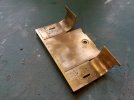
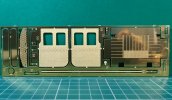
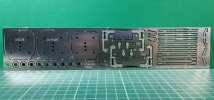
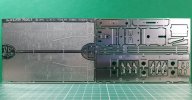
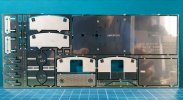
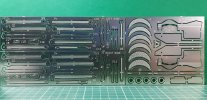
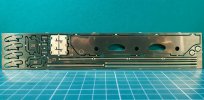
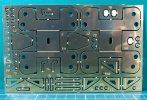
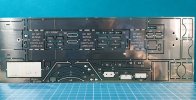
Here are the etchings.
20200115_132609.jpg20200115_132508.jpg20200115_132427.jpg20200115_133136.jpg20200115_133101.jpg20200115_132354.jpg

20200115_133030.jpg

20200115_132207.jpg
20200115_132950.jpg

20200115_132908.jpg20200115_132843.jpg20200115_132817.jpg

20200115_132754.jpg20200115_132633.jpg
.
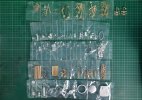
And the castings etc.
20200115_133428.jpg

I believe David Hill did a build on here where he mentioned an issue with the frames being over long at the front end and needing reducing so the footplate sits down. I'm must check that out and make any corrections needed in the flat. Should be fun.

Cheers,
Peter
 

Genghis

Western Thunderer
Peter, some butchery round the front frames is definitely required. Roger Scanlon is also having an issue with the nickel silver valve guides eating drills. We are moving the slidebar and crosshead castings to a different supplier and will order a stock of these castings in brass. Not sure how long it will take but will be happy to supply when we get them.

Dave
 

Brian McKenzie

Western Thunderer
...having an issue with the nickel silver valve guides eating drills. Dave
Have experienced this problem with the tips of 0.5mm drills breaking off in castings. The pointy end of the flutes were being loaded, each with a tiny chip of swarf, almost as if welded to the cutting edge.
Overcame this by making sure tiny drills, and milling cutters, were well lubricated with WD40.

-Brian M.
 

Genghis

Western Thunderer
Try heating the brass casting to red and allow to cool slowly before drilling. I found that worked with JLTRT lost wax brass which could be difficult to drill.

Ian.
The issue with the valve spindle guides is that they are nickel silver. I have today ordered brass replacements. They are nickel silver as they are on the same sprue as the slidebars. But I agree annealing should help.
 

Scanlon

Western Thunderer
Hi Peter,
Looking forward to your build of this kit. I have sent you an email with a number of photos showing the frame changes etc.
Regards
Roger
 

P A D

Western Thunderer
Hi Roger,
Many thanks. I've read and replied to your mail which is very helpful.

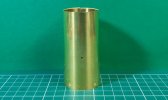
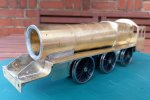
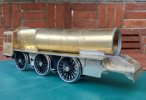
The part I missed in the preamble, the ready rolled boiler.
20200115_132147.jpg

I cant remember why, but when I first got the kit I decided to solder up the boiler.
20200115_132022.jpg

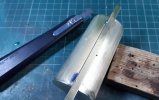
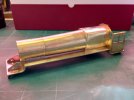
And to add the seam in the cladding. I soldered a strip of brass along the top side to act as a straight edge to scribe the seam with the scrawker. The excess solder at each end was removed with a wire brush before scribing the line.20200115_132044.jpg

To give this after cleaning up. The fastenings will have to be added separately.
20200115_132005.jpg

I know, most people start with the chassis or the tender, working bottom up and that's what I'll be doing for the rest of the build.

Cheers,
Peter.
 

P A D

Western Thunderer
Thank you Paul. I found a copy on Ebay for a couple of quid so I gave it a punt.

After installing the glazing in the 3P, I couldn't resist a further session on the Mogul, even though I should have been disciplined and glazed the 4P and 4MT. Until I pick up the Avonside jig from my brother I'm still working top down. After annealing the firebox wrapper I got that assembled using the usual Gladiator turned spacers and screws to jig up the front and rear plates. My rolling bars are also at my brother's so I used the old tried and tested method of rolling the smokebox wrapper on and old mouse mat with a steel rod, followed by some work with a length of dowel. Not as quick and easy as the rollers but I got there in the end, even without annealing which I avoid whenever possible.
20230805_195907.jpg

As Roger Scanlon found on his build, the cast front ring was a little small and I had to cut and splay it to fit, after filling the gap with some brass.
20230804_180207.jpg

I need to fill and smooth the joint at the bottom of the ring yet and further work on the firebox shoulders is in order.
20230805_195847.jpg

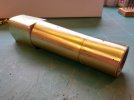
And the three components screwed together. The forward handrail pillar hole was missing so I had to drill that out. It looks a little high in this image so I'll check and correct if necessary.
20230805_195833.jpg

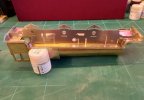
Moving on to the running plate, the valances are added first to the long central section in half etched grooves. The valances include the drops at the rear for mounting the rear drop plate, but the front sections are separate. In this case I annealed the forward extensions to the plate before mounting to ensure a tight fit to the curve of the valance.
20230805_195812.jpg

The part has the usual sacrificial cross members to keep the two side plates aligned until the front section is added.
20230805_195743.jpg

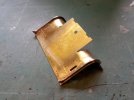
Again the extensions to the front plate were annealed before cutting the valances.
20230805_195713.jpg

20230805_195724.jpg

To joint the two sub assemblies I screwed the rear plate to a length of flat planed wood, then inserted the front section, lined it up and taped in position, before soldering. Worked a treat.
20230805_195657.jpg

And then the drag and buffer beams can be added.
20230805_195610.jpg

20230805_195634.jpg

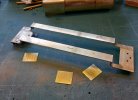
And finally the cross pieces were cut put with a slitting disc in the mini drill.
20230805_195548.jpg

Next the cab. Here are the main parts ready for soldering. The instructions suggest laminating the overlays to the side pieces, then soldering to the outside edges of the cab front, before fitting to the running plate. There is no mention of the window beading at this time but it seems better to me to add this in the flat rather than later in the build when the sides are on the model. Now time for a whinge at the kit designer. The beading was attached to the fret top and bottom by central tabs. When you cut the first tab it invariably distorts the part, top and bottom in this case as that's where the tabs are. Surely one tab at the top, bottom or side would be sufficient to hold these parts to the fret?
20230805_195525.jpg

Whinge over, on with the build. To aligned the overlays to the side pieces I pinned them to a piece of wood, soldered the back and bottom edges, then removed to solder the front edge and the edge behind the window. I then replaced the part on the pins, added the window beading aligned to the pins and held with a coffee stirrer. I then snuck the iron in to solder the top edge, removed the side from the block and soldered the remaining edges while holding the beading tight with a pair of pliers.
20230805_195440.jpg

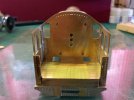
After cleaning up, job's a good un. The vent holes in the cab front looked a little small so I drilled them out. The half etched rivets have a sharp edge which is normal, so I gave the part a good zapping with a steel brush in the mini drill before rubbing with a nail polishing stick which gives them a more domed appearance.
20230805_195417.jpg
20230805_195401.jpg

After a three year break, it's great to get back to working with etched brass and nickel silver, instead of hacking away at chunks of diecast metal on the model cars, enjoyable though it was.

Cheers,
Peter

 
Last edited:

P A D

Western Thunderer
Thank you Rob.

Although I started on the body by chance, I thought it made sence to get it to a stage where I can check the fit of the frames while they are still in the flat. That's my excuse for pressing on with the body.

I made another simple jig from the same piece of wood that I used to align the cab side laminates and window beading, to solder the cable sides at 90 degrees to the cab front. The cab front was screwed to the wood through one of the holes to keep it still and save me burning my fingers. I did the left side first then turned it around to do the other.
20230806_112348.jpg

20230806_113605.jpg

And then soldered it to the running plate.
20230806_160156.jpg

Next the front frame extensions are added to the running plate followed by the white metal castings for the smokebox saddle and another etching for the front of the saddle.
20230807_172303.jpg

At the moment, the firebox is just screwed to the cab front and the smokebox is resting loose on the saddle. I want to add the wash out plugs and boiler bands before fixing the boiler in place. I've passed on the idea of having the boiler detachable as I need to solder the bottom of the firebox to the running plate to avoid a gap, and in any case, it's not so beneficial on a loco without side tanks.

20230807_172248.jpg

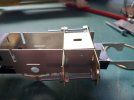
Next I prepped up the frames and mocked them up with PVC tape to see for myself what needs to be done to get them to fit.
20230807_182139.jpg

The front edge of the top of the frames need about 5mm removing to allow them to sit down in the body.
20230807_182148.jpg

Also, it's clear that the frame extensions in the body will interfere with the fit of the cylinder front plate in the slot in the frames.
20230807_182250.jpg

I marked up where to cut the frames with asking tape.
20230807_182822.jpg

Here the upper frame has had the offending area removed with a slitting disc
20230807_184014.jpg

Now the frames will fit.
20230807_184624.jpg

But the back edge of the frame extension overlaps the cylinder slot.
20230807_184633.jpg

So I marked up the area to remove with masking tape and took off 2mm with the slitting disc and now it's clear of the cylinder slot. 20230807_190716.jpg

If you're wondering if the integrity of the frame has been compromised, the front frame spacer bridges the area that has been removed so it should be OK when soldered up.
20230807_184455.jpg

20230807_190703.jpg

According to the article in the MRJ mentioned in an earlier post, further metal needs to be removed for the cylinders to fit correctly. However, I'll assemble the cylinders first to check what needs to be done before proceeding. 20230807_182753.jpg

Cheers,
Peter
 

P A D

Western Thunderer
The shaded area on the top edge of the frames does not need to be cut out. That is unless, like me (and I'm assuming the author of the article in MRJ) you put the folded up cylinder etch into the frames back to front! Yes, dozy git that I am, I didn't realise that the cylinders are "handed" and the back plate is deeper than the front plate. :headbang: :headbang::headbang::headbang::headbang: It should have been obvious as the frames have a deeper slot at the rear at the front. I'll just beat myself up again! :headbang::headbang::headbang::headbang::headbang: Suitably chastised I'll move on.

Why won't the cylinders sit down?
20230808_121847.jpg

Long story short, the area that was cut out has been reinstated and the cylinders sit down correctly.
20230808_203816.jpg

I also found that with the wheels in the frames, the rear ones which protrude into the cab, fouled the bottom edge of the cab front.
20230808_154415.jpg

The footplate has cut outs to clear the wheels, so I made similar gaps in the cab front. The soldder is a bit messy in there around the nuts and cab sides but will be covered by the footplate.
20230808_204341.jpg

20230808_203826.jpg

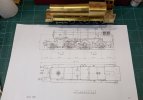
My brother has been collecting loco drawings from Railway Modeller for years and luckily he had the one for the Stanier Mogul from the March 1986 edition. I took it to my local copy shop and had it enlarged to 7mm scale.
20230808_122632.jpg

The kit parts match the drawing very closely and it confims that the holes I drilled for the front handrail pillar on the boiler section are too far back. Although there is a side elevation drawing in the instructions, it's not to scale and there is no other indication of the boilers band positions in the instructions.
20230808_204450.jpg

I filled in the holes with a length of NS rod soldered at both sides, then snipped and cleaned up.
20230809_193244.jpg

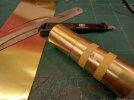
I really should make up the coupling rods and assemble the frames with solder instead of tape, but I'm still fannying around with the body. The boiler bands provided in the kit are a little too narrow for the Fox Transfers lining that I'll be using, so I cut my own bands from 10 thou brass. Using the drawing as refference, I marked the position of the bands from front edge of the boiler to the front edge of the bands with a pair of dividers. Then I added masking tape to give the position all the way round.
20230809_200622.jpg


Cheers,
Peter
 

P A D

Western Thunderer
Brian,
I can't fault your arithmetic. However, the bands don't look as overly thick as I would expect if they were a scale 7/16", so I checked the thickness with my digital calipers. The kit bands are 0.0065" and the wider ones I cut myself from brass sheet are 0.0045". I could have sworn it said 10 thou on the wrapper, but that now resides in the local landfill. Still overscale at 4.5 thou but they are acceptable to me.

mswjr,
I cut the bands with a steel rule and scrawker (Tamiya/Olfa scriber). I'm sure it would work with 10 thou just as well, but would require more scribed strokes of the scrawker, to get a good cut.

In the meantime, I've gone as far as I want for now on the body and have moved on to the loco chassis. Here's the state of play with the body after fitting the boiler bands and washout plugs.
20230811_213635.jpg

The completed boiler unti is now permanently fixed to the cab and running plate.
20230811_213612.jpg

One thing I have copied from the article in the MRJ is to replace the central 6BA fastenings between cab front and firebox rear, with 12 BA screws at the corners, as this gives a tighter fit around the perimeter of the firebox. As the firebox rear is a relatively thick laminate, I just drilled suitable holes and tapped them 12BA, to avoid faffing with nuts on the inside. These are steel screws in this image but I've now replaced them with brass to avoid rust due to washing after later soldering sessions.
20230810_161504.jpg


For starters on the chassis I first laminated the coupling rods, which I joined at the knuckle with 12 BA cheesehead bolts and nuts. The cheeseheads were filed as thin as possible to have maximum clearance at the rear of the rods and the nut was also filed down after fitting.
20230811_180304.jpg

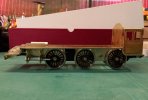
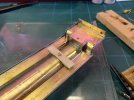
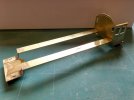
I then soldered up the chassis after setting it up on the Avonside jig. I've also added the front and rear bearings along with the rear laminates for the springs and lower firebox. The cylinders are just loosely placed in the frames for now and it is my intention to have them and the slidebars/valve gear removable as a unit. The front and rear bearings have been spaced to avoid the need for washers to take up the slack in the axles. The middle bearing will be allowed to "float" vertically with a simple wire spring bearing on the top. I didn't get time to clean up the excess solder so it looks a little untidy on the inside.
20230811_180325.jpg

Cheers,
Peter
 

Ian@StEnochs

Western Thunderer
An additional benefit of screws supplementing the central fixing is that a bit more rigidity is ensured. When only the single centre screw is used the boiler can twist relative to the cab which can result in the whole body having a slight twist, sight along the bottom, the buffer beam and drag beam should be parallel.
Sometimes only slight but enough to cause problems especially if you have fixed bearings. The chassis fixing screws may cause the frames to twist as they are tightened down onto a rigid body.

Ian
 

P A D

Western Thunderer
I agree Ian. I paid particular attention to getting the buffer and drag beams parallel at the bottom edges. I fixed the firebox first then epoxied the smokebox to the white metal saddle held with a home made clamp. Then before the resin had set, I turned it right way up and tweeked the smokebox, until until the bottom edge of beams rested squarely on the glass plate. The front of the saddle is an etched part so after the resin had cured, I soldered the top edge to the underside of the smokebox.
20230810_161704.jpg


Cheers,
Peter
 

simond

Western Thunderer
An additional benefit of screws supplementing the central fixing is that a bit more rigidity is ensured. When only the single centre screw is used the boiler can twist relative to the cab which can result in the whole body having a slight twist, sight along the bottom, the buffer beam and drag beam should be parallel.
Sometimes only slight but enough to cause problems especially if you have fixed bearings. The chassis fixing screws may cause the frames to twist as they are tightened down onto a rigid body.

Ian
I discovered this issue on a pal’s 9F - he’d bought it second hand, it looked lovely, but it would not run well.

I brought it home and discovered that sans body, the chassis ran perfectly. The issue was then getting them to assemble, still look good, and run…. Got there in the end, with a bit of judicious packing & filing.
 
Top