Thank you Paul. I found a copy on Ebay for a couple of quid so I gave it a punt.
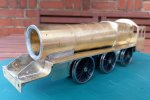
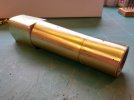
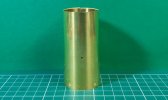
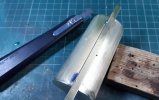
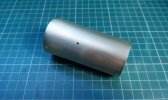
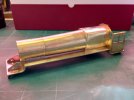
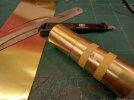
After installing the glazing in the 3P, I couldn't resist a further session on the Mogul, even though I should have been disciplined and glazed the 4P and 4MT. Until I pick up the Avonside jig from my brother I'm still working top down. After annealing the firebox wrapper I got that assembled using the usual Gladiator turned spacers and screws to jig up the front and rear plates. My rolling bars are also at my brother's so I used the old tried and tested method of rolling the smokebox wrapper on and old mouse mat with a steel rod, followed by some work with a length of dowel. Not as quick and easy as the rollers but I got there in the end, even without annealing which I avoid whenever possible.

As Roger Scanlon found on his build, the cast front ring was a little small and I had to cut and splay it to fit, after filling the gap with some brass.

I need to fill and smooth the joint at the bottom of the ring yet and further work on the firebox shoulders is in order.

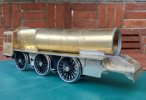
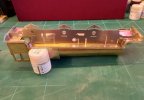
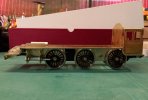
And the three components screwed together. The forward handrail pillar hole was missing so I had to drill that out. It looks a little high in this image so I'll check and correct if necessary.
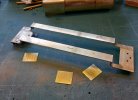
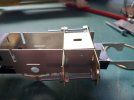
Moving on to the running plate, the valances are added first to the long central section in half etched grooves. The valances include the drops at the rear for mounting the rear drop plate, but the front sections are separate. In this case I annealed the forward extensions to the plate before mounting to ensure a tight fit to the curve of the valance.

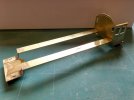
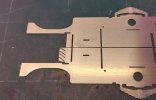
The part has the usual sacrificial cross members to keep the two side plates aligned until the front section is added.

Again the extensions to the front plate were annealed before cutting the valances.
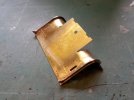
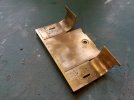
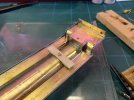
To joint the two sub assemblies I screwed the rear plate to a length of flat planed wood, then inserted the front section, lined it up and taped in position, before soldering. Worked a treat.

And then the drag and buffer beams can be added.


And finally the cross pieces were cut put with a slitting disc in the mini drill.
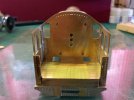
Next the cab. Here are the main parts ready for soldering. The instructions suggest laminating the overlays to the side pieces, then soldering to the outside edges of the cab front, before fitting to the running plate. There is no mention of the window beading at this time but it seems better to me to add this in the flat rather than later in the build when the sides are on the model. Now time for a whinge at the kit designer. The beading was attached to the fret top and bottom by central tabs. When you cut the first tab it invariably distorts the part, top and bottom in this case as that's where the tabs are. Surely one tab at the top, bottom or side would be sufficient to hold these parts to the fret?

Whinge over, on with the build. To aligned the overlays to the side pieces I pinned them to a piece of wood, soldered the back and bottom edges, then removed to solder the front edge and the edge behind the window. I then replaced the part on the pins, added the window beading aligned to the pins and held with a coffee stirrer. I then snuck the iron in to solder the top edge, removed the side from the block and soldered the remaining edges while holding the beading tight with a pair of pliers.

After cleaning up, job's a good un. The vent holes in the cab front looked a little small so I drilled them out. The half etched rivets have a sharp edge which is normal, so I gave the part a good zapping with a steel brush in the mini drill before rubbing with a nail polishing stick which gives them a more domed appearance.


After a three year break, it's great to get back to working with etched brass and nickel silver, instead of hacking away at chunks of diecast metal on the model cars, enjoyable though it was.
Cheers,
Peter



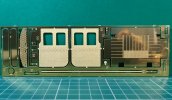
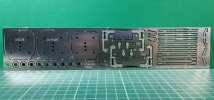
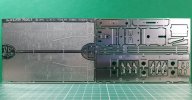
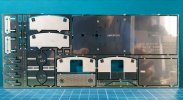



















 0.010" boiler bands = 7/16" proto thickness!