Gladiator 7mm Stanier Mogul

P A D

Western Thunderer
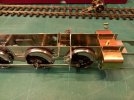
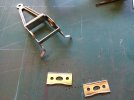
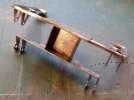
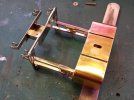
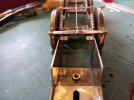
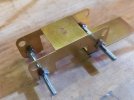
A little bit of discipline has crept in now and I'm concentrating on the chassis, although as usual I'll be flitting about rather than following the sequence in the instructions. For adding the wrappers to the cylinder etch I clamp the lower end to the required spacing with an M4 hex bolt and nuts, to avoid flexing. Once the bottom edge of the wrapper is soldered in place I remove the clamp. The kit provides two cylinder frame etchings, one to the correct width and a slightly wider one to give more clearance. The latter will have a detrimental effect on the appearance (mentioned in the instructions) so I've used the correct width version.
20230812_170705.jpg

And test fit in the cleaned up chassis.
20230812_181856.jpg

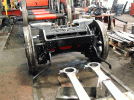
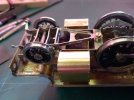
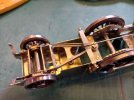
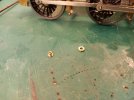
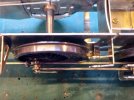
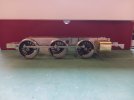
The crankpin holes in the wheels and the Slaters bushes were drilled and tapped to accept 10 BA bolts. The front one is screwed onto the bolt in reverse, with the flange on the outside and a brass washer on the inside of the coupling rod, to provide more clearance behind the slidebars and crossheads. The flanges have had two holes drilled to allow tightening with a pair of tweezers. The middle and rear bushes are screwed on flange first as normal, with the the rear finished with a steel 12BA washer and nut drilled/tapped to 10 BA. The chassis was free running from the start so any binding later on will be due to the valve gear. The large middle balance weights correctly cover 8 spokes, but the smaller front and rear weights were too large also covering 8 spokes. These had to be cut down to cover 6 spokes before fitting. The positions were determined from prototype images and marked on the rim with a felt pen before fitting.
20230813_154359.jpg

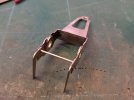
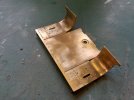
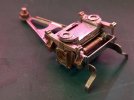
Next the motion and lifting link brackets. After adding the trunnions the two brackets are linked together with a couple of spacers. The latter are too deep and if fitted as supplied will extend below the bottom edges of the brackets and prevent the unit from sitting down in the frame slots. Many thanks to Roger Scanlon for giving me the heads up on that.
20230813_192048.jpg

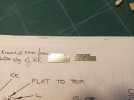
Much easier to correct in the flat than after they are in place. The tabs at each end for locating the brackets are also much too long and I cut and filed them down before fitting.
20230813_192544.jpg

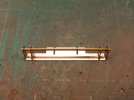
After folding up the outer trunnions for the lifting links, the inner ones were lined up and held with a suitable lenght of rod before soldering.
20230814_090900.jpg

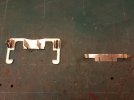
The ones on the motion bracket were done the same, although the outer ones are separate and have to be soldered "free hand" before using the rod for the inner ones. Then the spacers were added.
20230814_090832.jpg

Followed by the lifting links bracket.
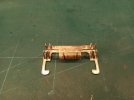
20230813_204953.jpg

20230813_205001.jpg

And dropped into the frames.
20230813_205119.jpg

You can see here that the bracket spacers as supplied would have fouled the middle frame spacer leaving the brackets sat too high.
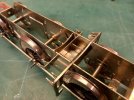
20230813_205036.jpg

With the body on, the hanging plates are pressing on the top of the motion bracket pushing it out of alignment so that will need some attention.
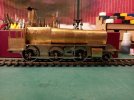
20230813_205427.jpg

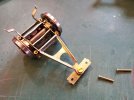
I also made a start on the pony truck which is a very simple representation of the real thing. Here's the instruction diagram showing the components. Although I made a start based on the instructions, it will need quite a bit of revamping to get it nearer to the real thing. The cast springs 151 and etch springs P4 are wrong for the Stanier Mogul truck. I believe they are correct for the Fowler 2-6-4T and the designer, David Andrews I believe, may have carried them over from his big Fowler tank.
20230814_091118.jpg

This is the real thing minus the leaf springs above the horn guides.
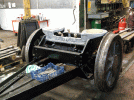
DSCF0982.gifDSCF0981.gif

And the kit components. I knew when I got the kit that the springs were wrong so I purchased a pair of 8F castings (made by Sanspareil) from MOK. As the castings need to go on the outside of the truck, I fitted the bearings on the inside.
20230812_150931.jpg


I'm up to the maximum images so I'll continue on the next post.

Cheers,
Peter
 

P A D

Western Thunderer
Once in place I cut down the bearings to allow the castings to be fitted.
20230812_151114.jpg

Another error. The top spacer is too narrow.20230812_151816.jpg

And there is no front plate for the truck frame. I used a length of rod located through the holes in the sides and the guard irons to space the front end.
20230812_161924.jpg

Here it is next to the 3P truck which it should resemble. I'm going to strip it down and start again as the guard irons should be at the bottom edge of the frame, with a cross member above. I wonder if the test builder got it wrong and assembled the frame upside down and that was copied into the instructions?
20230812_181837.jpg

Cheers,
Peter
 

Genghis

Western Thunderer
When I built one of these I had to resort to using scrap etch to complete the pony truck. It's great to get the comments on this build. I think that the frame etch isn't one of David's better efforts and I have been wondering how and when to get it redrawn. I will use all of these comments to inform the changes.

I suspect that the pony truck design is carried over from the O4.
 

P A D

Western Thunderer
When I built one of these I had to resort to using scrap etch to complete the pony truck. It's great to get the comments on this build. I think that the frame etch isn't one of David's better efforts and I have been wondering how and when to get it redrawn. I will use all of these comments to inform the changes.

I suspect that the pony truck design is carried over from the O4.
Hi David,
Now that I think about it, the DA Stanier 4P came with etchings for the bogie springs that matched the Fowler 4P, which are different to those that come with the Mogul, so thanks for confirming they are from the 04. As I see it so far, if you are going to make corrections, then you need to consider the following:-
1. Cut back the top front edge of the main frames by 5mm to allow the body to sit down.
2. Remove @ 2mm from the bottom edge of the motion/ lifting link bracket spacers KK.
3. Reduce the tab length on the same spacers to match the thickness of the bracket etchings.
4. Reduce the size of outer wheel balance weights to cover 6 not 8 spokes.
5. Redraw the instructions to show the truck frame the correct way up or add a note to that effect in the instructions.
6. Replace the truck axlebox/spring castings with items from Sanspareil. To my knowledge, they are common to the Mogul, 8F, 3P and 4P. I believe that apart from the length of the A frames, the trucks are identical.
7. The bottom edge of the cab front need a slot cut into it to match the slot in the front edge of the cab footplate, so as to clear the flanges of the rear drivers.
8. As far as I can see there is no mention of the front chassis mounting in the instructions. The front drop plate (part 1) has a half etch hole suggesting the addition of a 6 BA cheesehead screw is required.
20230805_195724.jpg

However, I prefer to have a captive nut on the body, with the screw inserted underneath through the chassis spacer. It's much easier to add a screw with a screw driver than faff about trying to get a nut onto the screw. There is just room for the nut under the cover that has yet to be added between the frames, but the screw needs shortening so that it does ot protrude above the nut when tightened.
20230814_130218.jpg

I hope that helps and if I find anything else I'll let you know. I'm not suggesting all the areas mentioned need new parts, but some notes in the instructions would help future builders.

By the way, I looked up your thread "The Heaton Mersey Mogul" on RMWeb, to see what I could learn from it before starting on mine. Unfortunately they seem to have deleted all the images from threads that date back a few years! I've not been there for a while and was amazed by the number of adverts that keep popping up. Thank God for Western Thunder.

Cheers,
Peter
 
Last edited:

P A D

Western Thunderer
So after dissmantling the pony truck I started again on the basis that the truck frames are represented upside down on the instructions. After making and fitting a front plate from waste fret, I added the guard irons to the half etch recesses to what is now the bottom edges of the sides.
20230814_204151.jpg

I wasn't happy with the A frame provided in the kit, so I removed it and replaced with the spare frame from my 3P model.
20230814_204226.jpg

The cross members ahead and behind the axle were knocked up from NS sheet and strips of waste fret for the beading.
20230815_111006.jpg

It's not 100% accurate but better than the original. After adding the cast axleboxes and springs I made a representation of the bolster casting from lead strip (to add some weight over the axle), nickle silver and 6BA washers. Finally I made a representation of the front side control spring and fitted that between the frames. There should bd ond behind the bolster, which I added to the 3P truck, but it cannot be seen so doesn't bring much to the party and I've left it off. Finally I added the cross member to the A frame.
20230815_181048.jpg

And with the wheels on.
20230815_181233.jpg

The guard irons needed shortening to clear the rails.
20230815_181242.jpg


20230815_181258.jpg

20230815_181403.jpg

The critical part was to get the distance between the pivot point and axle centre the same as with the original A frame and to ensure the new frame did not foul the bottom edges of the main frames on the curves.
20230814_202528.jpg

No bother there.
20230815_181857.jpg

Cheers,
Peter
 

P A D

Western Thunderer
Thank you David.

To complete the slidebar bracket assembly I added a plate to the open centre area so that it csn be screwed to the spacer it rests on.
20230818_135218.jpg

And moving onto the brake rigging. The cast shackles for the cross beams were missing and although I know David Hill would have arranged to send me a pair, I decided to make my own so I could press on. Not as nice as the Gladiator castings but they will pass muster tucked away underneath. Note also that the cross beams are too long by 3mm and will not fit between the brake hangers. I'd already made them up before I realised, but it was easy enough to remove 1.5 mm from each side without removing the lengths of rod.
20230820_125651.jpg

Here are the components ready for fitting.
20230820_122609.jpg

And in place on the chassis. The etchings provide either realistic laminated pull rods with forked ends or simple single layer alternatives that need to be attached to one side of the shackles. I chose to use the former, slower to install but better looking. The rear pull rod and brake cylinder were still to be added when I took this image.
20230820_204631.jpg

Note that the front brake hanger brackets foul the slots for the rear cylinder plate and need a few strokes with the file to clear.
20230820_204737.jpg

There's also limited space under the front pull rod end to get the pony truck screw into the spacer, but by shortening the screw to the minimum usable length it is just do-able.
20230820_210004.jpg

The running plate supports and simple spring for the middle floating bearing have also been added.
20230820_204755.jpg

Following the heads up from Roger Scanlon and some comments from other contributors, I approached the drilling of the valve rod guides with some trepidation. Fortunately I have a lathe and was able to drill them on the slowest speed using much 3in1 and frequent withdrawals of the bit. After fettling up the valve rods I found they were not interchangeable so I've matched them up with short lengths of copper wire for now. The slide bars snd crossheads needed quite a bit of filing to prepare them, not helped because I decided to remove the cast piston rods and replace them with lengths of nickel silver rod. I added the laminated etchings for the drop links, filed off the cast nuts from the crossheads and drilled them out to accept a bolt and nut to retain the connecting rod. The cylinder relief valves were also added at this stage for ease of fitting.
20230822_123950.jpg

The slide bars were then epoxied to the cylinders. They could be soldered, but using epoxy allows time to position them correctly. I'll do the same with the valve rod guides. Note that the cylinder gland plates need a flat filing to the inner edges to clear the brake hangers, again done before fitting.
20230822_141527.jpg

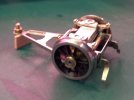
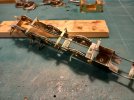
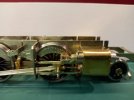
The cylinders and slide bar bracket were mounted and screwed to their respective spacers before soldering the ends of the slide bars to the bracket. They can then be removed as a sub unit for mounting the valve gear off the frames.
20230822_152803.jpg

And in the frames. The slidebars had still to be trimmed in these images.
20230822_153025.jpg

As mentioned earlier, the kit provides scale width and over width cylinders and slidebar options. As I used the former, I expected clearance issues with the front crank pin and crosshead and wasn't (or should that be was) dissapointed.
20230822_192238.jpg

However, after filing off the outer boss on the coupling rods and filing down the length of the brass bushes, all is well. There's about a fag paper's clearance but that's all you need. And yes, I know I have still to remove the ooze from the epoxy.
20230823_202135.jpg

20230823_202722.jpg

Here's an underside view showing the completed brake rigging. The screw retaining the slidebar bracket will be left over long for now to allow easy fitting and removal during the build, but will be trimmed later so it's not visible through hole in the frames.
20230822_192346.jpg

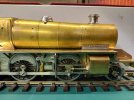
The chimney and dome are just placed for the photo, but the roof is soldered in place.
20230823_202556.jpg

Cheers,
Peter
 

simond

Western Thunderer
Peter

this is going to be another beauty!

forgive me if I missed it, but how will you remove the (shortened) pony pivot screw if required?

cheers
Simon
 

P A D

Western Thunderer
Peter

this is going to be another beauty!

forgive me if I missed it, but how will you remove the (shortened) pony pivot screw if required?

cheers
Simon
Thank you Simon.

For now I'm just using a 1mm wide screwdriver to slowly turn the screw. However, I'll make a simple fork spanner so I can tighten and loosen the screw via the captive 6ba nut. Once loose it can just be wiggled out.

Cheers,
Peter
 

Ian@StEnochs

Western Thunderer
Peter

this is going to be another beauty!

forgive me if I missed it, but how will you remove the (shortened) pony pivot screw if required?

cheers
Simon

I have the same problem on the mogul I am building at the moment. My solution was to substitute the screw with a pin soldered in place and cross drilled for a split pin which can be put in from the side. The poney truck can be wiggled on and off the pin fdirly easily.

Ian.
 

Dave Holt

Western Thunderer
That sounds a neat solution, Ian. On bogie mountings, I use a short length of 0.33 mm brass wire, passing through the pivot tube with the ends bent over at right angles. To remove the bogie, I just snip through the middle of the retaining wire and fit a new one on re-assembly.
In the past, I've cheated a bit and made the front brake pull rod attachment to the brake beam off centre, to clear the pony truck mounting screw. The subterfuge isn't too apparent, looking from the side.
Dave.
 

P A D

Western Thunderer
Thanks for the suggestions gents. It certainly needed a better solution than faffing around with a small blade driver or spanner turning the screw a fraction at a time, so I came up with a better solution. I removed the narrow truck mount/spacer, added some threaded brackets either side of the frames and drilled the mount so it could be screwed to the frames. I got one of the holes out of position and had to elongate it slightly.
20230824_151315.jpg

The brackets were made from waste fret with an extra layer laminated where the holes are to provide more thickness for tapping. I made the mountings quite long and soldered up the depth of the frames for a robust fixing.
20230824_151429.jpg

20230824_151617.jpg

I've left the screws overlong for now to facilitate removing and refitting during the build, but will cut them down later.
20230824_151700.jpg

I've added the remaining castings to the cylinders and made up the connecting rods. A quick check pushing the chassis with the big ends on the crankpin screws suggests all will be well. I can't go any further with this for now as I'm waiting for some brass bushes from Slaters to mount the big end of the rod and the return crank.
20230824_200350.jpg

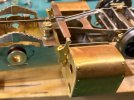
Note the extra spacer at the front end. I added this as I was forever snagging and bending the vulnerable front extensions. The slots at the front edge are to clear the square brass section added behind the buffer beam to give that a more robust fitting.
20230824_200404.jpg

20230824_201115.jpg

Cheers,
Peter
 

Dave Holt

Western Thunderer
Looking very nice indeed, Peter and a neat solution to the pony truck picot issue.
I have to say that the chimney casting just doesn't look right to me. It appears slightly tapered whereas the prototype was parallel. Perhaps it's just me?
Dave.
 

LarryG

Western Thunderer
A lovely model is in the making here. I was able to look over one of the early ones when it came on shed for the weekend in 1960, but I learned more about them in more recent years. Few carried the Stanier hooter, but that probably doesn't come into it in modelling terms unless one fits sound.
 

P A D

Western Thunderer
Dave, I agree it's not the best of castings but I don't think anybody does a Mogul chimney in brass that's suitable, but I need to check that. If I can't find one I'll just have to fettle it up as best I can. The dome needs work as well.

Larry, many thanks. I haven't looked at the whistle yet so I don't know what the kit provides. I never saw one in the flesh but it's clear from images in preservation that it would have been a much more handsome unit with a Stanier tender instead of those skinny Fowler ones!
 

P A D

Western Thunderer
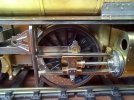
Next the return cranks. They come without any representation of the four retaining bolts so some modification was in order.
20230826_101446.jpg

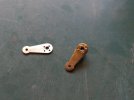
I drilled four holes to insert nickel silver rod to represent the bolt heads. I didn't get the holes in the one on the left centered correctly but I'm living with it. The one on the right has been soldered to a reversed 10 BA tapped crankpin bush. I then drilled into the bush through the crank holes, added and soldered the NS rod, trimmed and cleaned up. The centre hole in the crank was tapped 10 BA and screwed onto the crank pin and set at the correct angle before soldering. The 10 BA screw was then snipped and filed flush and then the crank was removed and the "fixing bolts" added.
20230826_111841.jpg

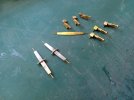
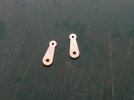
To space the connecting rod from the coupling rod, I made a spacer from 5mm brass rod, drilled out on the lathe to clear the 10BA steel screw. I then cut off the required thickness using the mitre block and razor saw. Here it is with the tapped Slaters Bush.
20230825_163926.jpg

From above, you can see how it goes together.
20230826_112247.jpg

20230826_112150.jpg

I had some bother with the left hand side getting the return crank in the correct position when tightened, so had to deal with that with the wheel off.
20230826_125358.jpg

To be sure there's no movement of the screw I secured it with a length of brass wire across the slot, with the ends glued into holes in the wheel boss.
20230826_125434.jpg

A quick test on the rails shows all is still well so far.
20230827_102725.jpg

20230827_102702.jpg

The expansion links are also devoid of bolt detail, so I drilled them out to accept lengths of NS rod to represent them. The links come with a forked joint for mounting the eccentric rods, which is incorrect as the forked joints are on the rods. Therefore, I cut off the outer mounting on each link.
20230826_142813.jpg

Here's the left hand link with the radious rod attached and set in forward gear.
20230826_190511.jpg

The union link comes in two pieces, one assumes to laminate with forked ends. However, that's not how it is on the prototype so I've only used a single thickness for the link. Also it should have an oil box at the rear end so I've soldered one of the spare links in place to represent that. This shows it before trimming and filing along with the combination lever which is a two piece laminate with a forked joint at the bottom.
20230826_172720.jpg

Here's the state of play so far on the right hand side. I'm going to need to remove and refix the drop link lower down on the crosshead to get the union link more horizontal.
20230826_190427.jpg

20230826_190455.jpg

Cheers,
Peter
 
Top