
You are using an out of date browser. It may not display this or other websites correctly.
You should upgrade or use an alternative browser.
You should upgrade or use an alternative browser.

simond
Western Thunderer
One of the comments that was made when I started 3DP was “you’ll need a bigger bin”

Yup

On the bright side, we believe that the CAD is now correct, and the models will look the better for it.
Actually there are another 6 prototypes that will be scrapped…
Still, it’s a learning curve
Atb
Simon
Yup
On the bright side, we believe that the CAD is now correct, and the models will look the better for it.
Actually there are another 6 prototypes that will be scrapped…
Still, it’s a learning curve
Atb
Simon

simond
Western Thunderer
Thank you Richard. It feels dreadful to put nice prints in the bin, particularly as it took more than a couple of goes to get to this point, but they’re dimensionally wrong, and there’s little point in keeping them when I now have good data, and the CAD is now as good as I can make it (with more than a little help from Nick @magmouse)I wonder if a few people would find the gash prints useful for painting and weathering practice. Seems a shame to put everything in the bin.
They’re in the bin in the lounge. if anyone wants one or more, they’re very easily extracted for the price of a Jiffy bag and the postage!
In a few days, they’ll be in the bin in the yard. Then, it’s going to be far more expensive (aka “bribe me with beer”) to get them out!

(and once they’ve been collected by the Binnies, well, it’s gazillions of crypto coins, indeed, you might need to buy the tip
 )
)
magmouse
Western Thunderer
with more than a little help from Nick @magmouse
Well, it was that special kind of ‘help’ that messes everything up just when you think you are home and dry. A fair bit of detective work, including Chris @ChrisBr kindly checking the GWR wagon registers, in the end led to the conclusion that the drawing we had been working from is a work of fiction - or at least, it is wrong for all the photos of diagram N6 wagons we have seen. It would have been more ‘helpful’ if I had worked that out rather earlier in the process, and less land-fill would have resulted.…
At some point I’ll write up our findings in more detail.
Nick.
simond
Western Thunderer
First two correct-height prototypes of the low and high bodied N6 coal wagons (without brakes) sandwiched between an incorrect N6 and a Coopercraft N13-sort-of to the left and a first-off N4 (also sans freins) to the right.
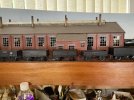
The difference is subtle (it’s three inches on the overall height) but noticable. Another high body is currently printing, and assuming it goes ok, I’ll print another this evening.
I’ll fit the brakes, etc., tomorrow to check they’re still ok, which they should be.
I need to re-slice the low body version, which will be a job for tomorrow, and hopefully by the end of the week, we’ll have enough of both. I‘m going to do a bit more N4 CAD modelling over the weekend, as the weather forecast is not generating much enthusiasm for outdoor activity.
The difference is subtle (it’s three inches on the overall height) but noticable. Another high body is currently printing, and assuming it goes ok, I’ll print another this evening.
I’ll fit the brakes, etc., tomorrow to check they’re still ok, which they should be.
I need to re-slice the low body version, which will be a job for tomorrow, and hopefully by the end of the week, we’ll have enough of both. I‘m going to do a bit more N4 CAD modelling over the weekend, as the weather forecast is not generating much enthusiasm for outdoor activity.
simond
Western Thunderer
Well, as Albert’s mother said, “Eee, I am vexed.”.
The print failed, this is the second consecutive complete failure, and it seems to be something to do with the printer, rather than the print file, as I’m simply trying to repeat a successful print. The print file has printed perfectly, the resin is from the same (new) 2kg pot, Elegoo black ABS-like. Temperature is pretty much unchanged, machine hasn’t moved, no other evident changes.
In both cases, the print has failed pretty much where the supports join the model, though some very small bits did print.
We conjectured that the first failure was bad timing: we thought it likely to be the dishwasher cycle turning on a big heating element, probably using a relay, and thus sticking a big spike into the mains, which could conceivably upset the printer. That was not the case the second time, and nothing else exciting was running on the same ring main, so probably not the root cause.
Bit perplexed, apart from giving the resin a very extreme shaking, I can’t think of anything else. Suggestions welcome!

The print failed, this is the second consecutive complete failure, and it seems to be something to do with the printer, rather than the print file, as I’m simply trying to repeat a successful print. The print file has printed perfectly, the resin is from the same (new) 2kg pot, Elegoo black ABS-like. Temperature is pretty much unchanged, machine hasn’t moved, no other evident changes.
In both cases, the print has failed pretty much where the supports join the model, though some very small bits did print.
We conjectured that the first failure was bad timing: we thought it likely to be the dishwasher cycle turning on a big heating element, probably using a relay, and thus sticking a big spike into the mains, which could conceivably upset the printer. That was not the case the second time, and nothing else exciting was running on the same ring main, so probably not the root cause.
Bit perplexed, apart from giving the resin a very extreme shaking, I can’t think of anything else. Suggestions welcome!
simond
Western Thunderer
Thanks Rob, the FEP is only about 6 weeks old, I replaced it then for the first time. The old one hadn’t failed, but looked a bit grey. It’s clean, clear and taut. I doubt that’s the issue.
This is the third run of a known good file, which is very confusing. Run 1 good, runs 2 & 3 failed.
I have to generate a new print file for the low body N6, so I might run that, alternatively, I might recopy the known good file for the high version, from the laptop onto the memory stick in case that’s the issue. Though a corrupt stick seems unlikely.
I’ve turned everything off, so it can all cool right down. I’ll fire it up before bed and try again, one way or another, whilst we’re asleep, and nothing is running except the fridge.
This is the third run of a known good file, which is very confusing. Run 1 good, runs 2 & 3 failed.
I have to generate a new print file for the low body N6, so I might run that, alternatively, I might recopy the known good file for the high version, from the laptop onto the memory stick in case that’s the issue. Though a corrupt stick seems unlikely.
I’ve turned everything off, so it can all cool right down. I’ll fire it up before bed and try again, one way or another, whilst we’re asleep, and nothing is running except the fridge.
simond
Western Thunderer
The printer ran last night, and the print appears to be successful. 
the differences were
A) I turned the printer off at the mains for several hours before turning it on to run the print. It’s been plugged in and on at the mains since I got it, but, well you never know.
B) I used a different memory stick, and copied the print file from the laptop
C) I violently shook the resin bottle about 10 minutes before pouring the resin, I don’t know if it separates. The bottle sits on a reptile mat so it’s gently warmed.
D) it wasn’t Christmas Eve but All through the house Not a creature was stirring Not even a mouse;
dunno…
the differences were
A) I turned the printer off at the mains for several hours before turning it on to run the print. It’s been plugged in and on at the mains since I got it, but, well you never know.
B) I used a different memory stick, and copied the print file from the laptop
C) I violently shook the resin bottle about 10 minutes before pouring the resin, I don’t know if it separates. The bottle sits on a reptile mat so it’s gently warmed.
D) it wasn’t Christmas Eve but All through the house Not a creature was stirring Not even a mouse;
dunno…

Rob R
Western Thunderer
Black art.......The printer ran last night, and the print appears to be successful.
the differences were
A) I turned the printer off at the mains for several hours before turning it on to run the print. It’s been plugged in and on at the mains since I got it, but, well you never know.
B) I used a different memory stick, and copied the print file from the laptop
C) I violently shook the resin bottle about 10 minutes before pouring the resin, I don’t know if it separates. The bottle sits on a reptile mat so it’s gently warmed.
D) it wasn’t Christmas Eve but All through the house Not a creature was stirring Not even a mouse;
dunno…


Rob Pulham
Western Thunderer
Sorry Simon
I can rivet down the edge of the strips and then cut them off at less than 1mm wide. You do get a little curling but nothing too excessive.
I missed this,Thanks Rob,
if you’re slicing strips off the edge of a sheet, how narrow can you go? I understand it’ll depend on thickness. Do you find the strips curl?
ta
Simon
I can rivet down the edge of the strips and then cut them off at less than 1mm wide. You do get a little curling but nothing too excessive.

Rob Pulham
Western Thunderer
It's worth mentioning that I did have to adjust the base plate so that it was closer to the blade to get a good cut. When it arrived, it had a tendency to push thin strips down between the base and the blade rather than shear them. Easily fixed as the base is adjustable.
There is also a sprung bar which is designed to hold the material down and keep your fingers away from the blade I'm sure it does if you are cutting big pieces. For the small strips etc that I cut it makes it difficult to see to align your cut off marks so I removed it.
I also replaced the 'guide' which is meant to help you keep your material square to the cut but it was tiny and so completely ineffective. I made one from more substantial material but I have been considering how to mount a section from a thick steel ruler which would hopefully allow measuring cuts on the fly.
I have a photo somewhere of the replacement, I will dig it out, although as an engineer I am sure that you will come up with a much more elegant solution than I did.
There is also a sprung bar which is designed to hold the material down and keep your fingers away from the blade I'm sure it does if you are cutting big pieces. For the small strips etc that I cut it makes it difficult to see to align your cut off marks so I removed it.
I also replaced the 'guide' which is meant to help you keep your material square to the cut but it was tiny and so completely ineffective. I made one from more substantial material but I have been considering how to mount a section from a thick steel ruler which would hopefully allow measuring cuts on the fly.
I have a photo somewhere of the replacement, I will dig it out, although as an engineer I am sure that you will come up with a much more elegant solution than I did.
simond
Western Thunderer
Thanks Rob,
we have a venerable guillotine at work, I’d hazard a guess that it’s “between the wars” vintage and very solid, but even that needs a little adjustment from time to time. It’s a bit big for modelling though!
I’ll give yours a good coat of “thinking about”
cheers
Simon
we have a venerable guillotine at work, I’d hazard a guess that it’s “between the wars” vintage and very solid, but even that needs a little adjustment from time to time. It’s a bit big for modelling though!
I’ll give yours a good coat of “thinking about”
cheers
Simon
Rob Pulham
Western Thunderer
I couldn't find the photo that I mentioned so I took a couple more.
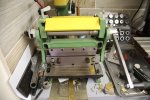
This is as it's sat on my bench with the front retaining piece removed
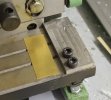
This is a close up of my replacement guide block. The original is little bigger than the two cap head retaining screws
I had quite forgotten that I had started a thread on it elsewhere on WT where I outlined the issue with the original guide block and my first attempt at improving it.
https://www.westernthunder.co.uk/threads/warco-mini-formit-3-in-1-universal-sheet-metal-machine.7288/
This is as it's sat on my bench with the front retaining piece removed
This is a close up of my replacement guide block. The original is little bigger than the two cap head retaining screws
I had quite forgotten that I had started a thread on it elsewhere on WT where I outlined the issue with the original guide block and my first attempt at improving it.
https://www.westernthunder.co.uk/threads/warco-mini-formit-3-in-1-universal-sheet-metal-machine.7288/

Ian@StEnochs
Western Thunderer
Rob,It's worth mentioning that I did have to adjust the base plate so that it was closer to the blade to get a good cut. When it arrived, it had a tendency to push thin strips down between the base and the blade rather than shear them. Easily fixed as the base is adjustable.
There is also a sprung bar which is designed to hold the material down and keep your fingers away from the blade I'm sure it does if you are cutting big pieces. For the small strips etc that I cut it makes it difficult to see to align your cut off marks so I removed it.
I also replaced the 'guide' which is meant to help you keep your material square to the cut but it was tiny and so completely ineffective. I made one from more substantial material but I have been considering how to mount a section from a thick steel ruler which would hopefully allow measuring cuts on the fly.
I have a photo somewhere of the replacement, I will dig it out, although as an engineer I am sure that you will come up with a much more elegant solution than I did.
A rule against the guide is useful but doesn’t always give identical sized pieces. I have one on my Metalsmiths guillotine which I keep for platework. I have another heavier machine, German and aimed at the school market, which I use for heavier stock for loco frames etc.
If I need to cut a number of pieces exactly the same size I use an adjustable stop on the rear so that pushing the stock against it sets the width. Before I made the stop I used the depth probe on my calipers, it worked but would have been easier if I had three hands!
Ian.
Rob Pulham
Western Thunderer
Hi Ian,Rob,
A rule against the guide is useful but doesn’t always give identical sized pieces. I have one on my Metalsmiths guillotine which I keep for platework. I have another heavier machine, German and aimed at the school market, which I use for heavier stock for loco frames etc.
If I need to cut a number of pieces exactly the same size I use an adjustable stop on the rear so that pushing the stock against it sets the width. Before I made the stop I used the depth probe on my calipers, it worked but would have been easier if I had three hands!
Ian.
It does come with an adjustable guide on the back. But I found that it was only really useful for cutting bigger pieces than I generally cut, so I removed that too. It's sat alongside the machine so easy to replace should I need it.
simond
Western Thunderer
Back to printing.
Having printed two high bodied wagons, I re-sliced the low body version of the N6 this morning, and swapped the Dean axle boxes for grease ones. I’d noted that the brake assemblies were slightly deformed, so I amended the supports on them, and added an extra spare into the file.
Sliced, saved, printed…. Oh no, not again…
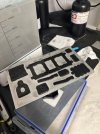
The large lumpy thing at the bottom left was the raft for a motor mount for Tony’s Manor for which he bought the motor at Kempton. Been waiting all afternoon for this
So, we can now conclude that it’s not due to:
A) the dishwasher
B) the resin not having been shaken
C) a faulty memory stick
D) a faulty print file
Whilst cleaning the tank, I noted that the fan slows down when the screen lights up. I wonder if the power supply is failing or going a bit weak under load, which might lead to a brown-out, or simply under-exposure of the resin - which would of course be most critical at the interface between the supports and the model proper - this would all be at roughly the same height / layer number in nearly all the parts, which is what it looks like.
But it’s another guess.
Any other suggestions welcome???
Having printed two high bodied wagons, I re-sliced the low body version of the N6 this morning, and swapped the Dean axle boxes for grease ones. I’d noted that the brake assemblies were slightly deformed, so I amended the supports on them, and added an extra spare into the file.
Sliced, saved, printed…. Oh no, not again…
The large lumpy thing at the bottom left was the raft for a motor mount for Tony’s Manor for which he bought the motor at Kempton. Been waiting all afternoon for this
So, we can now conclude that it’s not due to:
A) the dishwasher
B) the resin not having been shaken
C) a faulty memory stick
D) a faulty print file
Whilst cleaning the tank, I noted that the fan slows down when the screen lights up. I wonder if the power supply is failing or going a bit weak under load, which might lead to a brown-out, or simply under-exposure of the resin - which would of course be most critical at the interface between the supports and the model proper - this would all be at roughly the same height / layer number in nearly all the parts, which is what it looks like.
But it’s another guess.
Any other suggestions welcome???