Rivermead Central

40057

Western Thunderer
Martin

I went dashing back to post #172, and learned a great deal. Your blue 112 looks absolutely wonderful, like new. Pre 1923 GNR, therefore the one I am looking at is at least 104 years old - but the catalogue does say cast-iron wheels, so no Mazak worries at least.

Many thanks for your very helpful reply.

John
I can confirm 112s have cast-iron wheels.

There is also one in my post #765.

Martin

PS There is no special prize for posting the 1000th reply in this thread!
 

40057

Western Thunderer
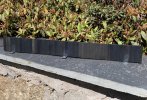
Modelling is still having to take second place to the garden. However, the current construction of a sleeper-built fence has reached its final length of 50 cm, not quite 20”:

B639320C-9003-4D26-AE50-37E9FF7A2D6B.jpeg

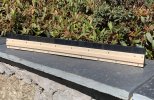
I still need to add the horizontal wooden rails. These will have to wait until I order some more small size walnut strips. I have however mounted the sleepers on their backing piece which will space the fence a few mm off the wall at the back of the layout:

E735DDD6-9355-4BC3-B5B7-013A640E9ABB.jpeg

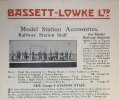
Referring back now to post #973 and the size of passenger and staff figures. Below is the relevant section from a Bassett-Lowke catalogue I have which says it is ‘Reprint, March 1929’. In other words, in terms of its contents, this is the 1928 season catalogue.

F8D94196-4CCC-4A3F-9144-EAF27CDAE233.jpeg

Sets 1 and 2 are Britain’s figures, 1:32 scale. For many years, these were the only size available. But recognising that 0 gauge had become by far the most popular scale, finally correct size figures were introduced. I cannot say for sure the 7 mm scale figures were first offered in 1928. Catalogue entries stating that something was ‘new’ or ‘a great improvement on last year’s model’ often remained unchanged for years.

Martin
 

40057

Western Thunderer
In my post #129 I described the pre-WW1 range of tinplate goods wagons made for Bassett-Lowke by the Nuremberg firm Carette. Specifically, and in post #133, I also discussed the wheels originally fitted to these wagons — but which have often been replaced. What I did not show in previous posts were examples of what I believe were the first type of wheels used by Carette.

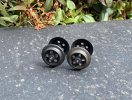
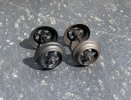
What is beyond doubt is that Carette used two different types of wheels on the goods wagons made for Bassett-Lowke. There were cast lead-alloy wheels as shown in my post #133 and the pressed sheet-metal type as shown below. There is, of course, no mention of the manufacturing process used for the wheels in the catalogue descriptions of these wagons. The wheels are easily removed so could be swapped or replaced. Most surviving Carette for Bassett-Lowke goods wagons no longer have their original wheels. Some types of wagons were offered over the whole five years (1909–1914) these wagons were made and the type of wheels fitted at the factory most likely changed over the production period. However, my view is the balance of evidence strongly suggests the pressed sheet-metal wheels were the first type used, when the Carette for Bassett-Lowke range of wagons was introduced in 1909. The cast lead-alloy wheels superseded the sheet-metal type, very possibly in 1911, and were then used until production ceased with the outbreak of WW1.

The pressed sheet-metal wheels:

52B2B919-DC03-486D-8965-865EAF8D7605.jpeg

E82C0C14-9B24-4893-B6BA-5D7E3026B9FB.jpeg

The wheels may not look terribly exciting or interesting, but I am delighted to have got them. I have several wagons without wheels that should have the type shown above and others where one wheel-set is unuseable due to a bent axle, eccentric or out-of-true wheel. So sheet-metal type Carette wagon wheel-sets have been high on the ‘wants’ list for many years.

The above wheel-sets are of quite complex manufacture. The wheel itself is a sheet steel pressing. Holding each wheel in place is a lead-alloy casting, or actually, I think, two separate castings, one inside and one outside of the wheel pressing. This type of wheel-set does not seem to suffer from bent axles as commonly as the lead wheel type. However, the steel wheel pressings are frequently not perfectly round and often slightly eccentric and/or out of true.

After years of not finding any, I have obtained ten of the sheet-metal type wagon wheel-sets over the last few months. Four sets very cheaply from eBay, six sets much more expensively from a dealer in vintage trains. But all well worth the relatively small sums involved for what they will enable me to do.

Not all of the new wheel-sets are good enough to use, but at least seven are. So several wagons will be able to be put into service. I will post photos of these as they are cleaned and repaired.

Martin
 

Osgood

Western Thunderer
There's something quite endearing about those wheels - they might have come straight out of a Welsh slate quarry! :thumbs:

Only yesterday I was admiring some very early German tinplate in Ipswich Museum - I didn't make a note of the maker but now wonder if it could have been Carette.
There was a nice rake of LNWR coaches - I didn't have the heart to advise @john lewsey that his current LNWR coach build was nothing like them - his has two too many doors and is way too long :D

IMG_0215.JPG
 

40057

Western Thunderer
There's something quite endearing about those wheels - they might have come straight out of a Welsh slate quarry! :thumbs:

Only yesterday I was admiring some very early German tinplate in Ipswich Museum - I didn't make a note of the maker but now wonder if it could have been Carette.
There was a nice rake of LNWR coaches - I didn't have the heart to advise @john lewsey that his current LNWR coach build was nothing like them - his has two too many doors and is way too long :D

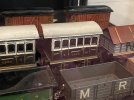
View attachment 266077
The coaches are lovely, very early, and hand painted. The only item I can identify with certainty in your photo is the Midland open wagon, which is Marklin. Marklin’s range of lithographed British-outline wagons was sold principally through Gamages in direct competition with the much larger range of wagons made by Carette and retailed by Bassett-Lowke. There is not much to choose between the two ranges in terms of quality of manufacture and accuracy, but Marklin made only ten different types whereas the Carette for Bassett-Lowke range included over fifty. Marklin used a very similar method of construction to Carette. Basically, they copied the way the Carette wagons were made.

Martin
 

John R Smith

Western Thunderer
Martin

The Carette pressed steel wheels look a lot nicer than I was expecting them to. Much better (in my view) then Hornby's pressed tinplate wheels of later years. A year or so ago I did have several Carette and Bing pre-1914 wagons, but I decided I wanted to refocus on the inter-war period and so I sold them on. They all had die-cast alloy wheels. The only item of rolling stock I now have which might possibly be pre-1914 is my Bing Precursor tank.

John
 

40057

Western Thunderer
Martin

The Carette pressed steel wheels look a lot nicer than I was expecting them to. Much better (in my view) then Hornby's pressed tinplate wheels of later years. A year or so ago I did have several Carette and Bing pre-1914 wagons, but I decided I wanted to refocus on the inter-war period and so I sold them on. They all had die-cast alloy wheels. The only item of rolling stock I now have which might possibly be pre-1914 is my Bing Precursor tank.

John
Hi John

The Precursor tank was certainly made by Bing both before and after WW1. As far as I know, there is no difference between the the pre- and post-War production. I think the same is true of the LBSCR 4-4-2T and the NER 0-4-4T. Mind you, I wonder if the NER tank was actually made post-War at all. It was offered, post-War, only in the 1919 catalogue. I have a copy of the August 1914 Bassett-Lowke catalogue. Almost all the Bing-made locos have ‘Cancelled’ stamped across the page. So Bing’s production for Bassett-Lowke for the 1914 Christmas season wasn’t delivered in 1914. I have seen it stated that Bing supplied Bassett-Lowke’s 1914 order in 1919, and did so at the pre-War price, such was the personal friendship between the Bing family and Mr Bassett-Lowke. The Carette wagons for 1914 clearly did reach Bassett-Lowke that year. No cancelled stamps in the catalogue on the wagon pages and wagons printed with 1914 as the running number are in circulation — I even have one (post #153).

Martin
 

John R Smith

Western Thunderer
The Precursor tank was certainly made by Bing both before and after WW1. As far as I know, there is no difference between the the pre- and post-War production. I think the same is true of the LBSCR 4-4-2T and the NER 0-4-4T. Mind you, I wonder if the NER tank was actually made post-War at all. It was offered, post-War, only in the 1919 catalogue.

Martin

Mike Delaney recently had an LBSCR 4-4-2T on offer (now sold), but it had been refinished (not very well) in SR livery. I'm pretty sure that my Precursor tank was made by Bing and is not a later (post-1921?) B-L made one (it has Bing buffers, and tinplate coal in the bunker). It could have been in the 1914 batch that got stuck in the War, of course. Perhaps a clue might be that the wooden box is stamped "Made in Bavaria" on the bottom, not "Made in Germany".

John
 

40057

Western Thunderer
Martin

Mike Delaney recently had an LBSCR 4-4-2T on offer (now sold), but it had been refinished (not very well) in SR livery. I'm pretty sure that my Precursor tank was made by Bing and is not a later (post-1921?) B-L made one (it has Bing buffers, and tinplate coal in the bunker). It could have been in the 1914 batch that got stuck in the War, of course. Perhaps a clue might be that the wooden box is stamped "Made in Bavaria" on the bottom, not "Made in Germany".

John
Hi John

Having seen your photograph, your Precursor tank is definitely Bing. Although very, very similar in overall appearance, the Northampton made ones have quite a few small differences. The head-lamps, the bogie wheels, the buffers, the edge of the cab roof, ‘British made’ stencilled between the rear cab windows etc.

Martin
 

40057

Western Thunderer
Martin

The Carette pressed steel wheels look a lot nicer than I was expecting them to. Much better (in my view) then Hornby's pressed tinplate wheels of later years. A year or so ago I did have several Carette and Bing pre-1914 wagons, but I decided I wanted to refocus on the inter-war period and so I sold them on. They all had die-cast alloy wheels. The only item of rolling stock I now have which might possibly be pre-1914 is my Bing Precursor tank.

John
Hi John

If you haven’t done so, you should look at my post #71. My definitely pre-WW1 Precursor tank.

Martin
 

John R Smith

Western Thunderer
If you haven’t done so, you should look at my post #71. My definitely pre-WW1 Precursor tank.

Martin

Yes, I had already seen that post, but I just refreshed my memory. It is interesting just how different the Bing and Marklin versions of the Precursor are. As you say, the Precursors both long and short must have sold very well, considering how many of them have survived in the vintage marketplace. So there is an intriguing mystery - why number 44? And who decided that - Mr Greenly? And why did Marklin choose the same number?

John
 

40057

Western Thunderer
Martin

Yes, I had already seen that post, but I just refreshed my memory. It is interesting just how different the Bing and Marklin versions of the Precursor are. As you say, the Precursors both long and short must have sold very well, considering how many of them have survived in the vintage marketplace. So there is an intriguing mystery - why number 44? And who decided that - Mr Greenly? And why did Marklin choose the same number?

John
Number 44 was the first engine of the 1907 batch and I assume the subject of the works photo. The 1907 locos had smaller diameter bogie wheels than the earlier built locos. So 44 was the obvious choice.

Martin
 

40057

Western Thunderer
In my post #74 (April 2024), I said I was proceeding with the restoration of an Exley Southern Railway all-3rd coach, and would report on progress ‘in a future post’. Eeek! More than two years ago! But progress there has been, albeit at a glacial pace. Paintwork restoration is now finished on one side of the coach:

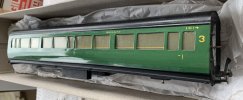
36033C6B-BADB-4E2F-A916-C363E8AB657A.jpeg

1B6093BC-ADBA-4994-AE82-1BA2D7C9354B.jpeg

Of course, it’s not supposed to show that I have undertaken paint repairs:

EEF7CA5C-B672-4552-856C-EA35A657E333.jpeg

I had not attended to the black paint on the solebar + footstep when this photo was taken. I had filled in three large chips in the green paint which I thought made the adjacent paint vulnerable to further losses. The new paint is ringed in red here:

0378B4AC-863B-4C78-9D71-526E844E2180.jpeg

The original paint is very thickly applied and a near match to Phoenix SR Malachite Green. Many layers of new paint were required to fill the chips up to the surface of the original green paint. The new paint was slightly too blue but a spot of orange added to it achieved a very close match to the Exley paint, as can be seen above. It’s not perfect, but it’s very close. The colour of the original paint is in any case not completely uniform, being slightly bluer towards the top of the coach side.

The other side of the coach, with no paint repairs undertaken at this stage:
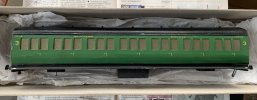
5E0F59C9-92CC-4C3B-BAE6-D161A2C51F31.jpeg

The paint on this side is in better condition with hardly any green paint missing.

I hope to be able to report on completion of the paint repairs to this side of the coach in less than two years.

One unusual feature of my SR all-3rd is that the metal wrapper forming the sides and roof is tinplate. Exley generally used aluminium, but I am aware of a few other examples of tinplate Exley coaches.

I have removed the gangways from this coach. They are constructed of paper and card glued to a block of wood and fastened to the coach with wood screws through the end castings. Both gangways were badly damaged but have now been rebuilt using mostly the original components. I will not reattach the gangways to the coach I until I have finished the paint repairs.

When I bought it, the coach was fitted with Bassett-Lowke bogies. I found some replacement Exley bogies of the correct type. These need cleaning and minor repairs before I fit them to the coach.

Overall, a lot of work to put this coach back into good order, as close as possible to original condition. But a nice coach, and a scarce one. Strangely, to my mind, there does not seem to be much demand for these simpler-type pre-WW2 Exley’s. For me, they are ideal. Shorter and lighter than the post-WW2 Exley coaches, so more at home on my 3’ 2” radius curves and more suitable for clockwork locomotives. Personally, I also like the hand painted finish. In contrast to the quantity, industrial, production that inevitably went with lithographed tab-and-slot construction, Exley’s hand assembled and painted pre-WW2 coaches are ‘Arts-and-Crafts’ in their ethos and quality. I think the manufacturer saw them that way too, as suggested by the Ruskin quote included in Exley catalogues:

‘All works of taste must bear a price in proportion to the skill, taste, time, expense and risk attending their manufacture. These things called dear are, when JUSTLY estimated, the cheapest. They are attended with much less profit to the maker than these things which everyone calls cheap.’

I don’t have — indeed, I have never seen — a pre-WW2 Exley catalogue. However, my SR all-third has to be late ‘30s in date. If anyone on WT can be more precise based on the changes to the SR’s coach livery, I would be interested to know.

Martin

 

John R Smith

Western Thunderer
I said I was proceeding with the restoration of an Exley Southern Railway all-3rd coach, and would report on progress ‘in a future post’.

Martin

Many thanks for the update. I too have very little information about Exley coaches, and I only have one post-war catalogue. The history of the later production seems to be rather sketchy, and I have never seen a proper chronolgy of the K5, K6 and Moddex output, which are the ones I own. There are also some very late restorations by Quentin and Tricia Lucas from the 1990s when they had ownership of the Exley brand, and I have one of those too.

I have just one pre-war Exley (or so it was described to me when I purchased it), but it is nothing like yours being a 16" corridor brake third with embossed door and commode handles. It also has wooden guard's duckets and Exley sprung bogies with quite fine wheels. However, it has been refurbished and repainted so it is hard to say what is original and what is not.

Does your SR Exley have glass windows? It looks as if the handrail on the corridor side is painted on the glass. I presume it has a wooden floor and wooden battery boxes. Are your Exley bogies sprung?

John
 

40057

Western Thunderer
Martin

Many thanks for the update. I too have very little information about Exley coaches, and I only have one post-war catalogue. The history of the later production seems to be rather sketchy, and I have never seen a proper chronolgy of the K5, K6 and Moddex output, which are the ones I own. There are also some very late restorations by Quentin and Tricia Lucas from the 1990s when they had ownership of the Exley brand, and I have one of those too.

I have just one pre-war Exley (or so it was described to me when I purchased it), but it is nothing like yours being a 16" corridor brake third with embossed door and commode handles. It also has wooden guard's duckets and Exley sprung bogies with quite fine wheels. However, it has been refurbished and repainted so it is hard to say what is original and what is not.

Does your SR Exley have glass windows? It looks as if the handrail on the corridor side is painted on the glass. I presume it has a wooden floor and wooden battery boxes. Are your Exley bogies sprung?

John
Hi John

From my limited knowledge, the K6 type replaced the K5 type shortly after WW2. I think the K5 coaches generally have the representation of the sliding top window painted on the glass, but K6 have all-metal window frames. The earliest post-WW2 coaches do still have hand-painted lettering and numbers, but whether this is one of the distinguishing features between K5 and K6 I don’t know. There were some LNER coaches made with square-cornered windows after WW2, but otherwise, apart from the different pre-grouping models, I think everything else post-War was basically LMS whatever the livery. I have seen pre-WW2 Exley’s with K4 on the maker’s label, but I have no idea about K1, K2 and K3, if indeed these exist.

I can’t recall seeing an Exley fitted with wooden duckets.

The pre-WW2 scale length Exley’s really are very good models and do reproduce the different window shapes and body styling of the various railway companies. Lovely things, and very accurate for their time. I don’t have any of these. For better or worse, on the ‘toy-to-model-spectrum’ I have pitched Rivermead Central at ‘main-stream scale models’. Whilst there are no hard boundaries, I exclude some vintage items on the grounds of being too toy-like, others as being ‘too scale’. I decided the ‘right’ Exley’s for Rivermead Central were the short, simpler type, as exemplified by the SR coach above. I don’t think these were made at all post-WW2.

From what I have seen (without the benefit of a pre-War catalogue), the shorter type Exley’s are all 35 cm long. The body styling and window shapes are always as per the SR coaches shown in previous posts. There are no interiors. The windows are represented by a sheet of plastic (celluloid I assume) overlying a sheet of black paper and nailed to a length of wood. The wood with the ‘windows’ on it is held in place by nails driven through the castings that form the ends of the coach. For corridor coaches, the internal handrail on the corridor side is indeed painted on the inside of the plastic strip. The regular passenger coaches have seven compartments all the same size (no class distinction), but can be painted as 1st or 3rd class. The brake coaches have four compartments. Gangwayed vehicles have a corridor side and a compartment side with an external door to each compartment. Non-gangwayed vehicles have two ‘compartment sides’. There were some specialist vehicles in this short series; I have seen a photo of a TPO and a friend has a kitchen car. The bogies I think were unique to the short coaches and can be seen in my post #74. Very simple, unsprung, with a rigid frame. Turned alloy wheels which cannot be removed, but these are to Bassett-Lowke standard, 27.0 mm back-to-back.

I don’t know how these short coaches were described or marketed by Exley. They are generic, not accurate models. Exactly comparable with, say, Bassett-Lowke lithographed coaches: the same body decorated in different liveries. Shorter than scale so suitable for ‘tinplate’ radius curves. Wheels compatible with tinplate or B/L track. Light weight, so helpful for clockwork. Whatever Exley said about them, the short range seem to have been made for use on mainstream tinplate railways where they would have been superior to other coaches, but still practical. Exley’s scale range would not have worked on a ‘floor railway’.

Martin
 
Top