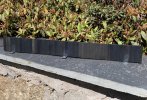
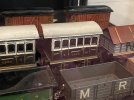
In my post #74 (April 2024), I said I was proceeding with the restoration of an Exley Southern Railway all-3rd coach, and would report on progress ‘in a future post’. Eeek! More than two years ago! But progress there has been, albeit at a glacial pace. Paintwork restoration is now finished on one side of the coach:

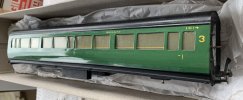
Of course, it’s not supposed to show that I have undertaken paint repairs:

I had not attended to the black paint on the solebar + footstep when this photo was taken. I had filled in three large chips in the green paint which I thought made the adjacent paint vulnerable to further losses. The new paint is ringed in red here:

The original paint is very thickly applied and a near match to Phoenix SR Malachite Green. Many layers of new paint were required to fill the chips up to the surface of the original green paint. The new paint was slightly too blue but a spot of orange added to it achieved a very close match to the Exley paint, as can be seen above. It’s not perfect, but it’s very close. The colour of the original paint is in any case not completely uniform, being slightly bluer towards the top of the coach side.
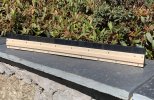
The other side of the coach, with no paint repairs undertaken at this stage:
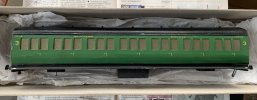
The paint on this side is in better condition with hardly any green paint missing.
I hope to be able to report on completion of the paint repairs to this side of the coach in less than two years.
One unusual feature of my SR all-3rd is that the metal wrapper forming the sides and roof is tinplate. Exley generally used aluminium, but I am aware of a few other examples of tinplate Exley coaches.
I have removed the gangways from this coach. They are constructed of paper and card glued to a block of wood and fastened to the coach with wood screws through the end castings. Both gangways were badly damaged but have now been rebuilt using mostly the original components. I will not reattach the gangways to the coach I until I have finished the paint repairs.
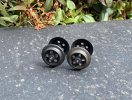
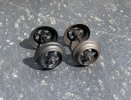
When I bought it, the coach was fitted with Bassett-Lowke bogies. I found some replacement Exley bogies of the correct type. These need cleaning and minor repairs before I fit them to the coach.
Overall, a lot of work to put this coach back into good order, as close as possible to original condition. But a nice coach, and a scarce one. Strangely, to my mind, there does not seem to be much demand for these simpler-type pre-WW2 Exley’s. For me, they are ideal. Shorter and lighter than the post-WW2 Exley coaches, so more at home on my 3’ 2” radius curves and more suitable for clockwork locomotives. Personally, I also like the hand painted finish. In contrast to the quantity, industrial, production that inevitably went with lithographed tab-and-slot construction, Exley’s hand assembled and painted pre-WW2 coaches are ‘Arts-and-Crafts’ in their ethos and quality. I think the manufacturer saw them that way too, as suggested by the Ruskin quote included in Exley catalogues:
‘All works of taste must bear a price in proportion to the skill, taste, time, expense and risk attending their manufacture. These things called dear are, when JUSTLY estimated, the cheapest. They are attended with much less profit to the maker than these things which everyone calls cheap.’
I don’t have — indeed, I have never seen — a pre-WW2 Exley catalogue. However, my SR all-third has to be late ‘30s in date. If anyone on WT can be more precise based on the changes to the SR’s coach livery, I would be interested to know.
Martin