On Heather's Workbench - going wide

Heather Kay

Western Thunderer
One more thing, before I go for a lie down in a darkened room…

As is so often the way, Swindon seems to take an idea and do it their own way. I have this awful habit of trying to understand how something works, so it makes sense when I try and fit the parts together, and a case in point is the early GWR vacuum brake system.

I understand how the "regular" VB cylinder works, by pulling the operating lever up when the vacuum is made. Looking at the mechanism I have for these late 19th century GWR vehicles, it strikes me the cylinder itself moves to operate the linkage. Would I be correct in assuming the cylinder is really a form of bellows, with what we would normally think of as a rigid outer shell in fact being leather or rubber?

I could be completely misreading the drawings and photos, of course.
 

Heather Kay

Western Thunderer
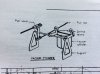
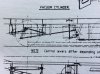
Here we go, from the original IKB instruction booklet.

image.jpg

image.jpg

I hope it makes some sense. The plunger or spigot is normally orientated downwards, and connected to the operating linkage and cross shaft. In this case, it seems as if the plunger is fixed to the floor of the vehicle, leaving the cylinder to move and operate the control levers.
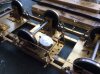
That is what I'm seeing, isn't it?

image.jpg

This is the cylinder casting.
 

Dog Star

Western Thunderer
The piston rod comes out of the top of the vacuum cylinder... and the top of the rod is fixed to the underframe by way of trunnions. When the brake is applied then the vacuum cylinder rises and pulls the brakes on - as the cylinder rises the piston rod rotates in the afore-mentioned trunnions to accomodate the movement of the cylinder.

The GWR built coaching and NPCS without an external handbrake in the 19th century and then had a change of mind during the early years of the 20th century. For example:- open siphons were built with a brake arrangement as described by you in earlier posts... and then the DC cr0ss-cornered handbrake linkage was added from circa grouping.

My understanding of GWR carriage design is that 6-wheel carriage underframes had clasp brakes only on the outer axles so if anyone has a photo / drawing of clasp brakes on the centre axle then I shall be very interested to see same. I have written "clasp brakes" as there are some photos in Russell of six-wheel stock where the "pull" is from one end and the brake blocks are on only one side of each (of the six) wheels.

regards, Graham
 

Heather Kay

Western Thunderer
Just had a very useful chat with Graham as we compared notes in one of Russell's books. I think we've more or less worked out what ought to be on the model, despite various variations on the theme.

I am going to email John Lewis, who is a known expert on matters GWR, and also wait on what my client thinks about the suggested scheme. Good job I have plenty of other builds to get on with!
 

Heather Kay

Western Thunderer
Meanwhile, I was reminded Slater's had various parts in their 4-wheeler kits. I checked on the part-built ones I have on the shelf, for a commission, and happily the previous builder had used the wrong parts for the vacuum cylinder gear. This meant the proper levers were unused…

image.jpg

Result!
 

OzzyO

Western Thunderer
Here we go, from the original IKB instruction booklet.

View attachment 34452
I hope it makes some sense. The plunger or spigot is normally orientated downwards, and connected to the operating linkage and cross shaft. In this case, it seems as if the plunger is fixed to the floor of the vehicle, leaving the cylinder to move and operate the control levers.

Hello Heather,

looking at the above drawing could this vac. brake be the non automatic type? That is that the vacuum applied the brake and that admitting air into the system released the brakes. If this is the case this type of brake was abolished in the mid - late 1800s, to the automatic vacuum brake that most of us know.

HTH

OzzyO.

PS. sorry for the cross post it looks like Graham had already mention this.
 

Heather Kay

Western Thunderer
The client has approved the inner brake rodding version, so that's what I am aiming at.

image.jpg

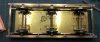
Happily, some spare parts from last year's JLTRT Collett build helped, so that's the V-hangers sorted. The pull/push rod lever is made up of CPL parts, with the Slater's vac levers. The cylinder is posed here. I'm leaving it out until I've got the rigging in place.

I fabricated some brake yokes from 0.7mm brass wire. A simple jig from pins in the ceramic block helped keep it sort of regular.

While I pondered how to make the brake shoe hangers - I'm using Slater's injection moulded loco shoes, which aren't quite right but will do - I decided to tackle the step boards.

image.jpg

The upper steps are as supplied in the IKB narrow gauge underframe kit, trimmed to length. The lower steps were to be from the same source, but sadly the axle box cutouts didn't line up with the chassis. This was a bit annoying, but luckily I had some suitable brass channel that could be pressed into service. L-section would have been better, but the channel, which is the same I used to beef up the solebars, needed some careful whizzydisc work to slice back one "leg". I then had to measure up for the axle box slots. I'm pleased with how it turned out. Things are started to progress nicely, after a long time being stuck in the doldrums.

Time to break again, and I think it's time to have another look at that pesky RMB build.
 

Wagonman

Western Thunderer
I agree with Graham about the operation of the Armstrong vacuum brake. Also I have never seen brakes on the centre wheels of 6 wheeled stock of this period and cannot see how it could have worked – some 1930s milk tanks may have had brakes on all 6 wheels, but they had a much shorter wheelbase and thus less sideplay on the centre axle.

Rule 1 is "don't believe everything Russell said". Rule 2 is if in doubt ask John Lewis, or perhaps in this case Alan Garner.

I'm stil not sure about the inside brake rigging...
 

Heather Kay

Western Thunderer
I'm stil not sure about the inside brake rigging...

I tend to agree, but if the client is happy… I'm not really in the mood for scratch building the outside gear, even with the IKB set for a template.

Having said that, I shall let it fester over the weekend. Hopefully, the weather will allow us to make the trip to RailWells, and if I get the chance I'll be able to pick a brain or two of the BGS.
 

Heather Kay

Western Thunderer
There are times when you wonder why you ever started a job. This seems to be turning into one of those types of jobs.

I had been happy with the suspension set-up. As ever, though, something was nagging at me. In this case it was sideplay. I had too much, and it was pretty obvious I hadn't widened the suspension units far enough. Having drilled out the bolt holes on the existing attempt, I felt trying to drill new ones without leaving the stretcher plates compromised would be a problem. New holes would also interfere with the channel holding the plates in register. So, somewhat inevitably, I would have to take another step back in order to make progress.

In addition, I had decided the outer brake levers would be more appropriate. Thanks, Richard! ;)

image.jpg

This time, I've made the stretcher plate almost the whole length of the frames. This has done away with the whole set of ironmongery I'd cobbled together before. It's a better fit, better measurement meaning I got the various axleguard slots in the right places, and it is now easier to work out the centrelines and alignments.

The two outer axles are aligned in the photo with double-sided tape. When I'm happy with the fit between the axleguards, and the alignments in general, I can mark out and drill new bolt holes. Altogether, this is a better engineering solution to my problem. When I get it right, it can be used for future BG builds that don't already have some kind of floor in the kit.
 

Dog Star

Western Thunderer
does this help with the brake levers?, I think the vac cyl . etc is the same.
In general terms.... yes. However, as Heather and I have discovered from excessive peering at photos in Russell BG stock exhibit variations in cylinder size, orientation of the cylinder (horizontal / vertical) and the way in which the brake is applied (moving piston versus moving cylinder).

From what I remember of the vehicle shown in Andy's photo the general arrangement of pull rods / pivots / levers is very applicable to the late BG stock.

regards, Graham
 

Heather Kay

Western Thunderer
Andy, that is helpful. Thank you. It complements the Russell book photos nicely.

I start today back where I started yesterday. I shall attempt to fit most of the brake rigging today, I think. It's all good fun.
 

Heather Kay

Western Thunderer
Right, first job today is to try and fathom the brass knitting that will make up the outer clasp brake system.

image.jpg

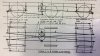
Here's the schematic in the IKB instructions. For the correct brake shoes and linkage I have raided the narrow gauge kit I have pending, reasoning I should be able to make the internal brake system on that build with most of what's left on the fret.

image.jpg

This is the brake shoes and levers, neatly folded and waiting for me to figure out how they go together.

image.jpg

Here is the upturned underframe, with some scribbles to help me keep the orientation for the vac cylinder and vee hangers. Not helping is the IKB instructions are for the narrow gauge version of this gear, as are some of the parts, so it will probably have to wing it at some point and fabricate some new parts as needed.

Right, soldering iron is on, plenty of brass wire to hand, coffee on the go … let's get started!

(I'll be back later with progress, hopefully!)
 

Heather Kay

Western Thunderer
It's taken me nearly all day, and all I've managed to do is fit eight brake shoes. They don't fit where they're supposed to in order for the outside levers to fit properly, so at best this is going to be a kludge, at worst a compete bodge.

I was right to have wanted the internal braking system. Why did I change my mind? Why?
 

OzzyO

Western Thunderer
Hello Heather,

if you have more that one of these to make why not make an axle centre jig, like the one below.Axle centre jig..jpg
The dimensions are only as a guide.

OzzyO.
 
Top