On Heather's Workbench - going wide

Heather Kay

Western Thunderer
Some progress so far this morning, in that I've begun to fit the actuating levers.

image.jpg

It's all a bit fiddly, and as you can probably see the outer lever isn't fixed in place just yet. In fact, only the inner lever is fixed at this point of the proceedings. That's why it all looks a bit saggy - and to be honest the mechanism sticks out a little further than I anticipated. It's not far off, though.

Three more sets to do...
 

Mike Sheardown

Western Thunderer
That looks really good Heather - I like the addition of this unusual braking arrangement!!

I've never seen it modelled before, which makes you model quite unique - lovely.

Cheers

Mike
 

Rob Pulham

Western Thunderer
That looks superb Heather.:thumbs:

I confess that I might have been tempted to paint the wheels before trapping them in with all that lovely detail.
 

Heather Kay

Western Thunderer
I confess that I might have been tempted to paint the wheels before trapping them in with all that lovely detail.

The thought hit me after fitting the last part. :oops:

In fact it only takes a quick dab with the iron to release a pin here and there if I felt the need. As it is, I've managed to blacken the tyres. I reckon painting won't be too hard with things as they are.
 

Heather Kay

Western Thunderer
I've now fitted buffing and draw gear. The safety chains will have to wait until I get some suitable chain at Telford.

image.jpg

The body parts posed to make me believe I'm not far off finishing this model. The extra width of the broad gauge is quite obvious, even when not stood on any track. The client has suggested the next model in the order should be acquired and brought up to the same level so painting can take place at the same time. That sounds an eminently sensible thing to do.

image.jpg

If you're wondering, the buffers and couplings are from Slater's. The buffers are Midland wagon buffers, and the couplings are the working screw variety.

image.jpg

It's all beginning to look suitably cluttered underneath. I hope I'm up to the lining on this model!
 

Heather Kay

Western Thunderer
Back to the BG for a bit. Today's goal was to erect the body sides.

I formed a simple right-angled jig of softwood. Fortuitously, the scrap wood I selected fitted neatly in the body between the folded top and bottom edges. To help things along I also formed the turnunder so the etched parts would sit neatly while I ran a solder joint up the corners.

image.jpg

This was reasonably successful in that I managed to get a pair of sides and ends joined together.

After a little vocabulary extension I also managed to join the pairs together.
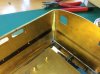
image.jpg

Like all good soldered joints, each part was cleaned, fluxed and tinned with my regular cored electrical solder. When brought together with a variety of clamps and wood offcuts, more flux and more solder on a clean iron tip let me run a seam up the join. The second attempts were better! Things even ended more or less square! Miracles do happen!

image.jpg

Now I have a fairly rigid body to sit on the frames. Next step is to fit the partitions for strengthening, blinders for the various grilles, and get some new material in for the roof. I have borrowed Rob P's idea of shaped internal ribs and longerons fitted to the roof itself, but I need to get some suitable brass sheet in first.

The underframe is pretty much complete now. The safety chains have been fitted, either side of the main coupling. I need to get some road testing done, which is a story in itself.

Yesterday I set about fitting an outside third rail to my test track, gauged off for the 49mm for the broad gauge. The idea was simple: take a length of C&L flexible track and slice it down the middle, then slip the chopped sleepers between the standard gauge ones, drill and pin.

Ah, the best laid plans. The test track is built on a flexible mat surface, because that's what was available in the loft space. This is fine for track with rails a fixed distance apart. A single rail, though, doesn't hold the gauge because of the flexible material. After some abortive attempts at getting things lined up, I decided the easiest thing was to actually build a proper BG test track on a rigid surface. This is what I will do, once I've acquired the relevant components from the BGS.

So, while the coach body is now almost ready to fit to the chassis, I don't want to do that until I have been able to test the running and squareness of said chassis. That needs the test track. Guess what I'm going to be spending some money on shortly!

 

Heather Kay

Western Thunderer
I've still not built the test track. To be fair, I've distracted myself with the Dean triplets ongoing in another thread.

Anyway, today saw the arrival of a second kit to be built. This time it's a diagram S6 all third. It's also a so-called "convertible". These were narrow gauge bodies that were fitted to broad gauge underframes at the point where the end of Brunel's gauge was not very far away. The idea was straightforward: when the day of the Big Change arrived, the bodies could be lifted off and replaced on narrow gauge underframes.

I have to try and dig some resources out to help with the concept. From what I have in the box, I appear to have a complete narrow gauge coach and underframe. If I can avoid the cut and stretch routine, as I managed with the V8, it ought to be a straightforward build.

Famous last words.

Anyway, the onus is on me. The client will be visiting from Down Under over the festive period, and it would be rather nice if he had something finished he could take home and play with.
 

Heather Kay

Western Thunderer
Back at the broad gauge today. The client will be over in the UK for Christmas, and it would be nice if he had something to take away with him when he goes back to Oz.

image.jpg

I have made a start on the second coach of the set, an S6 "convertible". This is one of the batch of 20 that was built as a narrow gauge body, plonked incongruously on a broad gauge underframe.

image.jpg

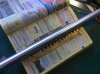
The body sides and ends have been cut from the fret, and gently annealed in the gas torch to help me form the turnunder. My weapons of choice for the rolling are a local Yellow Pages and a 25mm diameter aluminium bar. I initially selected Garden Services as a good place to roll, but found the Demolition and Dental Technicians more pliable. :)

Now the sides are curved, I shall consider whether to fit the bolection etches before I tackle assembling the sides. The idea is to get this coach bodywork to the same level as the V8 PLV so they can both be painted.
 

Heather Kay

Western Thunderer
I finally got round to ordering the required material for the V8 roof today. I also ordered a bunch of tools and bits, as I felt in need of a spend!

With the curves formed, I fitted the bolections.

image.jpg

Tinning and sweating on fiddly etches kept me quiet all afternoon. Each window needed a bit of tidying up after hamfisted soldering.

image.jpg

Cruel closeup. You can see that the window aperture doesn't always match the size of the bolection aperture. It's not bad, considering the artwork is dated 1985 - all but three decades ago now! I need to file back carefully so things don't look odd later.

image.jpg

Anyway, after all that, two ends and two sides, about ready to be joined together. Then I'll attach the drop lights and hinges and so on. I think that may be a job for tomorrow morning, when my eyes are up to it!
 

ZiderHead

Western Thunderer
View attachment 37599

The body sides and ends have been cut from the fret, and gently annealed in the gas torch to help me form the turnunder. My weapons of choice for the rolling are a local Yellow Pages and a 25mm diameter aluminium bar. I initially selected Garden Services as a good place to roll, but found the Demolition and Dental Technicians more pliable. :)


They say a picture is worth a thousand words, well in this case its 33:

How do I curve brass when I need to a couple of times a year without having to research, find, buy, calibrate, learn and store a couple of kilos of sheet bending contraption?

Many thanks for sharing the technique :thumbs:
 

Heather Kay

Western Thunderer
I will say the technique tends to bend the ends of the side more than the centre. This is because the bar overhangs the directory, and that's where I put my weight while rolling, causing the edges of the paper to compress more. To overcome this, I move the etched part towards, even overhanging, the edge of the book to bring pressure to bear on the centre, and work on gently, adding to the curve.

I guess I should either use a shorter bar or wider directory!
 
Last edited:

Heather Kay

Western Thunderer
Lots of fiddly bits this morning.

image.jpg

Five compartments, with an etched latch plate, two wire door bumpers and three etched hinges per door. My mental arithmetic makes that 30 parts per side, 60 in all.

Now I have back ache and eye ache, but I am praising my RSU. While fixing all the tiny bits, thoughts wandered into whether it might have been possible to kit bash a couple of Slater's Dean coaches to do all this laborious stuff for me!

In other news, the client has been thinking about future builds. I think he is scheming three more BG coaches, plus a selection of NG ones. That should keep me busy for a while.
 

Heather Kay

Western Thunderer
While I was in the zone, and while the RSU was deployed, I fitted the end steps on the PLV.

image.jpg

I also thought it would be useful to fit the lock plates as well. As there were spare ones on the S6 kit etch, it seemed churlish not to. As originally built, the V8 (and V13 narrow gauge version) had loop door handles. The client has specified T-shaped handles, as most coach were updated with them over time. From all the photos I can see, T-shaped handles have the lock plates, where the loop ones didn't.

I wasn't planning on spending the rest of the afternoon on this, but there you go.
 

Rob Pulham

Western Thunderer
I will say the technique tends to bend the ends of the side more than the centre. This is because the bar overhangs the directory, and that's where I put my weight while rolling, causing the edges of the paper to compress more. To overcome this, I move the etched part towards, even overhanging, the edge of the book to bring pressure to bear on the centre, and work on gentlymadding to the curve.

I guess I should either use a shorter bar or wider directory!


Hi Heather,
As an alternative I can recomend this method - starts about a third of the way down this post -
http://www.westernthunder.co.uk/index.php?threads/rob-ps-coaching-stock-workbench-newbould-gresley-restaurant-triplet-set.2555/page-5#post-81160
 
Top