Mr Grumpy

West Junction

Western Thunderer
That's coming on nicely.
I have been working on the body over the past few days and here are a couple of items that may help you later.
I was advised by MOK to use a 4mm rod for forming the bend in the front of the tank overlays. This worked out very well. I drilled a vertical hole in an offcut of melamine faced chipboard and inserted a length of 4mm steel rod. The centre of the bend is as near as possible half way between the two vertical handrail holes and the front edge of the first tab. I drew a vertical pencil line through the handrail holes and another from the front of the tab which made it simple to line up with the 4mm rod. To make sure the bend was at a right angle to the footplate I placed the top of the tank overlay on the melamine as this is the only clear straight edge, the only thing to be careful of is the cab side extending up to the cab roof which because it is upside down will extend quite a way below the melamine surface.
I only fixed the footplate valances by twisting the tabs as I was concerned I might fill the holes for the tank overlay tabs with solder. The tank overlay tabs broke of reasonably well after soldering the overlays by bending backwards and forwards but I did wonder if I would have been better off removing the footplate valances to do this although this again makes the front part of the footplate very vulnerable to accidentally bending.
There is a part 1009 (or 1019, instructions outside and too late to fetch them in) in the parts used below the smokebox. Unfortunately the whistle shield is also numbered 1009 (or 1019), no wonder I couldn't recognise it from the photo.
Hope this is of some help.
I will be interested to see photos of your brake gear as I haven't done mine yet and was also wondering how best to split it to enable the rear wheels to be removed.
Peter
 

Mr Grumpy

Western Thunderer
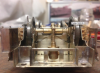
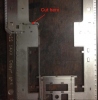
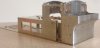
Well, I'm pretty sure the chassis is now complete.

As mentioned earlier, I wanted the brake gear to be fully and importantly, easily removable for painting and maintenance.


To recap, I soldered 14ba nuts to the rear of each brake hanger bracket, and attached the brakes with screws.

I have broken down the brake rods and stretchers in to two components so that the rocking rear axle assembly can also be removed. The rear brake pull rod is screwed on to the brake cylinder with a 14ba nut and screw. The nut has been filed to 1/2 its original thickness, and the screw will have a little more of it's length removed.

The front end of the pull rod is screwed to the rear stretcher. I left all the stretcher brackets movable by applying a tiny amount of solder to the bracket pins. I first smeared the inside of the bracket, stretcher and screw with graphite grease to prevent them soldering tight.


I will give the chassis a really good scrub over and make any final checks of the brake assembly.


So, going by the instruction manual, I need to add some sanding gear rods to the footplate, then on with the body. :)

Screen Shot 2016-04-12 at 14.52.43.png

Screen Shot 2016-04-12 at 14.52.08.png

Screen Shot 2016-04-12 at 14.52.22.png

Screen Shot 2016-04-12 at 14.51.50.png
 
Last edited:

West Junction

Western Thunderer
Smokebox saddle. I had a problem this evening with parts 1009 and 1011. Part 1011 was still on the fret and from the illustration on page 8 I assumed that part 1009 was fixed first followed by 1011. WRONG. The three tabs on part 1009 go through the slots in 1011 and then through the slots in the footplate. I had very carefully soldered 1009 to the footplate and part 1010 soldering all edges and tabs. It was at this point that I went to the fret to cut out 1011. Oh ******* how am I going to get that *********** part off of the footplate. I tried at first with my soldering iron but quickly realised that I was going to cause some damage. Fortunately a while ago I had bought a blow torch at the May Association of Larger Scale Modellers show in Reading thinking it might be useful. I gently played the flame on part 1009 and within a few seconds it was off, a bit of cleaning up and again fixed to the footplate but this time with part 1011 and blood pressure returned to normal. This was only the second time I have used the blowtorch, the first was again on this kit to fix the smokebox to the boiler (both brass tubes) as my 5o watt iron wouldn't touch them.

Peter
 

Mr Grumpy

Western Thunderer
There is certainly some entertainment to be gained trying to match the parts on the fret to the numbers in the instructions :confused:
I'm in a very fortunate position in that you are several steps ahead of me:D
And also MarkJJ has built a couple and is always handy for further reference to the whereabouts and fixing of the more elusive parts!
The thing is, it's such a nice kit to build, we need something to keep us on our toes!
Ps: I managed to drop the cab rear and badly deformed a window :eek: however, after s couple of mugs of tea, smooth jawed pliers and a bit of Bruce Springsteen on the iPod I very nearly managed to persuade it back to shape.
 

West Junction

Western Thunderer
I agree, it's a lovely kit. I am enjoying building it and once finished, if I can make a reasonable job of my JLTRT autocoach (bogies virtually finished) it will be great watching them run up and down whilst supping a beer.

Peter
 

Mr Grumpy

Western Thunderer
I agree, it's a lovely kit. I am enjoying building it and once finished, if I can make a reasonable job of my JLTRT autocoach (bogies virtually finished) it will be great watching them run up and down whilst supping a beer.

Peter
Hmmmm...drunk in charge of a 14xx and auto trailer :eek:
 

Mr Grumpy

Western Thunderer
The chassis has been put to one side and a start made on the body.

The spectacle plate is very straight forward, just having a couple of overlays placed on, tabs twisted and a tiny amount of solder.

Screen Shot 2016-04-16 at 10.28.13.jpg

The cab back is a little more involved and includes making up the hand brake recess, window coal bars, seats, working cab doors, coal door and bunker door. The cab doors and seats are attached via hinges that are folded out on the main cab back prior to adding detail overlays.


A jig is provided to help bend the window bars to the correct length. I'm generally useless at producing hand rails, so this little task had me worried. However, the bars went in very well and the protruding ends were cut and filed back. The handbrake recess is straight forward, the base folds out and the cover and lid are soldered on. The whole design and thought process in making this so straight forward must reflect the designer's engineering background.

The body frame is simply folded up, however, to produce the 45 degree bend above the cab door opening, I used bending bars across the door opening, and my Hold & Fold on the roof section so as not to buckle the doorway.

I have added some photos of progress so far, the cab back is in place just for the photos, it goes on when the body is attached to the foot plate.

Screen Shot 2016-04-16 at 10.27.09.png

Screen Shot 2016-04-16 at 10.27.30.png

Screen Shot 2016-04-16 at 10.27.45.png

Screen Shot 2016-04-16 at 10.28.00.png
 

West Junction

Western Thunderer
After fixing the tank overlays the top of the cab entrance needs filing to the shape of the body shell. If you look at the overlay and check the distance from the cab entrance top rivets to the cab opening and then look at the same distance on the prototype or the picture of the completed kit on the MOK web site it is quite clear that this needs reducing and also that the final curves are to a larger radius. I emailed Dave at MOK and he quickly came back to me to confirm that this filing of the overlay was intended to ensure a correct profile. I don't know if it was the correct way (if there ever is one) but bent this overlay over the cab roof after fixing to the body shell. It seems to have worked ok.

Peter
 

Mr Grumpy

Western Thunderer
Hi Peter,
Thanks, I was aware that David had revised the cab side etches to try to help prevent warping when bending the roof above the cab doors. I hope I can get a nice smooth finish to the correct shape!

However, I came across a slight issue today with the front sand box rodding. It has been modified from the old style, and now turns at a right angle and is secured to the footplate with two tabs.
However, once fitted, detail part 1005 will not fit. Unfortunately I had already made up the rodding, luckily I had not soldered the tabs.
I untwisted the tabs and gently levered the rod from the footplate, still attached to the front rodding and cut just beyond the first tab, (see below) then refixed and twisted the tab. Part 1005 then fitted as it should.
Hopefully although you have fitted your tank assembly, if you haven't got this far yet you can make the cut before assembly of the rodding.

image.png

image.png

Hope this helps,

Richard
 

Mr Grumpy

Western Thunderer
I find the slot and tab system of building a bit of a double edged sword....

On the one hand for me at least, the ability to assemble a large chunk of the kit without soldering is a massive bonus, and allows you to check for squareness and correct fit. Also, in a lot of instances, it saves having to have two pairs of hands and further clamps and devices to hold the work tightly and accurately together.

The down side, again, for me, is the snipping and filing of the tabs. It isn't too noticeable when assembling a few pieces, but I think Im about to find out, a tad monotonous with the larger structure......

Screen Shot 2016-04-18 at 09.11.12.png


Screen Shot 2016-04-18 at 09.11.46.png
 

Mr Grumpy

Western Thunderer
Didn't get too far cutting back the tabs.....

Had a mishap with the cab window and a pair of side cutters. I'm not sure how I managed to catch the window frame, but clearly I did!

Not only did the frame crease, a small chunk has been removed from the frame edge.

Screen Shot 2016-04-18 at 13.41.27.png

The only solution I could come up with was to file back the raised part of the crease and drop solder in to the hole and the 'valley' part of the crease.


So, some considerable time and a couple of glass fibre refills later, its looking better. Not quite there yet though....

Screen Shot 2016-04-18 at 13.41.13.png
 

West Junction

Western Thunderer
The fixing of the sandbox rodding is described in the chassis part of the instructions but is actually fixed to the body. I have only got the brake, rodding, guard irons and motor fixing to finish on the chassis and I decided to start the body before completing it. The body instructions do not mention the sandbox rodding and it doesn't appear in any of the construction photos until page 10 (your posting is timely as I am just getting up to that page). This seems to imply that that the sandbox rodding is not fixed until all of the body is complete other than fixing the boiler, lamp irons and closer between front of tanks and boiler. Some of the finishing parts including basic parts such as front wheel splashers and tank top overlays are not mentioned in the instructions so the page 10 photo is an important one.
All of the parts that covered the slots for the sandbox rodding are already fixed on my superstructure. Fortunately one slot of the pair is still clear so I will just cut off the redundant tab and file a clearance over part 1005, there should still be plenty of meat for the fixing and going by the picture in the chassis section the rod can also be soldered to the back of the splasher for extra security if necessary.
With the tabs I just cut them off with some Xuron flush cutters, although boring I find the final filing to a smooth finish quite relaxing like meditating.

Peter
 

Mr Grumpy

Western Thunderer
Next up was the bunker.......David told me this can be a little tricky.
The corners are lost wax brass castings and looked very nice. I took my time and carried out several dry runs before committing myself, but still felt a little unhappy that the N/S detailing sheets stood just a tiny bit proud of the casting when assembled. I sat thinking about it for what seemed an age, then decided to fill the gap with solder and dress back. In fairness, David does stress the importance of ensuring the intimacy of the fit of the sheet to the casting, perhaps I didn't allow them to get intimate enough!
I knew I would probably loose a few rivets on the way, but I will find a way to reinstate them.
I'm nearly there, but want to give the bunker a good polish and still have a couple of small blemishes to fill.
I was thinking of drilling 0.3mm holes and using wire to reinstate the rivets. I'm aware that resin type transfers are available, and if anyone knows the size and type of rivet (as there seems to be a fair few to chose from) please let me know. Thanks

Here are some photos of progress so far.....
image.jpeg

image.jpeg

image.jpeg
 
Last edited:

mickoo

Western Thunderer
I find the slot and tab system of building a bit of a double edged sword....

On the one hand for me at least, the ability to assemble a large chunk of the kit without soldering is a massive bonus, and allows you to check for squareness and correct fit. Also, in a lot of instances, it saves having to have two pairs of hands and further clamps and devices to hold the work tightly and accurately together.

The down side, again, for me, is the snipping and filing of the tabs. It isn't too noticeable when assembling a few pieces, but I think Im about to find out, a tad monotonous with the larger structure......

View attachment 54227


View attachment 54228
Use a disc cutter in a Dremel or some such, doesn't look like it'll matter if you mark the surface as most seems to be covered by half etch overlays.

I've also never had much luck using side cutters to cut things, by their very nature they twist the material and can cause distortion on surrounding metal, far better to use a fret saw with a 6/0 blade. A tad tedious, especially if it's an inside cut where you have to take the blade out and fit through the hole, but, in the long run it can save you time.

Mick D
 
Last edited:

Mr Grumpy

Western Thunderer
Use a disc cutter in a Dremel or some such, doesn't look like it'll matter if you mark the surface as most seems to be covered by half etch overlays.

I've also never had much luck using side cutters to cut things, by their very nature they twist the material and can cause distortion on surrounding metal, far better to use a fret saw with a 6/0 blade. A tad tedious, especially if it's an inside cut where you have to take the blade out and fit through the hole, but, in the long run it can save you time.

Mick D
Thanks Mick.
I'm having a tool buying spree soon and a fret saw is in the list.
I have a Dremel with disk cutters, but I would end up wth either the same kit in different components, no fingers or a combination of both lol!
 

Steph Dale

Western Thunderer
As an alternative point of view....

Xuron flush cutters are great for jobs like this. And I suspect Mick meant piercing saw rather than fret saw. After the cutters I follow up with sanding boards rather than files. These might be home made, a piece of emery paper stuck to a board or a bought in item (nail care area at Sainsbury or Boots)

Steph
 

mickoo

Western Thunderer
As an alternative point of view....

Xuron flush cutters are great for jobs like this. And I suspect Mick meant piercing saw rather than fret saw. After the cutters I follow up with sanding boards rather than files. These might be home made, a piece of emery paper stuck to a board or a bought in item (nail care area at Sainsbury or Boots)

Steph
No I meant Fret saw ;) but your probably right and I should say piercing saw :thumbs:

Tell me, what's the difference, coz they both look the same to me LOL

Xuron cutters are very good, but I've found on half etch material they have a habit of bending and twisting the material before cutting and then you have to go back and trim the remains anyway.

Sanding boards, yes I'm slowly moving up the scale toward them, I'm now finding that even the best and smoothest cut 6 Vallorbe files are too rough for my needs.

Mick D
 

mickoo

Western Thunderer
Thanks Mick.
I'm having a tool buying spree soon and a fret saw is in the list.
I have a Dremel with disk cutters, but I would end up wth either the same kit in different components, no fingers or a combination of both lol!
Tut...tools first, models later :rolleyes:

I've yet to meet anyone that ever followed that advice...me included :D

Dremel, you'll only cut yourself once, maybe twice, after that one becomes rather adept, blood can be removed from the model with warm water so no harm done ;)

Mick D
 
Top