Finescale - of a sort?!

Peter Insole

Western Thunderer
The brief outage notwithstanding, I'm afraid I have been doing more worrying brass and solder rather than writing again!

A little bit late in the day, I have collected a fair few photographs of progress to share now:

The straight connector and one of the nuts previously mentioned would prove to be almost perfect for the task...
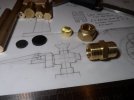
huSAM_yy1460.JPG

A couple of small, rubber discs from some pipe end stops will hopefully provide material for the valve seals later too?!

I have shifted from the original design slightly, in that the thread for the lever cap is on the exterior of the barrel, instead of being on a narrowed section. Using the existing nut and leaving a remnant of the matching thread seemed to be a slightly easier option, as well as providing a bit more clear access for later operations?

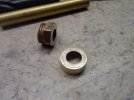
While I was still considering the best way to proceed, a start was made on the cap itself by filing down the nut and chopping a bit more off a remaining stub of another old donor 10mm coupler:
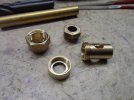
huSAM_yy1464.JPG
huSAM_yy1466.JPG

I have left the inner ring section rough cut for the time being, as I want to solder that, whatever I can find for a hollow centre fitting, and the operating lever clevis in a single, messy operation!

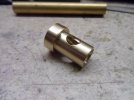
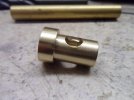
The symmetrical coupler barrel has a reduced diameter pipe stop section in the centre, beneath the former hex, which I felt could be handy for pressing a separating barrier plug into - but that turned out to be a bit of a fiddle:
huSAM_yy1467.JPGhuSAM_yy1470.JPG

It did make drilling the apertures for the two vertical tube connections rather a nether clenching exercise... but I got away without any serious mishaps, or missing bodily bits!!

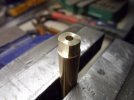
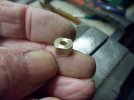
Making a really tight, press fitting plug to fit a hole with an unspecified, and difficult to accurately measure internal diameter required an amount of trial and error... plus a fair wind blowing in the end.
huSAM_yy1475.JPGhuSAM_yy1476.JPG
huSAM_yy1479.JPG

It might not look like it in the last image above, but the plug was sufficiently snug to require a bit of gentle "persuasion" before it settled in the correct position.

I wanted this essential barrier section to hold firmly in place during subsequent soldering up of the two, vertical branches and the front end fitting to come later.

Not only was working out the appropriate order of shaping down, drilling, tapping and cutting the branches tricky and troubling enough...

huSAM_yy1487.JPG

but on the lower, feed section, I was down to my very last bit of brass hex of the right size in the box...!
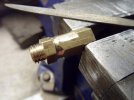
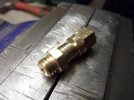
huSAM_yy1495.JPGhuSAM_yy1496.JPG

Wow! There really was just enough length to spin the shaft to shape when the piece was held in the chuck jaws - so not a millimetre to spare for any errors there!

I will admit that I am somewhat reluctant to order any more brass sections, particularly bearing in mind that I am now so close to completing all the plumbing jobs, that it would a shame to end up with any new lengths of odd size materials. for the sake of a single part!
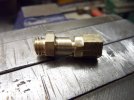
huSAM_yy1497.JPG

By the way, the vee shaped cuts filed in before separating the pieces from the stock bar are necessary to fit with the sections left open above and below the centre plug - and having those angles inside the barrel would also provide a flat surface to commence drilling the connecting airways.

I felt it was preferable to drill those airways after soldering up, rather than finding that the angle might be slightly too steep, and then having difficulty trying to clear the tiny holes again of any runaway solder?!

There are more pics and words to bring this bit up to date, but I will save them for later!

Pete.
 
Last edited:

Peter Insole

Western Thunderer
It was a bit of fun trying to ensure that the cruciform remained reasonably square during soldering up, and I did have some trouble with solder not flowing quite where I wanted it - requiring a second dose of flux and waft (or perhaps more accurately a blast) of heat to make sure that the plug was thoroughly airtight all round the edges!

huSAM_yy1500.JPG

The view above was taken before cleaning up the excess solder, while the two below show how the angles act as both a shaped fillet, that doesn't intrude too much into each chamber, and as previously mentioned, would then provide one, small, flat section for drilling an angled passage connecting with the main column bores at top and bottom.

huSAM_yy1502.JPGhuSAM_yy1503.JPG

Once again, I was so busy faffing about with it all that I quite forgot to take pictures of the new holes, so the best I can do is describe them! The front chamber (upper view) has the inlet hole leading down into the branch with the hex and male thread, while the rear chamber (lower view) has the outlet hole leading upwards into the short, stubby, top branch (female threaded for the whistle).

A 2.5mm (max. dia.) valve rod and larger seal should (hopefully) hold the air in the front chamber, and then when pushed in against a spring, allow air to pass through the 3mm hole in the plug, thence into the rear chamber and to atmosphere via the screaming fipple!

That's the theory anyway! I still have absolutely no idea if it will work... but the learning curve is a steep and rather adventurous journey!

huSAM_yy1505.JPG
huSAM_yy1507.JPG

Ah well, if it doesn't, I suppose it will still be as a golden ball, sitting pretty and surmounting the glorious dome?!

To bring the tale up to date; I have now soldered in the front ring, and more or less sealed the fate of the front end. Any alterations there are by no means impossible... but I fear it would be very easy for me to get the whole thing in a terrible mess when attempting to sweat any part back off!

huSAM_yy1510.JPGhuSAM_yy1511.JPG

It is all a bit tight in there, as the maximum diameter of the valve, (to fit against the plug) is 6mm, so I had to drill and tap the hole in the cap at an awkward M7. This also was at the maximum to allow the valve to be fed in, while still leaving just enough metal all round the cap for a hex screw head to finally seat and seal it up.

huSAM_yy1513.JPGhuSAM_yy1516.JPG

I found a handy little fibre washer that was exactly the right size for the whistle joint, but only after screwing it fully home on the valve body I discovered that one, or both of the hand cut threads was on the wonk!

Damn it and sigh!

We will just have to imagine that the exalted object copped a wallop at some time on it's host's travel on the lines around Horwich Works... (probably not a particularly unlikely scenario?) and that it has never been quite as straight as it's fellow bellowers ever since!!

Pete.
 
Last edited:

Peter Insole

Western Thunderer
Ah, I was just in a silly mood last night, as well as getting bored with typing ordinary words!

Trying to be as poetic as I could manage, I thought of an alternative that I was quite pleased with... was utterly convinced that I had inserted it... did a read through just before posting... and spotted a peculiar, empty space in the text. (?!)

For the life of me, I could not remember what the little gem was... so "screaming" was an act of frustration... being as I was, by that time, dog tired and just wanting to click post before heading off to bed!

Pete.
 

Peter Insole

Western Thunderer
I am still not quite sure of the best way to progress making the valve gland and operating rod sufficiently airtight when closed. Fitting a Schrader valve looks like an option, and with that in mind I picked up a small pack of spares (working out at around 50p each!) to have a play with. Fortuitously, and according to my original plan, I had drilled a 3mm hole through the partition in the valve body, while the Schrader valve spindle is 4.35mm at its widest point, so opening out and tapping should not be a problem. It would however require the special purchase of a specific, 5V1-36 tap... for just one solitary job... and for which there is no guarantee that it will actually work in practice?!

In the meantime, and with a decent spell weather promised at last - along with the prospect of being able start tackling a huge backlog of track maintenance tasks, I was quite keen to get the main, wooden (sorry Mr. Ramsbottom!) safety valve finally fettled and fitted!

The big idea for this was to use three steel strips, drilled and bent to form a tripod support within the dome, thus providing a rigid mounting, as well as leaving just enough room to pack a small air reservoir in the space:

huSAM_yy1535.JPG

It took me a fair amount of effort to cut and shape up two flange "hoops" out of ply sheet to fit really snugly over the valve stem - which incidentally, as it was not practical to fit in the drill chuck to rotate, had to be rounded as accurately as possible by hand and eye alone!

After setting out and drilling six stud holes through both flanges, plus chiselling a slot in the top of one to allow the insertion and lodging of a short fillet, as per the original castings, below the whistle branch.

huSAM_yy1530.JPGhuSAM_yy1532.JPG
huSAM_yy1534.JPG

I prefer to use, for better or worse (?) "Resin W" type wood adhesive for such jobs, and so far it has proved to be excellent at grabbing quite quickly, before going on to form good, sound joints.

Regrettably, it was only after gluing it all up and inserting the aforementioned fillet, that I discovered a very slight misalignment. Admittedly, it wasn't by very much, but it was totally unacceptable when viewing the whole mount, with it's distinctly geometric pattern of studs, from the all important, engine driver's position!

The glue had shifted beyond the grab phase... and even though it was not remotely cured, removing and resetting the double flange was only achieved by the use of boiling water straight from the kettle, an awful lot of grunting, and then cleaning up a dreadfully gooey mess!

Next, I needed to drill a big hole through from the underside of the saddle tank and the twin layered MDF base of the dome.

huSAM_yy1539.JPG

Great, good fortune smiled upon me here; as I had already drilled a central bore through the layers for accurate alignment of the dome, and that hole was the perfect size for the saw guide bit! The largest tool I had available also neatly cut just inside the four existing dome fixing screws!

Phew!

It took me a little longer to find some suitable steel for the tripod legs.

huSAM_yy1541.JPG

I found my last, well buried offcut of sheet eventually, but cutting out three more strips this time proved that either my much abused saw blade was getting blunt, my files were becoming dull, or more likely it was me losing my edge?!

After a load of bashing, several minor bruises, and at least two rounds of blood-letting later:

huSAM_yy1542.JPGhuSAM_yy1544.JPG

Gosh, I was glad I had chosen to only do three legs! It took an absolute age to ensure that the valve stood vertically, and at the right height.

It was a bit like sawing a shave off a chair leg that won't sit on the floor without wobbling... only to find that it still rocks, and needs a little bit taking off the other three! In the end, indeed if at all, you end up sitting with your knees up under your chin, and only just able to see across the dining table!

After an unimaginable faff of individually flapping legs and falling nuts, the whole shebang was finally bolted in place:

huSAM_yy1572.JPG
huSAM_yy1571.JPG

Despite all the fuss, it is still not quite in the middle - as the eclipse effect attests.

I had quite enough, so it can can jolly well stay like that for time being!

huSAM_yy1579.JPGhuSAM_yy1577.JPG

Incidentally, on the prototype examples, some had a metal ring lodged under the valve flange, overlapping the gap between it and the dome cover.

Such a fitting could be used to hide my own error and irregularity, but just to be wayward, as ever, I would rather leave it open.

On nice sunny operating days, the varnished black saddle tank and dome gets terribly warm inside - and along with heat generated by the motor and resistances in the controller directly beneath, some of the paint finish is already showing signs of tell tale blistering. I think it might be wise not to restrict any more of the excess therms gathering than is absolutely necessary?!

Pete.
 
Last edited:

Yorkshire Dave

Western Thunderer
On nice sunny operating days, the varnished black saddle tank and dome gets terribly warm inside - and along with heat generated by the motor and resistances in the controller directly beneath, some of the paint finish is already showing signs of tell tale blistering. I think it might be wise not to restrict any more of the excess therms gathering than is absolutely necessary?!

What it needs is a fan installed at the base of the chimney to draw the air through the firebox, over the electrical gear and exhaust it through the chimney. :)
 

Yorkshire Dave

Western Thunderer
Bang on Dave... but then might it start sounding a bit like an old "Shenfield" quietly humming away while standing at platform 16 on the East Side?:D

Two for the price of one :) - cooling the 'steam' loco electrics and some nostalgia for the old Shenfield EMUs.

I should have mentioned you could also place a 'dry ice' tray above the fan in the chimney to provide pseudo smoke :rolleyes:.
 

Peter Insole

Western Thunderer
Absolutely nothing Rob... indeed, I would love to hear that (sorely missed) sound again... but perhaps not emanating from a representation of an 1880's steam locomotive though?! ;)

There has been some previous discussion around here on the various benefits or difficulties of installing a rudimentary cooling system, but the subject had stalled on the points of battery draw - and noise generation! All full size engines gently rumble, gurgle, bubble and occasionally hiss when stationary in full steam, let alone the very individual "voice" of their essential blowers. Finding some way of making an electric fan and ducting produce acceptable tones is beyond me at the moment!

Ah, yes again Dave! Making "smoke" would be soo much fun!

I have made some attempts at provision for any future developments by ensuring that the blast pipe is clear all the way through from the otherwise empty steam chest anyway!

Pete.
 

Peter Insole

Western Thunderer
Oh gosh, I'm sorry James for not replying to your request for such a long time. My only excuse is that since the Spring I had been fully concentrating on outdoor works... and had not opened up this particular thread since then.

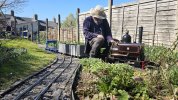
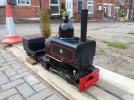
Rather oddly, I have taken very few recent overall images of the loco, but I can show these for you, and indeed anyone else who might still be interested:

hkSAM_1827com20250407_135342Rich.jpghkSAM_1827com20250407_135901Rich.jpghkSAM_1831.JPGhuSAM_yy2285.JPGhuSAM_yy2286.JPG

I must admit that very little has been done over the last few weeks on either the railway, rolling stock or any other matters come to that.

Just another example of the "usual" old health problem resurfacing and messing about with me (and more so for my loved ones) I'm afraid!

Less said about that for now though.

Pete.
 

class27

Active Member
It really is something else. If you Dirtied up the ground around it a bit with some Oil/water, coal and ash you could pass it off as Real, no problem..
Best
Steve
 

Giles

Western Thunderer
You should be so very proud of that little beauty.... Looked after (and I'm sure it will be!) It will out-live us all - though it may end up needing new wheels through natural wear and tear eventually!
I don't think anything has had us all so 'invested' as this little gem!
 

Oz7mm

Western Thunderer
Peter

You really have captured the mass of the real thing (though that was quite small).

Superb job, though I would expect no less from you.

John
 

Peter Insole

Western Thunderer
I forgot to thank you too Giles! You are quite right about those plastic wheels, and they have been the subject of much over thinking and nowhere near enough doing for quite some time now! I could have added the word "wretched" to that sentence, but I do have to agree with my family and close friends' observation that without them, the whole project would certainly never have started, let alone go on to provide so such enjoyment to date.

The effect of running both this engine and the "speeder" on the steel bar rail extension notwithstanding, (not every trip traverses it at the moment!) the aluminium rail is having a distinct impact, but it is fairly clear that the main cause of wear is that desperately tight "loop" curve.

Having said all that, regular examinations reveal that the polypropylene is proving to be surprisingly robust stuff, and it is obvious that there is plenty of potential mileage left on the treads and flanges. The current issues I am having with them is somewhat more unexpected... to this particular fool anyway!

On this engine I initially retained the original Poly bearings for the leading axle, even though at the time I feared they would not stand up to the potential punishment. With that problem in mind, I had replaced them early on with pillow blocks - and indeed used such from the outset on the "speeder".

That in a way turned out to be a significant error of judgement!

The "clock" or "piano front" shape of a pillow block, despite them appearing to be quite commonly used in miniature railway (5" and even some 7 1/4") rolling stock, is not in any way conducive to constant axle alignment when combined with any form of suspension. I now realise that, as my rough, exaggerated sketch hopefully shows, there is absolutely nothing to prevent the two springs from compressing unequally, and that the deflection of the axle centre is not only vertical, but radial as well...

zpoint 073.jpg

Axles running out of square by force (rather than controlled by design) is bad enough, but add the thrusting action of coupling rods during each wheel rotation and you can see that disaster is almost inevitable!

The previously mentioned, plain, poly bearings had the "wings" central to the horizontal axis, (in the form of a London Transport bullseye) so were not thus affected. Oh well, they say we live and learn... but do I?!

While still unaware of the above, my first inkling of a major problem was when a set screw locking one of the leading wheels to the axle sheared. Although I replaced it, after considerable effort with something beefier, a short time later the flange and collar that the screw passed through failed also! At that point I threw my dummy out of the pram and determined to loctite the whole assemblage together... with the thought that before the bearings need replacing I might have got round to obtaining some steel wheels anyway, so complete destruction of the former unit would not be so much of a concern?!

There is not a lot of setting leeway with loctite, so during that latest emergency repair I was extremely careful to make scratch marks across the wheel centres and axle ends before stripping down, just to make sure that the quartering remained true.

It did not.

Despite my concentration and best intentions... I had completely failed to notice that the incident had slightly knocked the quartering out anyway!

Idiot!

Such is the enormous power of the little beast, that from the first test runs after reassembly, the only clue of anything untoward was a faint, but annoying squeak per revolution emanating from one of the coupling rod ends, and it was urgent investigations into this that revealed the litany of issues, part of which I have alluded to thus far.

Sorry... yes, there is more to come!

This emergency occurred not long before the usually busy school holiday period, so before taking more drastic (and ultimately appropriate) actions, I decided on two relatively simple fixes:

The only reasonable way that I could see to reposition the errant, M5 threaded crank pin was to remove it and open out the hole with an offset, and of sufficient diameter to ensure that the new centre was in the correct position. In this case it turned out to be M8. The only way for me to achieve that was to clamp the entire wheel/axle assembly in the bench vice, and hand drawing with a rat-tail file... awkwardly working it from left to right! The new crankpin itself was a walk in the park by comparison!

hkSAM_yy2282.JPG

It only required spinning down and re threading one end for the M5 fittings.

The M8 head did have to be awkwardly reduced in proportion though, as this time there was insufficient clearance between the axle and hub fitting on the back of the wheel.

Now I should point out that our little yellow painted, roughty-toughty, go anywhere, do anything, all weather, "speeder" is a very basic representation of a 2ft gauge, Wingrove and Rogers (B.E.V.) battery locomotive, whereon the prototype has a single, fore and aft, centrally mounted, double ended motor, directly driving gearboxes on both axles. With no shafts or other flexible connections, the albeit short wheelbase is completely rigid... and despite that surprising lack of suspension, they do nonetheless seem to have been very popular and successful in service for many years! For simplicity, I decided that ours only required to be similar in the latter respect. However, in our case perhaps, and unlike the above prototype, there is a modicum of flexibility already built in by using the same plastic wheels as the subject of this thread? Be that as it may, so far the speeder continues to run reasonably well - although admittedly it's performance is starting to deteriorate.

Back to the subject, and with the quartering (including squeak) successfully sorted, and bearing in mind all of the above, I decided to deal with the pillow block situation by replacing the springs with four solid spacers.

The following test runs proved that the lady has found her heels again... or at least in part!

Mmmm!

Well, she gallops finely enough, in her own fashion, on the straights... but like her little yellow cousin, is starting to lose her wind and noticeably judder on that dreaded top curve.

It would seem that the wear on the leading wheel tyres on both engines is well within profile tolerances - but the surfaces have lost any semblance of shine. It is becoming abundantly clear that the wheels are becoming more and more resistant to the unavoidable degree of "creep" (as discussed at length in earlier posts) when negotiating a curve!

Now on continuing the point of that unavoidable "creep", or whatever the experts prefer to call it, I would not blame anyone for being more incredulous than I was when it finally dawned?

I know I have admitted, on several occasions to having an almost chronic degree of Dyscalculia... but in this case it seems I have surpassed myself!

After such a long period of time, and after so much measuring, you might assume that I had the simple foresight to check...?

The only apparent differences between the leading and trailing wheels on the original toy was a rebate in the tread for a traction tyre, and a larger centre boss on the rear of same for an hexagonal ended driving axle. In every other respect, they appear to be from the same pattern.

Oh yeah?!

Believe it or not, until a few weeks ago it had never occurred to me that their diameters might be different!

Even more ridiculous is that I have actually possessed my very own Vernier... from since I cannot remember when?! I suppose that is a bit like having a nicely tuned piano in the parlour - just in case someone happens to come along who might actually be able to play it...

Ahem, OK, we did that too for a while!

So it turns out that all this time the trailing drivers have been merrily trying to overtake the leading pair on both our locomotives!

Crazy!!

Sort of fine while they were all smooth and shiny, nobody noticed. Now the front tyres are becoming... slightly, well, tired... the race is definitely on!

Looks like the only real winner will be steel all round? The additionally associated faff and fuss of conversion is going to be compulsory rather sooner than I might have prayed for!!

Pete.
 
Last edited:
Top