Caught in the Cross hairs!

An extremely useful Laser cutter upgrade​

Like many modellers the acquisition of a laser cutter opened up a wide range of new projects however there were still a few limitations, the main one being the problem of double siding “etching”. Having devoured the seminal Chris Croft’s MRJ articles on wagon building being able to etch and cut thin plywood on the laser cutter has always been a target build for the laser cutter. However this requires being able to etch and cut out the wagon sides then turn the component over and laser etch the internal detail.

Various solutions were tried with numerous alignment jigs and location systems, the newer open frame laser cutters being more problematical as they are just a X-Y plotter on legs with no integrated bed. Then last year I watched a video where the presenter suggested a user modification of fitting a laser crosshairs to aid alignment. This was the solution I was looking for and with the added satisfaction of using the laser cutter to produce the upgrade.

Overall design.​

The modification is very simple, to fit a laser crosshair to the laser cutting head so that we can precisely locate the start of the cutting operation. The laser cutting software Lightburn has an option to define a laser cutting pointer offset. This allows us to align the laser crosshairs accurately on the work piece, the laser software will then move the laser cutting point to this offset before it starts cutting.

Figure-1.jpeg
[ Figure-1 - General view of cross hairs fitted to the laser cutter ]

Parts Required​

Very few parts are required, many I already had lying around.
  • A laser cross hair unit - search on eBay for “5v laser cross hair”, they can be obtained for less than £5, including postage.
  • USB power supply, there is a USB socket on the laser cutter I could have probably used but I had a little mini power pack I could use, again eBay for less than £10 if required.
  • 2mm MDF sheet to make the mounting cradle.
  • USB cable to wire up the cross hairs
  • Double sided adhesive pad or glue.
Figure-2.jpeg
[ Figure-2 - components required for the cross hairs ]

Cross hair cradle​

A few minutes was spent drawing out the cradle for the cross hairs, this was then cut out in 2mm MDF sheet and assembled with a little wood glue. [dxf file attached]

Figure-3.jpg
[ Figure-3 - CAD drawing of the comments to laser cut in 2mm MDF ]

One end of the USB cable was cut off and ground and +5v wires soldered to the laser cross hairs. The unit was assembled and stuck onto the side of the laser cutter head unit using a double sided adhesive pad. The position isn’t critical, just make sure it doesn’t interfere with the other wires when the laser head moves from side to side and place it so that the cross hairs are visible when working on the machine.

Calibrating the software​

To calibrate the offset on a scrap piece of MDF sheet etch a square box shape, around 10-20mm square.
Figure-4.jpeg
[Figure-4 - Etching a square box to set up the offset calculation. ]

First this allows us to rotate the cross hairs so that they align with the X-Y axis of the laser cutter, once aligned a drop of superglue in the cradle helps to hold them in position.

Second for the calibration align the cross hairs on the bottom lefthand corner of the box. On the laser settings use the options to cut selected graphics using the selection origin.
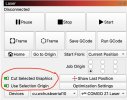
Figure-5.jpg
[ Figure-5 - Lightburn settings cutting selected graphics and selection origin ]

Then laser etch the box a second time. Using a ruler or vernier calipers measure the X and Y distance from bottom left corner of the second box to the same corner of the first box. Accuracy isn’t vital as we can fine tune it later. In my case the laser crosshairs are mounted to the left and rear of the laser head so the offset in this case measured as X = -46.5mm and Y = +21.0mm.
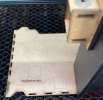
Figure-6.jpeg
[ Figure-6 - Second box etched after aligning the cross hairs on the first box ]

On the device settings in Lightburn we enter this as the Laser Offset. Now for the fine tuning, turn on the option to enable the laser offset and etch the box for a third time. If the dimensions are perfect then the two boxes will align perfectly. My dimensions were slightly out, but tweaking the X offset to -41.65mm perfected the alignment. As indicated it can take half a dozen tweaks to fine tune the alignment.
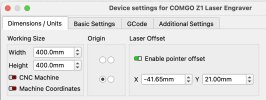
Figure-7.jpg
[ Figure-7 - Lightburn settings to define the Laser Offset ]

Figure-8.jpeg
[ Figure-8 - Several fine tuning efforts to align the two etched boxes ]

Ready to roll​

First benefit : Will it fit? When you have a component to cut out and you find a suitable off cut of material. No longer the dilemma of is the offcut big enough or trying to set up the alignment in the laser cutter. Simply turn on the cross hairs and use the Frame option in Lightburn. The laser cross hairs will trace out the frame required to cut out the item so you can check that they remain on the work piece. If the cross hairs drift off the workpiece you can then adjust it appropriately.

Figure-9.jpg
[ Figure-9 - Lightburn options to trace out cutting frame ]

Second benefit : double sided etching. This was the aim of the project. I drew out the wagon side with etching for the planking and location marks for the platework and strapping.

Figure-10.jpeg
[ Figure-10 - Laser cutting and etching wagon side in 1.5mm plywood ]

We can then turn over the wagon side and now etch the interior planking. Use the frame check to check alignment, making sure the outside cut lines are selected so that the frame check matches on size. On the cut settings we then turn the output off for the cut line.

Figure-11.jpg
[ Figure-11 - Select the cut line to generate the frame but turn off the output ]

and we can etch the inside detail perfectly aligned.

Figure-12.jpeg
[ Figure-12 - Wagon side showing the etched planks on the inside ]

The final stage of the wagon building has been to apply the POW lettering, initially I tried etching the lettering as a guide when cutting out the side. Unfortunately it wasn’t that successful as the when I filled out the letters the colour bled into the sides and wasn’t very sharp. Now I’m currently experimenting with cutting out a letter free wagon side, then applying sanding sealer followed by a couple of coats of base colour.

Once dry I can then put the wagon side back in the laser cutter and using the laser crosshairs align it to etch the letters into the base coat paint.
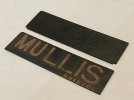
Figure-13.jpeg
[ Figure-13 - Painted wagon side followed by etched lettering for painting ]

[ps. For @daifly - yes this has been submitted to the Scale7 editor for consideration in the Scale7 Newsletter. ]
 

Attachments

  • cross-hair-laser.dxf
    114.6 KB · Views: 8

J_F_S

Western Thunderer
Just a question which has baffled me for ever!

Why do you not cut the door completely out? To me, there is nothing more ruinous of the look of an otherwise excellent model wagon than the glaringly obvious non-opening door? When you look at a real wagon, there is always a significant gap round the door and when the wagon is empty, you can see a LOT of daylight through it!. Very often, the door is a long way off being co-planar with the side - which usually has a bad bow to eccentuate the effect - and, with wear in the hinges, the planks do not line-up.

Please don't take this as a criticsm - all wagon bashers seem to go the same route. It looks to me (as a pasenger-only-railway modeller!!!) to be one of those dreadful elephant-in-the-room modelisms. There are people making wonderfull 3D prints of solid wagon sides - as if we are making a copy of a injection moulding!

Or perhaps there is some limitation imposed by the Laws of Modelling of which I am unaware:)

I would add that in the case of Scottish "Cupboard Door" wagons, this is even more prominent given there are three doors per side...

Baffled of Derby!
 

simond

Western Thunderer
Well, having just 3D modelled the GWR N6 & N4 iron loco coal wagons, I’ll say firstly, that there are overlaps on the sides, so you can’t see through there, and secondly, when I modelled the gap at the top of the door as a gap, rather than a groove inside and out, the door bowed out in a fashion most unlike the photos of the wagons I’ve got.

so on my models it’s not see-through.
 

adrian

Flying Squad
Why do you not cut the door completely out? To me, there is nothing more ruinous of the look of an otherwise excellent model wagon than the glaringly obvious non-opening door? When you look at a real wagon, there is always a significant gap round the door and when the wagon is empty, you can see a LOT of daylight through it!. Very often, the door is a long way off being co-planar with the side - which usually has a bad bow to eccentuate the effect - and, with wear in the hinges, the planks do not line-up.

Please don't take this as a criticsm - all wagon bashers seem to go the same route. It looks to me (as a pasenger-only-railway modeller!!!) to be one of those dreadful elephant-in-the-room modelisms. There are people making wonderfull 3D prints of solid wagon sides - as if we are making a copy of a injection moulding!
You're quite right - I've just done it for convenience and strength at this point. I suppose there's no reason I couldn't go back after lettering to cut around the door. I've might try just cutting the sides and top to avoid the problem of fixing it in place and stop it dropping open when running around.
 

J_F_S

Western Thunderer
Well, having just 3D modelled the GWR N6 & N4 iron loco coal wagons,

I thought it unnecessary to say - given the content in this post and my mention of "planks" - that I was talking about WOODEN bodied Wagons: I clearly overestimated some of the the audience;)

I might try just cutting the sides and top to avoid the problem of fixing it in place and stop it dropping open when running around.

I would not want to push you into something that might spoil a very nice job, but I would be interested to see the effect. The 'fixing' issue might not be too difficult where (say) etches are used to represent the catches (in their various forms) and hinges. Otherwise cutting everywhere except the hinge and catch positions might serve.
 

John Duffy

Western Thunderer
The biggest issue I found with laser cutting for wagons was producing the ironwork. I ended up going for Laserboard and pushing out the bolt heads. That and with the very limited range of fitting for axleboxes, buffers etc. I now find it a whole lot easier to 3D print wagons.

John
 

adrian

Flying Squad
The 'fixing' issue might not be too difficult where (say) etches are used to represent the catches (in their various forms) and hinges. Otherwise cutting everywhere except the hinge and catch positions might serve.
The plan is to use manilla card for the platework and plastic bits for the added detail.
 

Overseer

Western Thunderer
Just a question which has baffled me for ever!

Why do you not cut the door completely out? To me, there is nothing more ruinous of the look of an otherwise excellent model wagon than the glaringly obvious non-opening door? When you look at a real wagon, there is always a significant gap round the door and when the wagon is empty, you can see a LOT of daylight through it!. Very often, the door is a long way off being co-planar with the side - which usually has a bad bow to eccentuate the effect - and, with wear in the hinges, the planks do not line-up.

Please don't take this as a criticsm - all wagon bashers seem to go the same route. It looks to me (as a pasenger-only-railway modeller!!!) to be one of those dreadful elephant-in-the-room modelisms. There are people making wonderfull 3D prints of solid wagon sides - as if we are making a copy of a injection moulding!

Or perhaps there is some limitation imposed by the Laws of Modelling of which I am unaware:)

I would add that in the case of Scottish "Cupboard Door" wagons, this is even more prominent given there are three doors per side...

Baffled of Derby!
Dear Baffled of Derby
You will find the answer to your baffle with a little research and study. You appear to have made assumptions based on ‘preserved’ wagons which were probably condemned long before they were patched up for display. Slaters and other injection moulded wagon kits closely follow the appearance of in service wagons. Mineral wagons, in particular, had tapered edges to the side doors forming a plug to prevent coal dust etc from escaping. This is clearly shown on the readily available RCH general arrangement drawings - the door opening was an inch or so smaller on the inside than the outside. An in service mineral wagon could have a door slightly proud of the body planking but would not be accepted for traffic with any gaps around the doors, even in the 1950s and 60s.

Open goods wagons could have less tightly sealed doors as they weren’t required to contain loose material, but they were less abused in service so large gaps were unlikely.

A browse through any of Keith Turton’s wagon books, or any of the many other wagon books, will show why wagons are modelled the way they are by most modellers.

A wagon with gaps around an ill fitting door would be wrong, unless you are modelling a stuffed and mounted exhibit on a preserved railway. It would actually be one of those “dreadful elephant-in-the-room modelisms” you are worried about.

No need for an elephant gun. Just look at the evidence.
 

J_F_S

Western Thunderer
Dear Baffled of Derby
You will find the answer to your baffle with a little research and study
Just for information, I was foreman in a wagon shop during 1977/8 before I moved on to better things (EMUs!). By then of course, wooden-bodied wagons had been on steel underframes for many years and they were much less prone to movement than traditional wooden underframes, yet the side doors fitted where they touched. Of course they were not used for minerals by then. (I could tell a story or two about 16T minerals). I am well aware that doors were traditionaly tapered for a plug fit when they left the builders, and, had I known I was kicking a hornet's nest, I would have taken more care to say at the outset that doors are very often not flush to the sides for that very reason.

I also fully accept that in earlier days wagons would have been much better maintained, but after WW1, standards of maintenance fell off to such an extent that the original design intent became lost. Judging by reports of goods train break-aways in the 30's, if the all the underframes in a train stayed in one piece for a whole journey it was regarded as fortunate - that doors could be made to a fine fit in such circumstances seems unlikely to me and I think photos of the day support that.

"Most modellers" (who ever they are) seem to model wagons with P numbers / patched unpainted boards / bowed sides and other signs of being un-loved, yet the doors are apparently fitted using feeler gauges?

In the books you mention, I would suggest that a critical look will show that misaligned planks and non-flush faces are not the rarity you imply - even if the side-gaps are plugged by the taper of the door. And, of course, on the inside of an empty wagon, there should be a 1/2" gap all round ...

We do at least agree that what is seen on preserved railways is no guide to anything!

Many thanks to Adrian for an interesting idea and sorry to have invoked sarcastic vilification and vituperation from the cognoscenty round here.
 

Overseer

Western Thunderer
Just for information, I was foreman in a wagon shop during 1977/8 before I moved on to better things (EMUs!). By then of course, wooden-bodied wagons had been on steel underframes for many years and they were much less prone to movement than traditional wooden underframes, yet the side doors fitted where they touched. Of course they were not used for minerals by then. (I could tell a story or two about 16T minerals). I am well aware that doors were traditionaly tapered for a plug fit when they left the builders, and, had I known I was kicking a hornet's nest, I would have taken more care to say at the outset that doors are very often not flush to the sides for that very reason.

I also fully accept that in earlier days wagons would have been much better maintained, but after WW1, standards of maintenance fell off to such an extent that the original design intent became lost. Judging by reports of goods train break-aways in the 30's, if the all the underframes in a train stayed in one piece for a whole journey it was regarded as fortunate - that doors could be made to a fine fit in such circumstances seems unlikely to me and I think photos of the day support that.

"Most modellers" (who ever they are) seem to model wagons with P numbers / patched unpainted boards / bowed sides and other signs of being un-loved, yet the doors are apparently fitted using feeler gauges?

In the books you mention, I would suggest that a critical look will show that misaligned planks and non-flush faces are not the rarity you imply - even if the side-gaps are plugged by the taper of the door. And, of course, on the inside of an empty wagon, there should be a 1/2" gap all round ...

We do at least agree that what is seen on preserved railways is no guide to anything!

Many thanks to Adrian for an interesting idea and sorry to have invoked sarcastic vilification and vituperation from the cognoscenty round here.
Sorry, there was no sarcasm, vilification or vituperation in my post. Taking an intelligent interest in the prototypes of our models should be encouraged. Spreading incorrect information helps no one, especially while claiming expertise in the subject.

I make no claim to be an expert on the topic and have nothing to prove. I have simply looked at the available evidence while building some models.

The drawings show that the tapered edges of the side doors on RCH mineral wagons had 2 1/4" x 1/4" plates fitted to both the body planks and the door planks. The steel plates formed the door seal. There was no timber rubbing on timber. The steel plates were replaced when worn. There was no 1/2" gap around the inside of the door.
rch1002 crop.jpg

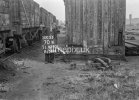
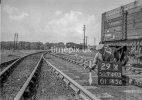
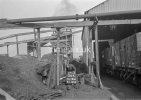
The following photos are useful as they show details of random typical wagons in service and are mostly dated. RCH 1923 seven plank wagon P391431 is visible in this August 1955 photograph. The wagon is in fairly typical service condition of the time showing unpainted replacement planks. Note the side door is relatively flush with the body planks, as they are on the other wagons visible.
PO i-PxX3szq-XL copy.jpg

This photo is undated but probably early 1950s. The part visible wagon on the right is a pre 1923 seven plank wagon. Note the open door reveals that the ends of the planks are not visible, confirming the presence of the steel door seal plates. The grey painted ironwork on the other wagons shows they had repairs soon after nationalisation before all painting of ex PO wagons was stopped (until 1957 when overall painting was partially resumed).
PO i-s6zXhDS-XL copy.jpg

Another pre 1923 wagon. P93834 looks like it is a 16' long wagon to the later version of the 1907 RCH standard, probably built between 1920 and 1923, therefore around 30 years old. The wagon has had various repairs using narrow planks but the door is close to flush with the body sheeting.
PO i-W7HsMx9-XL copy.jpg

An April 1953 view of a RCH 1923 wagon showing the side door is fairly flush and well fitting.
PO i-F229kjd-XL copy.jpg

Resources were restricted following WW2 but the wagon repairers were experienced tradesmen who continued doing their jobs to the standards they had been trained to.
 

J_F_S

Western Thunderer
I have simply looked at the available evidence while building some models.

It must be a point of view thing: I look at your photos (what a wonderful resource Timepix is!) and I see PLENTY to support my assertion - though I am bitterly regretting how I phrased it - and nothing to contradict me.

Forget what I said about gaps (I will need to find the GW report into the condition of colliery-owned wagons where I saw reference to this) and look at this photo:-

Wagon 1.jpg

If you are telling me that the door looks in any way like it could be made in one piece with the side and still replicate this look then I will give up and take up flower arranging.
The front faces are nowhere near flush, the planks do not line up and there are splits in the side boarding which do not carry over to the door. Moreover, the door bows outward where it bears on the floor and in the vertical plane quite independently of the side. To me, the demarcation between the side planking looks completely different from the demarcation between the side and the door - be that a gap or a close taper-wedge fit.

Am I REALLY the only person on this forum who sees this please?

Then take this (steel-framed) example (this was the first one I came across after a 2 second internet search)

Wagons.jpg


The main door is clearly "falling open" against the pins (no way is the wedge-action working) and as for the cupboard doors...

Of course, perspective in everything - if your layout involves 70-wagon coal trains then who will notice? But so many layouts (especially in 7mm) are cameos and they invite detailed inspection. Their builders go to extreme lengths to create 'the look': for example, to build empty bottom-doored wagons with separate doors (to get the "grain" running the right way) and will 'distress' doors on their goods sheds etc. So why not wagon side doors?

I want to point out that the context of Adrian's thread is the use of modern technology to replicate detail. I for one would fully accept that using traditional methods, to scribe a piece of flat material was realistically the only way to create a side and I have seen many an excellent wagon that was beyond reproach done that way. But - using technology opens up new possibilities. Surely?

I rest my case.

Cognoscenty? I want shooting - half my daughter's in-laws are Italian!
 

martin_wynne

Western Thunderer
If you are telling me that the door looks in any way like it could be made in one piece with the side and still replicate this look then I will give up and take up flower arranging.

I can see that it's not flush, and the planks don't line up. There might even be a different number of planks on some prototypes?

But with modern methods -- 3D printing, injection moulding, casting even, I can't see why it can't be in one piece. Makes a much stronger box structure.

For plywood or etched brass, maybe not.

Martin.
 

J_F_S

Western Thunderer
But with modern methods -- 3D printing, injection moulding, casting even, I can't see why it can't be in one piece.

Fair clarification Martin - my point was only in the context of a laser-cut plywood side. With a 3D print, the separation would only be in the digital model.

At the risk of boring everyone beyond death ... AND having rested my case ... just two more please... the first one more representative of the post-group era, the second pre-preservation.

Slide3.JPGSlide4.JPG
Edit:- Yes, if you zoom in, that IS daylight you can see above the door of the NE wagon.
 
Last edited:
Top