John TAYLOR
Western Thunderer
Over the past 18 months I`ve been learning (probably for the first time in 40 years) how to improve my airbrushing skills, which were never really good enough.
At the same time I`ve looked for a faster way of priming and finishing my brass and white metal kits using modern Acrylic paints.
I`ve always used Enamels as I believed them to be harder wearing for model railway engines and stock which are likely to be continually handled.
Also, an acid etch primer is always essential when painting brass made models to improve and maintain paint adhesion.
And so, after spending many hours on Youtube watching Aero-modellers and Airbrush artists, I`ve upgraded my collection of airbrushes together with choosing what I hope will be an equally reliable ` Acrylic approach to airbrushing brass models`.
Before I paint one of my brass loco kits I have used one of the late Adrian Swain`s GWR wagons to test out my chosen products.
A NON ACID ETCH PRIMER FOR METALS.
There are three on the market . One from Mr Hobby, one from VMS and the one I`ve chosen from SMS.
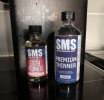
This is an Australian product and looks like a lacquer which is airbrush ready. It can be further thinned using their Premium Thinner.
Instructions advise airbrushing with a 0.3 nozzle at 12-15psi. These types of metal primers are used exclusively on expensive metal and plastic military and aircraft models
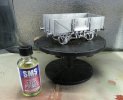
Applied in thin coats, it was an easy task despite it being a clear coat !! It gives the metal a dusky appearance and dries very quickly.
I did`nt mask off anything so it will be interesting to see how the wheel rims clean up. It has`nt gummed up the sprung buffers either.
Airbrush cleaned easily with the above lacquer thinner, Tamiya Lacquer thinner and a final rinse through with warm distilled water.
BASE COAT PRIMER.
I`ve chosen two products. Mr Hobby Surface Primer 1500 thinned with 50/50 Mr Hobby Levelling thinner or Ultimate Primer ( also known as Stynylrez Primer )

It does not need thinning and should be airbrushed with 0.5 nozzle at 25-30psi . It is self levelling and quick drying to touch but really needs 24hours to be fully hardened and then is fully sandable.

A very smooth finish indeed.
Airbrush cleaned with Ultimate Cleaner and distilled water.
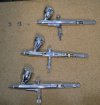
I used my Japanese airbrush collection........

Creos PS-266 0.5 nozzle.
Iwata Revolution CR3 0.3 nozzle.

I`m impressed with Ultimate Products and use their thinners and cleaner on most acrylic paints.
I`ve also experimented with home made cleaner using equal ratios of Isopropyl Alchohol, Winter grade windscreen wash and distilled water with very good results.
Next will be an Acrylic top coat using Humbrol.... yes Humbrol... Acrylic Matt Tank Grey No 67, but not using their Acrylic thinner as it causes too much trouble with tip drying particularly at low psi settings.
I have found that Ultimate Thinner probably contains a flow improver and retarder.

At the same time I`ve looked for a faster way of priming and finishing my brass and white metal kits using modern Acrylic paints.
I`ve always used Enamels as I believed them to be harder wearing for model railway engines and stock which are likely to be continually handled.
Also, an acid etch primer is always essential when painting brass made models to improve and maintain paint adhesion.
And so, after spending many hours on Youtube watching Aero-modellers and Airbrush artists, I`ve upgraded my collection of airbrushes together with choosing what I hope will be an equally reliable ` Acrylic approach to airbrushing brass models`.
Before I paint one of my brass loco kits I have used one of the late Adrian Swain`s GWR wagons to test out my chosen products.
A NON ACID ETCH PRIMER FOR METALS.
There are three on the market . One from Mr Hobby, one from VMS and the one I`ve chosen from SMS.
This is an Australian product and looks like a lacquer which is airbrush ready. It can be further thinned using their Premium Thinner.
Instructions advise airbrushing with a 0.3 nozzle at 12-15psi. These types of metal primers are used exclusively on expensive metal and plastic military and aircraft models
Applied in thin coats, it was an easy task despite it being a clear coat !! It gives the metal a dusky appearance and dries very quickly.
I did`nt mask off anything so it will be interesting to see how the wheel rims clean up. It has`nt gummed up the sprung buffers either.
Airbrush cleaned easily with the above lacquer thinner, Tamiya Lacquer thinner and a final rinse through with warm distilled water.
BASE COAT PRIMER.
I`ve chosen two products. Mr Hobby Surface Primer 1500 thinned with 50/50 Mr Hobby Levelling thinner or Ultimate Primer ( also known as Stynylrez Primer )
It does not need thinning and should be airbrushed with 0.5 nozzle at 25-30psi . It is self levelling and quick drying to touch but really needs 24hours to be fully hardened and then is fully sandable.
A very smooth finish indeed.
Airbrush cleaned with Ultimate Cleaner and distilled water.
I used my Japanese airbrush collection........
Creos PS-266 0.5 nozzle.
Iwata Revolution CR3 0.3 nozzle.
I`m impressed with Ultimate Products and use their thinners and cleaner on most acrylic paints.
I`ve also experimented with home made cleaner using equal ratios of Isopropyl Alchohol, Winter grade windscreen wash and distilled water with very good results.
Next will be an Acrylic top coat using Humbrol.... yes Humbrol... Acrylic Matt Tank Grey No 67, but not using their Acrylic thinner as it causes too much trouble with tip drying particularly at low psi settings.
I have found that Ultimate Thinner probably contains a flow improver and retarder.