Airbrushing.... my journey from Enamels to acrylics... so far

John TAYLOR

Western Thunderer
Over the past 18 months I`ve been learning (probably for the first time in 40 years) how to improve my airbrushing skills, which were never really good enough.

At the same time I`ve looked for a faster way of priming and finishing my brass and white metal kits using modern Acrylic paints.

I`ve always used Enamels as I believed them to be harder wearing for model railway engines and stock which are likely to be continually handled.
Also, an acid etch primer is always essential when painting brass made models to improve and maintain paint adhesion.

And so, after spending many hours on Youtube watching Aero-modellers and Airbrush artists, I`ve upgraded my collection of airbrushes together with choosing what I hope will be an equally reliable ` Acrylic approach to airbrushing brass models`.

Before I paint one of my brass loco kits I have used one of the late Adrian Swain`s GWR wagons to test out my chosen products.


A NON ACID ETCH PRIMER FOR METALS.

There are three on the market . One from Mr Hobby, one from VMS and the one I`ve chosen from SMS.
P1010292.JPG

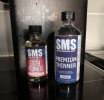
This is an Australian product and looks like a lacquer which is airbrush ready. It can be further thinned using their Premium Thinner.
Instructions advise airbrushing with a 0.3 nozzle at 12-15psi. These types of metal primers are used exclusively on expensive metal and plastic military and aircraft models
P1010301.JPG

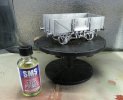
Applied in thin coats, it was an easy task despite it being a clear coat !! It gives the metal a dusky appearance and dries very quickly.

I did`nt mask off anything so it will be interesting to see how the wheel rims clean up. It has`nt gummed up the sprung buffers either.


Airbrush cleaned easily with the above lacquer thinner, Tamiya Lacquer thinner and a final rinse through with warm distilled water.


BASE COAT PRIMER.

I`ve chosen two products. Mr Hobby Surface Primer 1500 thinned with 50/50 Mr Hobby Levelling thinner or Ultimate Primer ( also known as Stynylrez Primer )

P1010293.JPG


It does not need thinning and should be airbrushed with 0.5 nozzle at 25-30psi . It is self levelling and quick drying to touch but really needs 24hours to be fully hardened and then is fully sandable.

P1010307.JPG

A very smooth finish indeed.

Airbrush cleaned with Ultimate Cleaner and distilled water.


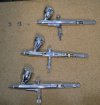
I used my Japanese airbrush collection........

P1010296.JPG


Creos PS-266 0.5 nozzle.

Iwata Revolution CR3 0.3 nozzle.


P1010309.JPG


I`m impressed with Ultimate Products and use their thinners and cleaner on most acrylic paints.

I`ve also experimented with home made cleaner using equal ratios of Isopropyl Alchohol, Winter grade windscreen wash and distilled water with very good results.


Next will be an Acrylic top coat using Humbrol.... yes Humbrol... Acrylic Matt Tank Grey No 67, but not using their Acrylic thinner as it causes too much trouble with tip drying particularly at low psi settings.

I have found that Ultimate Thinner probably contains a flow improver and retarder.

P1010303.JPG
 

Mike Trice

Western Thunderer
Looking forward to more on this. A subject not really covered much.

I did an in depth investigation into Vallejo Acrylics on RM back in 2015 some of which might be of interest (Vallejo Acrylic Paints). Unfortunately the images are missing but the information that is there might be of use.

What will be apparent is I used a bulk purchase of plastic spoons as test pieces for the various formulae rather than use a model.
 

John Duffy

Western Thunderer
Very similar to my own experience. I did whatever I could to avoid using an airbrush with enamels. My go to was aerosol cans. I am now almost 100% acrylic. I do still use cans for certain things, mostly primer but my top coat colour work is mostly acrylic.

A couple of things I have picked up along the journey;
Tamiya - I find these excellent but use their lacquer thinner. It gives a little more time on the model and I find it easier to get a nice ever coat.
Cleaning - One of the most effective cleaners is hot water. I take a flask of boiled water with me and run three or four cupfuls through. Then finish off with one of Ultimate and one of IPA.
Varnish - I found VMS varnish to give superb results. This has to go on in a wet coat though, which was very off-putting initially. They have a tutorial video which is really helpful. There is a link to this on the Scottish Wagon Works site in the 'Using our transfers' downloads.

John
 

John TAYLOR

Western Thunderer
Aha ! Thanks John,

I concur with you on Tamiya Acrylics except that the current thinking for many , is that they are best thinned with Mr Hobby Levelling Thinners which is self levelling and gives a much better and stronger finish than their usual X-20A thinner.

I`m in the process of mixing my own GWR loco green using Tamiya Acrylic.

Yes ! VMS varnish is a top quality product. I `ve used it on my Hatchette Mallard.

20230813_131358 1.jpg
 

John TAYLOR

Western Thunderer
I almost had to resort to Amphetamines to get through watching airbrushers using plastic spoons to try out Acrylics !!!.........

I prefer to slog it out with real modelling so resorted back to my aero modelling days for experimenting with acrylics and airbrush choices.

20231222_124118.jpg

I`ve also researched Decal application products ....in this example I had great success with Humbrol Decal Fix.

Next will be AK Decal Adapter Solution.......... I`m trying to avoid those two part solutions.......


Further, as a GWR Railway Modeller there are limited choices for Railway livery Acrylic paints.....

I`ve chosen RAILMATCH ACRYLICS as my No 1 choice ( despite their odd choice of GWR building colours and GWR goods stock grey)

LIFECOLOR ACRYLICS. have mainly railway weathering colours and early to late BR railway livery colour packs.

AMMO BY MIG. do a railway fast track ACRYLIC paint set, and some weathering sets.

HUMBROL produce a few railway colours and useful brick acrylic colours .
 

paulc

Western Thunderer
Final coat of paint using Humbrol acrylic thinned 30% with Ultimate Thinner...... dried to touch in 30mins.

Overall, a very smooth finish using the aforementioned products.

Johnsons Pledge to be applied as gloss base for transfers and then a final sealing with VMS semi gloss varnish.

View attachment 225966
Hi John , thats a nice finish .
I inwardly groaned when you came up with another paint supplier ( VMS ) as i thought i had finally got a lid on every thing i needed in the paint department.
Modelling the LNWR can sometimes be a challenge when it comes to paint colours .
 

richard carr

Western Thunderer
Thanks John

All very interesting. I've started weathering using acrylics, mainly Vallejo and AK Interactive. Again these aren't railway specific colours but you can buy them in your local model shop.

For my American trains, there is Tru Color paints which seem to be acetone based acrylic, these are really nice to spray but need different thinners etc t othe others.

Richard
 

simond

Western Thunderer
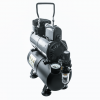
It’s a lovely finish. Can I ask which compressor you use please?

John
I don't now what John uses but I bought one of these from a fellow WT'er

Sparmax TC-610H​


I wish I had bought one many years earlier, it is great. I have several airbrushes acquired over the years, but my go-to is a couple of Iwata, one was an eBay special and the other was a generous birthday present. I have quick-connectors on the hoses.

The compressor transformed my pleasure of airbrushing from an "oh if I must" to a "ooh good" moment.
 

Rob Pulham

Western Thunderer
For a recent birthday I received a Gaahleri Swallowtail trigger type airbrush which comes with three needles/nozzles 0.2mm 0.5mm and 0.7mm and a couple of cup sizes

https://www.amazon.co.uk/Gaahleri-Airbrush-Ace-GHAC-Swallowtail-Rex/dp/B0CY1PWQN7

So far I have only tried the 0.7mm needle, spraying acrylics but I am really impressed with just how controllable it is. I have even successfully sprayed the cheapest craft shop acrylics (Anitas Acrylics) without issue.

I also have an Iwata Revolution with a 0.5mm needle and an el- cheapo chinese airbrush which feeds from a jar but I suspect that they won't get much use going forward.

My compressor is an Iwata, it wasn't cheap but thoroughly recommended.
 

John TAYLOR

Western Thunderer
I still want to airbrush another wagon , but I`m pleased and confident I have found the right (non acid) metal/brass etch primer together with two quality acrylic primers in black, grey and white.

Ultimate products make an excellent airbrush thinner and cleaner for all the acrylic paints I will use.

I have also discovered a `home made` method for an economic acrylic paint airbrush cleaner , although an important and effective cleaner in my arsenal is hot distilled water +/- 1-2 drops washing up liquid. ( find a plastic container with long tube and heat in the microwave before airbrushing)

I`ve retired my 40 year use of Badger airbrushes as these replacements atomize paint to the next level........

P1010318.JPG

They are the `new Chinese kids on the block` from Gaahleri and have a new novel design of Multiple Air Channel nozzles together with PTFE seals at ALL paint contact areas.
 

John TAYLOR

Western Thunderer
Further experimentation:-

Contact with SMS via Facebook as they are an Australian Company regarding whether I am able to add colour to their Etch Primer so I can see what I`m covering .

It can be mixed with one of their Lacquer Paints.....

20241030_122331.jpg


Makes life a lot easier..............

20241029_205016.jpg


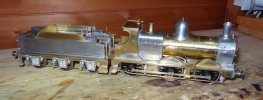
And so, I feel confident enough now, to carry out a first for me, in using acrylic paint on this long finished loco kit..................


DSC05059.JPG

watch this space !!!!
 

Mike Trice

Western Thunderer
One of the problems I found with acrylics is they are easily scratched and/or rubbed off. Have you been able to test this using your chosen approach?
 

John TAYLOR

Western Thunderer
One of the problems I found with acrylics is they are easily scratched and/or rubbed off. Have you been able to test this using your chosen approach?
Hi Mike,

Modern Acrylics IMO should`nt really be easily rubbed off, they might possibly get chipped, but not rubbed.

So far, to achieve a more reliable, and hopefully a better hard wearing result, with airbrushing : I am hopefully getting results with the following plan. Based on the vast experience of long standing modellers in areas other than railway modelling who IMO often get stuck in the past...... oops !!

Acrylic Etch primer base.

Quality self levelling Primer coat.

Appropriate Acrylic livery coat.

Quality gloss acrylic coat to transfer application areas.

Final quality acrylic varnish clear coat for increased protection.

All the above need to be thinned well ( thinner than skimmed milk ) as usually promoted and applied at lower psi according to the type of product choice. And applied in light coats until the required finish is obtained. Read the instructions on Primers.

An advantage, is that nearly everything is quick drying ( although the self levelling primer coat should be left for 24 hours if rubbing down is required)

My testing application is underway : and is both the two wagons which will be compared to an enamel/acid etch primer example when I scrape the wheel treads clean......

......and a test brass piece I am working on and will also be tested by scratching with a coin after all the above coatings have been applied.

20241031_192536.jpg

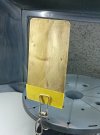
I have airbrush the acrylic etch primer to half of the above brass sheet which was cleaned with Viakal beforehand.
 

John Duffy

Western Thunderer
One of the things to take into account with acrylics is that whilst they dry very quickly, they harden very slowly. Once they are hardened, they will not rub off.

The only real issue I have, which you are in the process of addressing, is the adhesion to brass. I have so far stayed with an aerosol of self-etch primer, then sprayed on top.

Watching with interest.
 
Top