Liver & Fry's workbench

Liver & Fry

Western Thunderer
The last few days have seen progress on the bufferbeams and underframe, with drawhooks and L&Y 3-bolt buffers being fitted, as well as brake shoes and a coat of black underneath (minus the insides of the w-irons so not to cause friction on the spring carriers when fitted)

20260304_215755.jpg20260304_215500.jpg

Very close to having a rolling chassis now, and then it'll be a game of working from bottom to top, with axleboxes and springs, followed by solebar detailing and then metal strapping and details such as hinges on the body, before finally fitting a roof. I have a week of leave starting Monday so hopefully I'll pick the pace up a little more!

- James
 

Liver & Fry

Western Thunderer
Well, I said I was hoping to make the most of some free time and I sure have!

Earlier this week I was able to fit the wheels, springs, solebar detailing and make a start on the bodyside ironwork:

20260311_221353.jpg

Then today I have fettled and fitted the axlebox covers, as well as all the ironwork on one side, giving a strong flavour of what the finished van will look like!

20260313_192706.jpg

As can be seen, I still need to do the brake levers on both sides, as well as the ironwork on the other side (although this is all pre-cut and ready to go) along with the end detailing (namely brake pipes and lamp irons) BUT it's coming along very nicely now and I'm certainly enjoying building this one!

- James
 

Liver & Fry

Western Thunderer
Brake levers, various pipes and lamp irons have been added to each side/end, meaning that, with the exception of a roof, the build is physically complete!

20260317_213929.jpg

I've also found what I am hoping is a suitable shade of pink, which is currently on its way to me in the post. I will do a test swatch before I commit to it, but hopefully I'll be able to present this van in a prototypically garish fashion before much longer!

- James
 

Liver & Fry

Western Thunderer
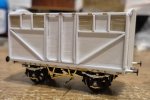
We have a roof!

20260319_212923.jpg

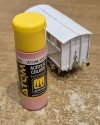
And we have a shade of pink...

20260319_213535.jpg

This is a pretty close match to the shade sometimes used on the cover of the L&YR Society 'Platform' magazines, with the van colour being quoted as "a pale pink very similar to the colour on the cover of this issue" in the article on both diagrams of Meat Van. Below is an RGB pull from the cover of 'Platform 32':

Screenshot_20260316_175718_Chrome.jpg

I told you it was going to be garish! But it will also be prototypical, and that's the important bit...

- James
 

James

Western Thunderer
20260319_212923.jpg
That's rather lovely!
 

Liver & Fry

Western Thunderer
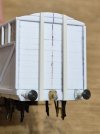
One final set of finishing touches and that is the physical build of this Dia.49 complete!

20260322_220040.jpg

Those being some end corner strapping and the two torpedo roof vents.

The drawing I have been using shows four vents on the roof. However, this is representative of ten examples built to Order F43 in 1908; the twenty examples built in 1901 to Order E32 featured only a pair of torpedo vents, mounted along the centre line. The one photo of a Dia.49 that I am aware of, shows a van from this earlier batch. It also offers something visually different when compared to the previous special traffic vans I've built (the Dia 64 and Dia.72, which both have four vents).

Time to crack out the paintbrush I reckon...

- James
 

Liver & Fry

Western Thunderer
Prepare yourselves by putting on some sunglasses because this one is rather bright!

Having finished the physical build, the whole van received an undercoat in Revell 35 'Flesh' (I did a test patch first using 'flesh' and white and the flesh base gave a better finish to the pink). It does however look more yellow in this photo than it did to the eye, but you get the idea!

20260324_201021.jpg

Then came the pink...

20260325_213217.jpg

It was at this point that I could be heard muttering "but it's so pink" to myself for the next day or so...

Before I continue, in case anyone missed my builds of the Dia.72 fish, Dia.64 butter and Dia.60 gunpowder vans, I have consistently painted the roof the same colour as the body, as this is what is quoted as having been done on the fish vans in real life, and what I have seen others replicate on the gunpowder vans (for those in the red camp, anyway!) and so logic dictates that the same practice would have been applied to the other special liveried vans.

With that in mind, the black ironwork and underframe followed:

20260326_220022.jpg

At this point I was beginning to question my own sanity, but once I applied lettering in the next stage, it suddenly looked better (to me, anyway):

20260327_164352.jpg

Some liberties have had to be taken with number and letter positioning, as no clear photos exist of a Dia.49 to show this. I have tried my best to apply lettering based on what is known from the other specialist vans, particularly the refrigerator vans that were built in the preceding batch (Order D32).

The number, 29370, was chosen on the basis that 29359 was a refrigerator van to Order D32, which consisted of ten vehicles. I do not know, however, where this appeared within those ten. As Order E32 consisted of 20 meat vans, I went just past ten above '59 to ensure I was definitely in the E32 number range.

So there we have it! It's certainly the brightest thing I've ever built, but it's also one I hope you will forgive me for having a little self indulgence for, as I'm honestly rather proud of it, being my first scratch built model!

I will endeavour to get a photo of it with the other vans, but beyond that, the next post will take us on to the next project (which as you will see, is fortuitously timed!).

- James
 

Marc Dobson

Western Thunderer
Shrimp pink as I said before not the most unusual colour. Looks very good. Now I know what all the Black LYR decals in the HMRS sheet are for. For the record the LSWR vans were originally wagon brown with while letters but they were repainted quite quickly to shrimp pink with red letters.
 
Lewis Merthyr Consolidated Collieries Ltd wagon New

Liver & Fry

Western Thunderer
Just after midnight on 4th April 1912, the White Star Line's newest vessel, the RMS Titanic, arrived in Southampton to prepare for it's maiden voyage to New York on 10th April.

When she left Belfast on 2nd April, she carried 1880 tons of coal, but would require considerably more to make the voyage.

At the same time, between 28th February and 6th April 1912, the UK was undergoing its first national coal strike which had resulted in several other transatlantic crossings being postponed, and vessels laid up. As such, a good portion of coal was transferred from other White Star vessels, such as Adriatic and Oceanic, but Titanic would go on to take 4427 tons on 5th April, giving a total of 5892 tons when it departed on 10th April (allowing for that burnt on the voyage from Belfast and whilst stationary in port).

The White Star Line sourced it's coal from Lewis Merthyr Consolidated Collieries Ltd in the Rhondda Valley, Wales, and Titanic was no different, with the rest of the coal coming from here. As such, coal would have been supplied to Southampton in the collieries own wagons.

Research has shown these to be a mix of six and seven plank end door opens with internal strapping, matching designs by Gloucester. In particular, one very clear photo from 1909 shows a 15' seven plank example.

Screenshot_20250615_131055_Chrome.jpg

(Source: Lewis Merthyr Colliery, photograph - Collections Online | Museum Wales ).

Having had a fascination with Titanic for almost as long as I have railways, it seemed like an appropriate crossover to model such a wagon, with now, in the month of April and having just returned from a trip to Belfast to visit the Titanic Museum, seeming like an equally appropriate time to start this build.

I have been planning this one for a little while, and when I first started researching this I sought to identify if such a wagon was available.

That was when I discovered Meow Valley Models, who produce a range 3D printed wagon kits, with an apparent focus on Gloucester and Charles Roberts types.

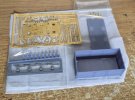
So with that, here is their kit for a Gloucester 15' seven plank open:

20260405_135714.jpg20260405_135747.jpg
20260405_135800.jpg

These have been designed with Brassmaster chassis kits in mind, of which I have also acquired the appropriate etch.

First impressions are positive. The print is very crisp and detailed, and I look forward to building it.

- James

 

simond

Western Thunderer
As a slightly askew aside, what is the appliance on the horse’s tail?

the tail has obviously been cut short, which was not unusual, but there appears to be some sort of grip part way down, which seems very strange to me. I’m far from an equestrian expert but I have ridden, and been around horses, for sixty some years…
 

Rob R

Western Thunderer
As a slightly askew aside, what is the appliance on the horse’s tail?

the tail has obviously been cut short, which was not unusual, but there appears to be some sort of grip part way down, which seems very strange to me. I’m far from an equestrian expert but I have ridden, and been around horses, for sixty some years…
Looks like something tied around the tail?
 
Just after midnight on 4th April 1912, the White Star Line's newest vessel, the RMS Titanic, arrived in Southampton to prepare for it's maiden voyage to New York on 10th April.

When she left Belfast on 2nd April, she carried 1880 tons of coal, but would require considerably more to make the voyage.

At the same time, between 28th February and 6th April 1912, the UK was undergoing its first national coal strike which had resulted in several other transatlantic crossings being postponed, and vessels laid up. As such, a good portion of coal was transferred from other White Star vessels, such as Adriatic and Oceanic, but Titanic would go on to take 4427 tons on 5th April, giving a total of 5892 tons when it departed on 10th April (allowing for that burnt on the voyage from Belfast and whilst stationary in port).

The White Star Line sourced it's coal from Lewis Merthyr Consolidated Collieries Ltd in the Rhondda Valley, Wales, and Titanic was no different, with the rest of the coal coming from here. As such, coal would have been supplied to Southampton in the collieries own wagons.

Research has shown these to be a mix of six and seven plank end door opens with internal strapping, matching designs by Gloucester. In particular, one very clear photo from 1909 shows a 15' seven plank example.

View attachment 261098

(Source: Lewis Merthyr Colliery, photograph - Collections Online | Museum Wales ).

Having had a fascination with Titanic for almost as long as I have railways, it seemed like an appropriate crossover to model such a wagon, with now, in the month of April and having just returned from a trip to Belfast to visit the Titanic Museum, seeming like an equally appropriate time to start this build.

I have been planning this one for a little while, and when I first started researching this I sought to identify if such a wagon was available.

That was when I discovered Meow Valley Models, who produce a range 3D printed wagon kits, with an apparent focus on Gloucester and Charles Roberts types.

So with that, here is their kit for a Gloucester 15' seven plank open:

View attachment 261100View attachment 261101
View attachment 261102

These have been designed with Brassmaster chassis kits in mind, of which I have also acquired the appropriate etch.

First impressions are positive. The print is very crisp and detailed, and I look forward to building it.

- James
Will you be using POW transfers I see they have a couple of versions for Lewis Merthyr Colliery I can see?
 
Top