Prototype Tim Mills' Photos

oldravendale

Western Thunderer
Thank you Paul @hrmspaul and Dave @Yorkshire Dave for so much info about the southern end of the MML and Tony @76043 for the confirmation about the location. All carefully preserved. Your warning about AI is well taken, Paul - see my own experiences just to come. Incidentally, I have very pleasant memories of Elstree Station before I had any meaningful interest in railways as a dear aunt and uncle, who bought me my first "Observers Book of Locomotives" in 1954 lived in a flat very close to the station. My sister and I were allowed to visit the station on our own to "collect train numbers". I guess the year would have been between 1951 and 1953. I still have the images of the Garratts imprinted on my memory cells and always wanted to see one whenever we went to the station. How I wish I still had those tatty bits of paper with the numbers...

That's a very cruel (but absolutely accurate) comment about the Viva, Simon @simond ,

Thanks to you as well, Roger @Roger Pound for the background to the Class 45/46 question.

Shunter 08 194 probably photographed from the train on the way to Cardiff on an unknown date. It was introduced when new on 20 August 1956 as 13264 to Duffryn Yard and moved to Neath (Court Sart) in the following November/December. From there it went to Cardiff East Dock in July/August 1957 and was renumbered to D3264 at Swindon on 8 September 1961. It then went to Cardiff Cathays in October/November 1962 and Cardiff Canton in November 1964 and was renumbered again to 08 194 in April 1974 and withdrawn on 8th November 1980. Finally it went to Swindon Works where it was scrapped on 29th October 1983. I have no information about dates of livery changes. (BR Database)

img165 TM 08194 Cardiff Date Unknown copyright Final.jpg

At an unknown date Class 47 47079 George Jackson Churchward probably at one of the Cardiff sheds. This loco was introduced as D1664 in two tone green livery with a small yellow warning panel at Landore on 27th February 1965. I have no details of later livery changes. It was named George Jackson Churchward on 8th May 1965. It moved to Cardiff Canton in February/March 1966 and back to Landore in July/August the same year, then to Old Oak Common in December 1972 at which time it became 47079 in February 1974. It was back at Cardiff Canton in October 1976 and there is a second allocation to Canton on 4th October 1987 – whether it was reallocated in the meantime I do not know. The loco became a Class 57, No 57009, on 22nd December 1999 when it was renamed Freightliner Venturer and it remains in service. (BR Database)

img166 TM 47079 George Jackson Churchward Cardiff Shed Date Unknown copyright Final.jpg

37285 was D6985 in green with a yellow warning panel when introduced at Cardiff Canton on 27th May 1965. It was painted blue in February 1969 after a period as green with full yellow cab front or nose by August 1968 and renumbered 37285 in March 1974. In October 1987 it moved to Inverness and was withdrawn on 1st August 1994 being scrapped at Immingham by Raxstar in May 2000 but not before being renumbered 37335 in September 1994 while being stored for component recovery. (BR Database and Class37.co.uk)

By the way, don’t believe anything AI tells you… (I’m not suggesting anyone does!) According to AI 37285 was originally D6884 but if you ask for the TOPS number of D6985 it gets it right!
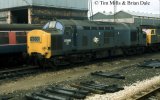
img167 TM 37285 Cardiff Date Unknown copyright Final.jpg

Brian
 
Last edited:

Yorkshire Dave

Western Thunderer
It could well be the Cardiff photos were taken around the mid 1970s, possibly on an excursion or railtour. During the 1970s and early 1980s British Rail ran a fair number of excursions and rail tours all over the network on weekends and bank holidays. London Midland region marketed theirs as 'Merrymakers' and the Southern Region as 'Pleasure Seeker'. Not sure what the other regions marketed theirs as.
 

Northroader

Western Thunderer
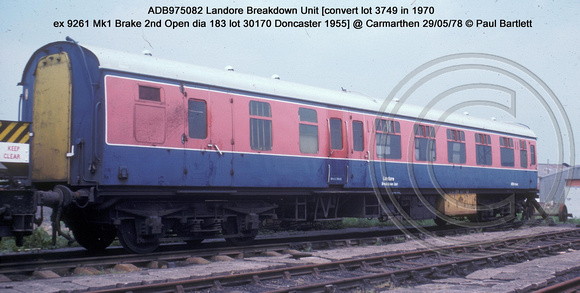
The breakdown train at Canton needed replacing after it got plastered inside with 3500’ oil after a derailmenxt at Ebbw Vale. We adapted surplus Mark 1 BSK at Cathays, which had the blue and grey paint scheme. The Corporate BR Image handbook said service vehicles blue and red, so the grey panel was overpainted. Derby Research saw it and objected that was “their” livery, and there was another specification the main works were using which said breakdown coaches overall red, but the Canton coaches kept the red and blue.
 

oldravendale

Western Thunderer
Cor! I reckon we'll never get closer to a primary source of information than your comment here, Northroader. That's wonderful and thank you. Thanks to @hrmspaul for kicking that ball off as well and for the info about the LMS BG.

I remember the Merrymakers, Dave, and travelled on one or two myself, notably a trip to York which was electric hauled to Preston, then a Class 40 through beautiful scenery and mill towns to get to the ECML. I wish I could remember the route in detail as it was a wonderful trip. Our son was two years old...

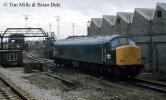
45042, the erstwhile D57, suggested to be at Cardiff but bearing in mind it was introduced to the Nottingham Division when new on 17th June 1968 and moved to the London Division in September/October 1972 I wonder whether the location of this photo was actually somewhere on the MR main line. It was renumbered in December 1974. At the time of introduction it was green with small yellow panels, probably a centre split headcode panel and a white bodyside band at the base of the body. It was repainted blue with small yellow warning panels by August 1968 and had a full yellow cab front by March 1970. The headcode panel was removed and replaced with marker lights probably at some time after the end of 1975. The loco was allocated to Toton in March 1978 and withdrawn on 29th April 1985 going to Vic Berry at Leicester where it was cut ip by the end of January 1987.

According to AI on Google D57 became 40057. Or, if you try from the other end and ask about 45042 it advises it was originally D82. I wonder whether someone is deliberately inputting spurious data to confuse.

This information above has been cobbled together from a number of sources including BR Database, Classes 44, 45 & 46 data and class 45 and 46 headcode panels and I’ll be pleased to receive any later and corrective data. (You’ll note, not from AI/Google!)

Edit: I'm changing my mind about the potential location of this photo - I suspect it might in fact be Cardiff. Looking in the background of the photo that water tank looks decidedly GWR to my eyes.

img168 TM Poss 45042 Cardiff Date Unknown copyright Final.jpg

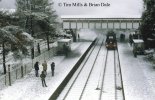
I’ve searched on Six Bells Junction for information about this train which, from the slides in this particular box and bearing in mind the weather conditions were probably all exposed on the same day. However, the info I have gathered is this:

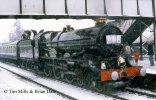
The train was probably hauled by both 6000 King George V and Black 5 5000 (see next post). The reporting number was Z16, at least for the portion headed by 6000 which was photographed at Church Stretton. The date is not recorded. The history of the King is here: 6000 King George V

img169 TM 6000 Church Stretton Undated copyright Final.jpg

img171 TM 6000 Church Stretton Undated copyright Final.jpg

img177 TM 6000 Church Stretton Undated copyright Final.jpg

img172 TM 6000 poss Church Stretton Undated copyright Final.jpg

img178 TM 6000 prob leaving Church Stretton Undated copyright Final.jpg

Brian
 
Last edited:

oldravendale

Western Thunderer
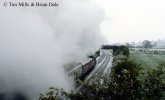
I’m guessing that this may be the same train as the one above but Black 5 5000 carries an unreadable headboard but no reporting number. Date is again unknown. Information about the Black 5 is here: 45000 (LMS 4500 & BR 45000)

img170 TM Prob 5000 at prob Church Stretton Undated copyright Final.jpg

img173 TM 5000 location NK Undated copyright Final.jpg

img174 TM 5000 Undated copyright Final.jpg

img179 TM 5000 location NK Undated copyright Final.jpg

I’m of the opinion that this photo of an unidentified Class 25 diesel is at Church Stretton on the same day as the rail tour in the two previous posts. However that date is not known.

img176 TM Unidentified Class 25 prob Church Stretton Undated copyright Final.jpg

Brian
 

AJC

Western Thunderer
Yes, definitely Church Stretton, still recognisable, but obviously different (NB - I hadn't realised that the station had been moved as long ago as 1914):


2560px-Church_Stretton_old_railway_station.JPG


Image by David Jones, CC BY-SA 3.0, File:Church Stretton old railway station.JPG - Wikimedia Commons

Adam
 

hrmspaul

Western Thunderer
The breakdown train at Canton needed replacing after it got plastered inside with 3500’ oil after a derailmenxt at Ebbw Vale. We adapted surplus Mark 1 BSK at Cathays, which had the blue and grey paint scheme. The Corporate BR Image handbook said service vehicles blue and red, so the grey panel was overpainted. Derby Research saw it and objected that was “their” livery, and there was another specification the main works were using which said breakdown coaches overall red, but the Canton coaches kept the red and blue.
That is interesting. although by the mid 1970s a breakdown coach should have been painted yellow, the red had been dispensed with some years earlier (Peter Tatlow has recorded this in detail in a HMRS Journal article associated with the release of his Breakdown crane books). I had wondered why a breakdown train had copied the official Research Dept. livery, it did seem out of place.

This is a Landore example, a conversion of 1970 would suggest the alternative of all over red would be correct.

Paul
 
Last edited:

Yorkshire Dave

Western Thunderer
Edit: I'm changing my mind about the potential location of this photo - I suspect it might in fact be Cardiff. Looking in the background of the photo that water tank looks decidedly GWR to my eyes.

img168 TM Poss 45042 Cardiff Date Unknown copyright Final.jpg

It is Cardiff Canton.

Apart from the Midland Main Line, in this period class 45/46 Peaks wouldn't be unusual at Cardiff or Bristol as they were the mainstay of NE/SW cross country services such as Newcastle/York - Bristol/Cardiff as well as trans-Pennine services such as Newcastle/Scarborough - Liverpool.
 

oldravendale

Western Thunderer
Thank you for confirmation of locations, Adam @AJC , Tim @Tim Lewis and Dave @Yorkshire Dave . Also Paul @hrmspaul for more information about the breakdown train.

Sketchy details again but I’m pretty confident these four photos are on the ECML and probably somewhere around Hornsey on the same day.

31411 was introduced as D5691 on 15th March 1961 at Sheffield Darnall in green with white bodyside bands at base and middle of body. In June 1969 it received full yellow cab front but remained green. I have no definitive date for the repaint to blue. It became 31411 in February 1974 and 31511 at the end of May 1990. It was a well travelled loco being based at March in September 1962, back to Sheffield Darnall in January 1963 and then Tinsley on 26th April 1964. From there it went to Immingham in March 1966, Gateshead in March 1972, Finsbury Park in April 1976 and Crewe on 15th May 1988 where it was withdrawn on 30th November 2005. It was broken up by Ron Hull Junior, Rotherham. (BR Database).

img180 TM 31411 poss ECML Undated copyright Final.jpg

31404 and I suspect again on the ECML somewhere near Hornsey at an unknown date. The loco was introduced to Hornsey on 7th April 1960 as D 5605 and at that time in green with white bodyside bands at the base and middle of the body. It had a full yellow cab front by July 1969 but I have no details about when it was painted blue. It was initially classed as a 30/2 but became a 31/1 in April 1966 and then a 31/4 in March 1974. In April 1960 it moved to Finsbury Park, Stratford in January 1961 and back to Finsbury Park in May/June 1961 before moving to Crewe on 15th May 1988 where it was withdrawn on 21st February 1991. It was scrapped at C F Booth, Rotherham, in March 1994. (BR Database).

img181 TM 31404 poss ECML Undated copyright Final.jpg

Obviously a busy time with two class 313 units and an HST, probably near Hornsey on an unknown date. The only unit I can identify is 313014 a Dual voltage pioneer class EMU.

img182 TM 313 014 on left An HST and two Class 313s Undated copyright Final.jpg

This loco was introduced to Gateshead as D246 on 20th November 1959. At the time it was green including front of the cab but by July 1971 was blue with full yellow cab front and was renumbered to 40046 on 5th January 1974. It had a string of allocations after Gateshead starting with Thornaby in October 1964, Healey Mills January 1967, Springs Branch (Wigan) October 1967, Allerton May 1968, Liverpool Division on 17th June 1968, Preston Division May 1970, Healey Mills (again) April/May 1971, Springs Branch (Wigan) again January 1976, Carlisle Kingmoor April/May 1976, and finally Healey Mills where it was withdrawn on 20th February 1983. It then went to Vic Berry, Leicester where it was scrapped in June 1987. (BR Database).

Edit: Erroneously attributed to "somewhere around Hornsey". See evidence below.

img183 TM 40046 prob ECML see overhead wires Undated copyright Final.jpg

Just as a by the way... I continue to scan Tim's slides. I'm very nearly at 4000 colour slides I'm calling "Transport" as they include railways, traction engines a few cars and motorcycles and a lot of buses. Tim appears to have been obsessed with Routemasters. Apart from those there are well over 1000 family photos and a couple of thousand "Scenics" which don't fall in to the other categories. Many are quite pedestrian but some are crackers...

Brian
 
Last edited:

Yorkshire Dave

Western Thunderer
The ECML photos will be commensurate with the previous ones around 1976/78 to 1980 or so.

As for the class 40 we could have moved on a few years to the 1980s. Initial guesses could be Stewartby (south of Bedford on the MML) or Fletton south of Peterborough on the ECML) looking at the four red brick chimneys in the background. Both of these areas had brickworks.

There are not many areas on the ECML and MML north of London where there are greater than four tracks.

At this period the ECML was being electrified from Hitchin to Leeds and the MML was progressing from St Pancras/Moorgate to Bedford. It's hard looking at the OS maps as the latest 1:1,250 and 1:1,500 editions are to the mid 1970s and we are now seeing newer housing estates.
 

40057

Western Thunderer
The ECML photos will be commensurate with the previous ones around 1976/78 to 1980 or so.

As for the class 40 we could have moved on a few years to the 1980s. Initial guesses could be Stewartby (south of Bedford on the MML) or Fletton south of Peterborough on the ECML) looking at the four red brick chimneys in the background. Both of these areas had brickworks.

There are not many areas on the ECML and MML north of London where there are greater than four tracks.

At this period the ECML was being electrified from Hitchin to Leeds and the MML was progressing from St Pancras/Moorgate to Bedford. It's hard looking at the OS maps as the latest 1:1,250 and 1:1,500 editions are to the mid 1970s and we are now seeing newer housing estates.
The catenary looks more like that on WCML to me.

Martin
 

mickoo

Western Thunderer
Four photos of unidentified Deltics believed to be at Hornsey although unconfirmed. Date unknown. The final shot shows Class 313 EMU units in the background.

View attachment 255412

View attachment 255413

View attachment 255414

View attachment 255415
Brian

Brian,

55 022 single wipers and dent in the nose, photo is post Sept 79 when wipers were changed from double to single.
55 009 single line nameplate (short), no crest and single wipers (may 79 ish onward) number has been wiped clean and just visible when you blow it up, certainly a 00 number and only 9 fits. 009 had a white cab roof by Jan 80.
55 016 single line nameplate, no crest double wipers. Cast crest was removed around 79 and sticker one added 80/81
55 021 double wipers and paint flake on nose.
 

Yorkshire Dave

Western Thunderer
The catenary looks more like that on WCML to me.

It's definitely ECML or MML simple catenary. It's easy to be confused by the lattice signal gantry as you can see the walkway and safety mesh. You can also see one of the catenary wire tensioners anchored on the tall mast.

All are my photos below to illustrate the differences.

WCML catenary in the original electrification to Manchester, Liverpool and Crewe was of the compound type with lattice gantries and heavier insulators with the registration arms mounted from the gantries (Watford Junction).
WCML catenary S.jpg

When the WCML was electrified from Crewe to Glasgow then a simple catenary was used with lighter insulators and the registration arms mounted from the wire cross spans (Penrith).
WCML catenary N.jpg

MML simple catenary (Site of Ampthill station closed 1959).
MML catenary.jpg

ECML simple catenary (Biggleswade).
IC225 Biggleswade 1991-1996.jpg
 

40057

Western Thunderer
It's definitely ECML or MML simple catenary. It's easy to be confused by the lattice signal gantry as you can see the walkway and safety mesh. You can also see one of the catenary wire tensioners anchored on the tall mast.

All are my photos below to illustrate the differences.

WCML catenary in the original electrification to Manchester, Liverpool and Crewe was of the compound type with lattice gantries and heavier insulators with the registration arms mounted from the gantries (Watford Junction).
View attachment 255952

When the WCML was electrified from Crewe to Glasgow then a simple catenary was used with lighter insulators and the registration arms mounted from the wire cross spans (Penrith).
View attachment 255951

MML simple catenary (Site of Ampthill station closed 1959).
View attachment 255950

ECML simple catenary (Biggleswade).
View attachment 255953
You’re right. It’s a signal gantry. So ECML or (less likely for a 40) MML.
 

mickoo

Western Thunderer
The ECML photos will be commensurate with the previous ones around 1976/78 to 1980 or so.

As for the class 40 we could have moved on a few years to the 1980s. Initial guesses could be Stewartby (south of Bedford on the MML) or Fletton south of Peterborough on the ECML) looking at the four red brick chimneys in the background. Both of these areas had brickworks.

There are not many areas on the ECML and MML north of London where there are greater than four tracks.

At this period the ECML was being electrified from Hitchin to Leeds and the MML was progressing from St Pancras/Moorgate to Bedford. It's hard looking at the OS maps as the latest 1:1,250 and 1:1,500 editions are to the mid 1970s and we are now seeing newer housing estates.
It's not Peterborough as that was electrified in 1989 and the 40 was scrapped in 83, it's also a bit too hilly for the fens.

Added to that there's an embankment running 90° to the tracks by the houses and almost certainly a closed railway line.

What's throwing me are the wooden sleepers, by this date I'd have expected concrete on both ECML and MML.

The date is pre 1983 so that kind of rules out the ECML and MML extensions and that catenary is not new nor that track bed and I cannot recall ever seeing a 40 on the MML, not to say it didn't happen but odds are stacked against it.

My gut feeling is WCML in the Warrington area, all the photos I have of 46 are Preston, Warrington Lancashire, Cheshire area. I'll do some Google flying later.
 

mickoo

Western Thunderer
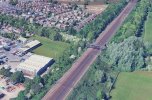
40 046 is at Preston, just south of the station. The four chimneys are Ribble power station on the river Ribble near Preston docks, there are still HV pylons radiating out from that area today

What threw me was the obvious signal bridge and catenary droppers, turns out there's two structures right next to each other and they still exist, as does the old track bed and housing estate.

Image0.jpg

Image.jpg

Image2.jpg

Addendum, Ribble Power Station, demolished in 1983.

599074745_122229187292102439_8864372523667633036_n.jpg
 
Last edited:
richard carr

Western Thunderer
I'm in agreement with Mick, 40's on the south end of the ECML were not a frequent event, the Bradford newspaper train did sometimes get one but that was the only reasonably regular working. On the south end of the MML pretty rare, that was Peak country.
That's far more likely to be the north west of the country, those chimneys look just like those that Fred Dibner spent his life taking down.

Richard
 
Top