Prototype South African 2ft. gauge railways

David Waite

Western Thunderer
Hi Phil
I noticed on the sides of various vehicles there are many small steel rings some positioned at different levels on different vehicles around the sides and ends you said a tarpaulin was used to water proof a vehicle are these rings for this if so some had a roof but still had these rings why would this be. Fascinating photo’s thank you for sharing them.
David
 

PhilH

Western Thunderer
Hi Phil
I note that some wagons were built by Barlow Heavy Engineering and some by Barlow Head-Wrightson, What was the tie-up with Head-Wrightson? I ask as I have had many encounters with Head-Wrightson strip handling equipment during a lifetime working for British Steel and its successors in South Wales.
Keep the photos coming, they are amazing!
Cheers
Dave

Dave,
I don't know and I was curious about that myself, but a quick search of the internet didn't provide the answer. The firm still exists apparently as Barlows Heavy Engineering Ltd. at Benoni, just to the east of Johannesburg, and list railway rolling stock manufacture as one of their activities. Presumably there was some tie up with Head Wrightson in the past when the two earlier vans shown in the first two photos were built, and the build details would have been taken off plates on the actual vehicles.

Hi Phil
I noticed on the sides of various vehicles there are many small steel rings some positioned at different levels on different vehicles around the sides and ends you said a tarpaulin was used to water proof a vehicle are these rings for this if so some had a roof but still had these rings why would this be. Fascinating photo’s thank you for sharing them.
David

David,
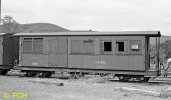
The rings are indeed for tarpaulins and later on when we come to the Natal lines I'll show a photo of one of the USATC vans fitted with a tarpaulin. On the Avontuur line the vans were mainly used for the transport of fruit and it seems to have been the practice to sheet over the loaded vans, possibly as a form of insulation and maybe dependent on the weather temperature. Richard Hay's recent mainly pictorial book on the Avontuur Railway shows several trains with sheeted over vans, some with an entire train of 11 vans all so fitted. In later years some of the vans had the sides removed to permit pallet loading and the sides were then covered with a drop down tarpaulin sheet.
 

PhilH

Western Thunderer
Along the line from Humewood Road:


56. Chelsea B © PGH.jpg
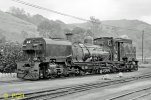
Chelsea was the junction for the private 12 mile long branch to the Eastern Province Cement Company's works, the ultimate destination for the limestone trains on the Avontuur line. In September 1973 the EPCC Hunslet Taylor 6wDM loco that normally worked the branch was under repair and the Baldwin 4-6-2 kept as spare had been in use. Unfortunately in August about three weeks before my visit the Baldwin had been left unattended and ran away off the end of a siding causing damage to its front end and tearing off the front bogie of the loco and front bogie of the tender. I found it back in the shed and a NG15 hired from SAR was working the line. The Baldwin was subsequently sold for scrap but purchased for preservation in the UK by Tony Hills and fully restored for use on the Brecon Mountain Railway. Shortly after two secondhand Funkey diesel locomotives were obtained by EPCC to work the branch and these were also later imported to the UK, one for use on the Festiniog Railway (rebuilt with modified bodywork to the FR loading gauge) and the other for use on the Welsh Highland Railway.

An account of the limestone traffic and details of the locomotives used by both SAR and EPCC, together with drawings of locomotives and rolling stock, was published by the Narrow Gauge Railway Society in 2006 under the title "Narrow Gauge Superpower". The title emanates from the latter years of the limestone traffic when on the steepest section of line three of the diesel locos were used in multiple on trains of 33 loaded wagons.


57. 16521B © PGH.jpg

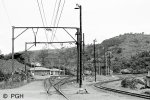
Chelsea - view towards Humewood Road, the EPCC line branches off to the exchange sidings on the left.


58. SAR 091B © PGH.jpg

NG19 in trouble - after leaving the EPCC sidings with an empty limestone train the loco is stopped on the main line with a derailed tender bogie.


58a. 16522B © PGH.jpg

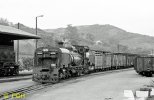
The train is composed of 12 class DZ wagons and a brake van, the first two wagons have no side extension "boards" the next two have one and the fifth wagon has two. Wagons were emptied at the cement works by dropping the doors on one side and shovelling out the contents. In 1976-7 a fleet of 200 new C class wagons were introduced with Willison automatic couplers to match the diesel locos, and these were then emptied at the works by means of a rotary tippler.


59. 16524B © PGH.jpg

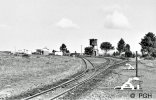
Greenbushes, the next station west of Chelsea, view towards Humewood Road. On the main line the station is marked only by a sign and small shelter, and access is from a road crossing the line on the level just behind the camera. The goods loop has a pen for livestock loading and a small goods shed on a short platform. The weight on the point lever in the foreground has been painted white/red to indicate the route - with white uppermost the point is set for the main, with red uppermost it is set for the loop. Instead of catch points there are hinged levers painted white fixed across one rail at each end of the loop. The steel sleepers scattered to the right of the main line were in preparation for relaying the line with new 60lb rail.


60. 16525B © PGH.jpg

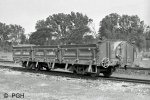
Open Wagon DZ2867 in the loop.


PhilH

Western Thunderer
60a. Van Stadens B © PGH.jpg

Van Stadens Station was situated on the east side of the Van Stadens Viaduct. Limestone trains usually consisting of 8 DZ class wagons and a brakevan worked from the ropeway terminal at Loerie up the 1 in 40 gradient to Summit and on to Van Stadens, where the wagons were left in one of the four loop lines behind the station building or the loop line with the loading bank. The loco then returned to Loerie with the brakevan for another 8 wagons, and when these reached Van Stadens the two trains were combined for the downhill run to Chelsea.


61. 16526B © PGH.jpg

Van Stadens Station from the west end


62. 095B © PGH.jpg

NG120 on a mixed train approaches the station on the short uphill climb from the Van Stadens Viaduct.


63. 16528B © PGH.jpg

NG120 taking water from the tank at the east end of Van Stadens Station. NG120 was imported into the UK for the Welsh Highland Heritage Railway (Portmadoc) where it was allocated the name BEDDGELERT, but has since been sold on to a private owner.


64. 16530B © PGH.jpg

Although regular passenger services had ceased and the South African Railways timetable stated "Passengers are conveyed by road transport service", coaches were still attached to the rear of some trains such as this one. In addition to a tank wagon, several vans and a brake van, coaches NG65, NG50 and NG73 were attached to the rear and carrying passengers.


65. 16536B © PGH.jpg

4 compartment 3rd Class Coach NG65


66. 16535B © PGH.jpg

Brake Van V2812 with 2 compartments. The lettering on the compartment doors is a sign of the time. Noticeable on this view is the 2" gap between the van body and the frame, as the body sits on rubber blocks fixed to the 7 angle brackets on each side of the frame.


67. 16534B © PGH.jpg

1st/3rd Class Saloon Coach NG50


68. 16533B © PGH.jpg

2 compartment 1st Class Brake Coach NG73
 

PhilH

Western Thunderer
69. 16608B © PGH.jpg


70. 16605B © PGH.jpg

Class NG13 Garratt No.81 takes water from the tank at the west end of Van Stadens Station after arriving on a limestone train.


71. 094B © PGH.jpg
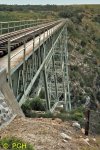
The Van Stadens Viaduct from the east (Humewood Road) end. At the far end the line curves sharply to the left and climbs up the hillside before the long descent down to Loerie. Its a steel trestle with an open deck and steel plate walkway on each side of the track, and with a maximum height of 254 feet is second only to the Victoria Falls Bridge as the highest railway bridge in Southern Africa. In the photo most of the height is hidden from view below the sides of the gorge and I walked far enough across it to see the bottom and the river below then quickly retraced my steps !

There is an excellent website covering the complete history of the South African 2ft gauge lines and South African Railways in general with many photographs, maps and track diagrams:
Soul of A Railway

But be warned - its what some would call a "rabbit hole", if the subject is of interest you could get lost for days in there.
 

timbowales

Western Thunderer
View attachment 206718


View attachment 206719

Class NG13 Garratt No.81 takes water from the tank at the west end of Van Stadens Station after arriving on a limestone train.


View attachment 206728
The Van Stadens Viaduct from the east (Humewood Road) end. At the far end the line curves sharply to the left and climbs up the hillside before the long descent down to Loerie. Its a steel trestle with an open deck and steel plate walkway on each side of the track, and with a maximum height of 254 feet is second only to the Victoria Falls Bridge as the highest railway bridge in Southern Africa. In the photo most of the height is hidden from view below the sides of the gorge and I walked far enough across it to see the bottom and the river below then quickly retraced my steps !

There is an excellent website covering the complete history of the South African 2ft gauge lines and South African Railways in general with many photographs, maps and track diagrams:
Soul of A Railway

But be warned - its what some would call a "rabbit hole", if the subject is of interest you could get lost for days in there.
Yes, I disappear down that particular warren frequently,
Tim T
 

PhilH

Western Thunderer
Port Shepstone is the terminus of the electrified 3ft 6in gauge line running south along the coast from Durban. From here a 2ft gauge line was built inland to Harding a distance of 76 miles in 1911-17.


Port Shepstone B © PGH.jpg

This rough sketch plan shows most of the 2ft gauge yard area with loco depot and transhipment facilities - two large sheds for general goods, an overhead crane for timber and a cattle dock. Sugar cane was dealt with at a separate yard to the north of the station (off this plan to the left)


1. 17632B © PGH.jpg

View from the 2ft gauge entry into the yard area with the line straight ahead to loco shed and station and line to left into the goods sidings.


2. 17636B © PGH.jpg

Sidings alongside the transhipment shed with wagons including Class DZ low sided open wagons with extended sides, Class B high sided open wagons and a tank wagon.


3. 17633B © PGH.jpg

NG13 Class Garratt No.49 shunting the narrow gauge yard.


4. 17635B © PGH.jpg

No.49 was built by Hanomag of Germany in 1928.


5. 17623B © PGH.jpg

The loco depot with a small shed that accommodated both 2ft and 3ft 6in gauge locos. The shed was more a repair facility than a loco shed as it only held one loco of each gauge.


6. SAR 207B © PGH.jpg

Outside the shed on the right is NG16 Class Garratt NG130 having a boiler washout and beyond inside the shed is NG16 Class NG154, which I noted as under repair, possibly only minor repair as the loco was then only 5 years old. NG130 is now in the UK, privately owned but on long term loan to the Welsh Highland Railway. The left hand road has the spare 3ft 6in gauge shunter - S2 class 0-8-0 No.3723. Although the main Durban line was electrified many of the sidings had no overhead wires and steam was still used for yard shunting.


7. SAR 211B © PGH.jpg

The working 3ft 6in gauge yard shunter - S2 class 0-8-0 No.3759.


8. SAR 208B © PGH.jpg

NG13 Class Garratt No.49 at the water column. With the drop from the spout to the tank hatch, filling the tank on a windy day must have been rather messy !
 

PhilH

Western Thunderer
9. 17618B © PGH.jpg

A slightly blurry view of No.49 crossing the 3ft 6in lines at the north end of the station. The 2ft gauge joined a 3ft 6in gauge branch for a short distance as mixed gauge track down to an exchange yard alongside the river, passing under the left hand side of the road overbridge. The line to the right is the main line to Durban, curving to the right out of view to cross the Umzimkulu River by a combined road/rail bridge just visible through the overbridge in the distance.


10. 17621B © PGH.jpg

View from the mixed gauge section of the branch towards the station.


11. 17619B © PGH.jpg

Looking the other way, after passing under the overbridge the 2ft gauge separated and both lines continued down to the exchange yard passing under another overbridge carrying the main coast road. The 2ft gauge line dropped directly down to the yard at a steeper gradient than the 3ft‑6in gauge line, which reached the yard via a reversal.


Port Shepstone (2) B © PGH.jpg

Continuation of the track plan from station to lower level exchange yard.


12. 17620B © PGH.jpg

Two Class 1E electric locos nos. E30 and E55 leave Port Shepstone on a freight train to Durban.
Just after taking this photo I was approached by a railway official for the first (and only) time on the trip. He said "do you have permission to take photographs on the railway". I said "Yes, I have a letter from the General Manager giving me permission to do so", getting ready to show him said letter if required, but he said "Oh, that's OK then", which was fortunate as the letter gave me permission to visit certain listed loco depots and take photographs there and to take photographs elsewhere but only where the public had access. Neither of course applied to exactly where I was standing, but I suppose the excuse could have been - "I'm a little bit lost, where is the loco shed ?"


13. 17622B © PGH.jpg

Brake Van V951 at Port Shepstone.


14. 17628B © PGH.jpg

Class B Open Wagon No.B1645. Note that the Natal lines have link and pin couplers instead of the Norwegian chopper couplers on the Avontuur line.

15. 17629B © PGH.jpg

End View


16. 17630B © PGH.jpg

Detail of bogie. From the additional holes it would appear that the underframe or steel channel and some other parts had seen some previous use before the construction of this wagon. Several of these wagons are now in the UK on the Festiniog and Welsh Highland Railways. For the record this wagon was 25'‑1½" long over body; 27'‑9½" long over couplers; bogies 3'‑10" wheelbase at 15'‑6" centres with 1'‑8" dia. wheels; total height rail level to top of body 5'‑10". (Essential when packing for a holiday to include a tape measure !)

Next the Umzimto to Donnybrook Line.

 

timbowales

Western Thunderer
I always liked the 1E’s when I was at university in Durban in the early ‘70s
With regard to all the unused holes in the structure of the B-type wagon, perhaps there were standard drillings in the various members to provide universal pieces, the fitters then just used the ones appropriate to the wagon yhey were building?
Tim T
 

PhilH

Western Thunderer
Umzinto was the eastern terminus of the 98 mile long 2ft gauge line to Donnybrook opened in 1908. It was connected to the main Durban to Port Shepstone coast line at Kelso by a 3ft 6in gauge branch line approximately 6½ miles long and overhead wire electrified like the coast line. From Umzinto both gauges ran together southwards as mixed gauge for approximately a mile to the next station, Esperanza, where the lines diverged - the 3ft 6in gauge curving away eastwards towards Kelso and the 2ft gauge curving westwards towards Donnybrook.


17a. Umzinto B © PGH.jpg

The separate passenger platforms for the two gauges were back to back, although by 1973 both lines were operated for freight traffic only, passengers being catered for by bus services operated by South African Railways. Transhipment facilities like Port Shepstone comprised a large shed for general goods, an overhead crane for timber and a cattle dock. The coaling facility for 2ft gauge locos was unusual (and would have been worth a photo or two !). The 2ft line and coaling stage were at a higher level than the adjacent 3ft 6in gauge line, so the 3ft 6in gauge wagons were unloaded into "V" skip wagons on an isolated 2ft gauge track which were then hauled up an incline to the top of the coaling stage by a winch.


17b. SAR 212B © PGH.jpg

The 2ft gauge station with brick station building and transhipment shed beyond.


18. SAR 213B © PGH.jpg

View of the 3ft 6in gauge side of the station, the platform is next to the wagons loaded with timber in the centre of the photo.​


19. 17737B © PGH.jpg

The locomotive depot.


20. 17614B © PGH.jpg
NG16 Class Garratt NG143 built by Beyer Peacock works no.7868 in 1958, now working on the Welsh Highland Railway. This was the last Garratt locomotive built by Beyer Peacock. I noted NG143 shunting at Umzinto on two consecutive days, possibly being preferred for this use because of its lower water capacity than the other Garratts.
(NG137 to NG143 were originally ordered by the Tsumeb Corporation with a larger coal capacity designed to work with an auxiliary tank wagon but were supplied new to the SAR because the line they were intended for was converted to 3ft 6in gauge).

Three more views of NG143 shunting.

21. 17809B © PGH.jpg


22. 17735B © PGH.jpg

A rather misty view of NG143 alongside a pair of 3ft 6in gauge electric locos. On the left is the start of the mixed gauge line at the exit to the yard.


23. 17736B © PGH.jpg
 

PhilH

Western Thunderer
24. 17734B © PGH.jpg

NGG16 Class Garratt NG149 built by Hunslet Taylor in South Africa in 1967.​


25. 17616B © PGH.jpg

NGG16 Class Garratt NG112 built by Beyer Peacock in 1939 prepares to leave Umzinto on a freight train.


25a. Esperanza B © PGH.jpg

At Esperanza the 3ft 6in and 2ft gauge lines diverged and between the two were a series of sidings of both gauges, each ending in a single line under a hoist, which originally served the adjacent Reynolds Bros. Ltd. sugar mill. Although the hoist remained the rest of the mill building had been demolished. The Mill once had its own 2ft gauge system with six 0-4-0T locomotives mainly built by Avonside Engine Co., but the last one was scrapped about 1972.


26. 17731B © PGH.jpg

The end of the mixed gauge track at Esperanza - left view towards Umzinto, right view towards Donnybrook.


27. 17730B © PGH.jpg

Esperanza station on the 3ft 6in gauge is in the centre of the photo with the 2ft gauge at right and sidings beyond which formerly served the sugar mill. There was no passenger platform on the 2ft gauge line.


28. 17733B © PGH.jpg

NG114 with a train of empty type B wagons from Umzinto crosses the road at Esperanza.


PhilH

Western Thunderer
Rolling stock at Esperanza


29. 17724B © PGH.jpg

Brakevan NG18 built by Cravens Ltd. of Sheffield.


30. 17725B © PGH.jpg

Brakevan V976 converted from a saloon coach originally built by Sachsische Waggonfabrik of Werdau, Germany No.29589 in 1926.


31a. 17727B © PGH.jpg

Brakevan V1432 with two passenger compartments.


31b. V1432 B © PGH.jpg

Basic dimensions of V1432


32a. 17728B © PGH.jpg

Brake and Saloon Coach BDV888 built by Sachsische Waggonfabrik of Werdau, Germany No.29584 in 1926. This had a brake compartment at the left hand end, a saloon with transverse and longitudinal seating in the centre and a toilet at the right hand end. There was evidence of a former door to the right of the number on this side and also in the brake compartment on the other side of the coach.


32b. BDV 888 B © PGH.jpg

Basic dimensions of BDV888​


33. SAR 065B © PGH.jpg

Preserved NG4 Class 4-6-2T No.16 supplied by Kerr Stuart works no.1344 in 1914 at De Aar Loco Depot. Prior to the introduction of the Garratts the four Natal narrow gauge lines were worked by 4-6-2T locos built by Hunslet, Hawthorn Leslie and Kerr Stuart. No.16 was originally allocated to the Escourt to Weenen line, then later when replaced by the Garratts used as a shunter at Port Shepstone. It was sold by SAR for industrial use, but returned to the SAR for preservation and restored to cosmetic condition as shown here. It was later acquired by Sandstone Estates and restored to working order.
 

Big Train James

Western Thunderer
Phil,
I appreciate you posting all these photos. I've never been one to get overly excited about narrow gauge, but I find these pictures quite interesting. I especially liked the photos of the narrow gauge diesels.

Most of all, I really like the maps that you are including with the posts. I like maps because I think they're one of the best communicating tools around (when done well), and they give me some context for the photo locations.

Lol. I just read the post above mine as I was about to hit send. Dave said the exact same thing! :oops::confused: Soooo, I agree with Dave. :D

Jim
 

Tycho14

New Member
Great to see pictures of NG Garretts in their original settings. I can remember visiting Umzinto in the early 1980's and they told me that they were running one train a day to Donnybrook. We drove out the road to Esperanza and I was not popular with my family
(who wanted desperately to go to the beach!) when I insisted we wait until it came. But it was worth it!
 

PhilH

Western Thunderer
The last 2ft gauge line visited ran from Umlaas Road Station, on the electrified Johannesburg to Durban main line southwest of Pietermaritzburg, for a distance of 27¼ miles to the terminus at Mid Illovo. The line was opened in 1911 and its loco allocation in 1973 was two NG13 class Garratts, one in use and one spare.


34. 17908B © PGH.jpg

View of Umlaas Road Station from the Pietermaritzburg end with the line to Durban in the centre and the main line island platform to the left.


34a. Umlaas Road B © PGH.jpg

Umlaas Road had most of the usual facilities within its rather minimal track layout, although there was no passenger platform on the 2ft gauge.

According to the local SAR timetable passenger accommodation was provided on the 5.30 am excluding Sundays Umlaas Road to Mid Illovo goods train and 9.30 am return from Mid Illovo, but that service didn't seem guaranteed as the timetable added "when run". The prospect of leaving the overnight hotel in Pietermaritzburg at some ridiculously early hour in order to catch a train that was not guaranteed to run didn't seem particularly attractive, so I spent the morning with the 30 plus main line Garretts at Masons Mill shed in Pietermaritzburg, including watching a GMAM leaving south on the Donnybrook line adjacent to the shed and then, after spotting a column of smoke on the far side of the town, chasing a pair of GMA Garratts doubleheading a goods train north in the Greytown direction. The train from Mid Illovo actually arrived back at Umlaas Road at 2.25 pm, a somewhat leisurely schedule for the 54½ miles round trip, although I was told that the departure was sometimes later than 5.30 am, and no doubt shunting was required at all the intermediate stations. Sometimes if traffic warranted another trip was done as far as Tala, about 10 miles from Umlaas Road. Traffic appeared to be mainly timber and sugar cane carried in open wagons.


35. 17911B © PGH.jpg

NG13 class Garratt No.58 arriving at Umlaas Road with the train comprising 8 type B wagons loaded with sugar cane, 3 type B and one type DZ wagons loaded with timber, an ex USATC van and brake composite coach No.27. No.58 was built by Hanomag of Germany in 1927.


36. 17918B © PGH.jpg

No.58 at the passenger terminus. Behind the train is the goods platform and shed, the area in front is the nearest the narrow gauge terminus got to a passenger platform. The loco has just made up the train for the following morning and will shortly uncouple and retire to the loco shed.


37. 17902B © PGH.jpg

The spare locomotive NG13 class Garratt No.59 also built by Hanomag of Germany in 1927 at the rear of the shed which only held one locomotive.
 
Top