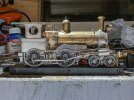
Scale7 JB Workbench.

Scale7JB

Western Thunderer
Hi JB, I wasn't making myself very clear. Is all the pipework on the model going to be unpainted and left in bare metal? If so wouldn't the pipework all be in copper, whatever the size.

Tim
Apologies Tim, yes I believe john wants all the pipework to be bare so does really need to be done in brass.

I'm beyond certain that the original pipework would have been Copper, brass would have been too difficult to bend I'd think.

JB.
 

Scale7JB

Western Thunderer
It's hard to tell from the photo, but is the wrong type of pipe attached to the smaller horizontal pipe or the larger, curved pipe which goes to the boiler clack valve? If the latter, which I would expect, was it really a "hillside" connection or square to the main pipe axis?
Dave.
Hi Dave, yes its the small one that comes off the main injector feed pipe. I'm pretty sure it'll be a take-off for a slacker hose.

I was very lucky to find these super hi resolution images in the New South Wales state archives, though far enough in in the build that a couple of things had to be changed. Always the way of course...

1210_2_sm.jpg1210_3_sm.jpg

Pipe connection definitely 'hillside'. A term I'd not heard before, learn something new every day.

Crop and adjusted image.

1210_2_sm_crop.jpg

JB.
 

simond

Western Thunderer
It should not be difficult to electroplate copper onto brass - though I’m less sure about polishing it.
 

Scale7JB

Western Thunderer
It should not be difficult to electroplate copper onto brass - though I’m less sure about polishing it.
An idea... I'm sure though once the brass tarnishes, and with some very light weathering it will look more than acceptable :thumbs:

JB.
 

Giles

Western Thunderer
Very easy to electroplate copper to brass - if you want it to appear polished, plate it at a low(est) voltage, if you want it darker, matt, raise the voltage a little...... in the past I have plated to copper (nice and shiny!) And then heated it to tarnish it for injector pipes etc.
 

Dave Holt

Western Thunderer
Very nice indeed. They certainly didn't hide the pipework out of view, did they? Makes even a BR Standard look positively bare.
It looks as if something is not quite right with the spring below the rear, left hand driver. Has it beome detatched at the front end? It certainly doesn't match the RH one.
Dave.
 

Scale7JB

Western Thunderer
Very nice indeed. They certainly didn't hide the pipework out of view, did they? Makes even a BR Standard look positively bare.
It looks as if something is not quite right with the spring below the rear, left hand driver. Has it beome detatched at the front end? It certainly doesn't match the RH one.
Dave.
Ah, well spotted. All of the driver springs are pivoted on the hangars so that they can be lowered to release the axle boxes if required. Once painted I will be able to put a pin through each spring strap into the bracket above.

They were fun to do. 9 freely moving pivot points on each side that all had to be easily moveable.

JB.
 

Ian@StEnochs

Western Thunderer
That engine has a lot of charm! Very neatly modelled. The porthole cab is a bit reminiscent of Patrick Stirling’s work but he would have insisted on flush rivets and hidden pipework!

Ian.
 

Scale7JB

Western Thunderer
That engine has a lot of charm! Very neatly modelled. The porthole cab is a bit reminiscent of Patrick Stirling’s work but he would have insisted on flush rivets and hidden pipework!

Ian.
Thanks Ian!

I can only imagine it was partly due to the NSWR ticking all the boxes on the options list and nowhere to hide the pipes.

JB
 

Overseer

Western Thunderer
That engine has a lot of charm! Very neatly modelled. The porthole cab is a bit reminiscent of Patrick Stirling’s work but he would have insisted on flush rivets and hidden pipework!

Ian.
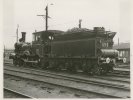
It wouldn't be a proper Beyer Peacock loco if it didn't have lots of rivets on show. They didn't start out with many exposed pipes, or Belpaire fireboxes, or cab upper sides. The cab is a William Thow signature item, he used them on a number of classes in South Australia before moving to NSW in 1889 (after all the other SAR senior staff refused to work with him). He was popular in NSW but I don't think was a competent locomotive designer, his standard practice was to travel to the UK and sit in the Beyer Peacock drawing office while they designed the locos. The C(79),later Z12, class originally had a spectacle plate and a large roof over the footplate, with no upper sides. The class were a tender version of the Metropolitan Railway A class 4-4-0 tank locos.

JB, it does look good. I assume it is a model of 1210 in preserved condition? It would never have had fully polished pipework while in normal service after being fitted with the Belpaire boiler. 1210 has the kinks in the handrails which the others don't seem to have.

 
  • Like
Reactions: AJC

Scale7JB

Western Thunderer
It wouldn't be a proper Beyer Peacock loco if it didn't have lots of rivets on show. They didn't start out with many exposed pipes, or Belpaire fireboxes, or cab upper sides. The cab is a William Thow signature item, he used them on a number of classes in South Australia before moving to NSW in 1889 (after all the other SAR senior staff refused to work with him). He was popular in NSW but I don't think was a competent locomotive designer, his standard practice was to travel to the UK and sit in the Beyer Peacock drawing office while they designed the locos. The C(79),later Z12, class originally had a spectacle plate and a large roof over the footplate, with no upper sides. The class were a tender version of the Metropolitan Railway A class 4-4-0 tank locos.

JB, it does look good. I assume it is a model of 1210 in preserved condition? It would never have had fully polished pipework while in normal service after being fitted with the Belpaire boiler. 1210 has the kinks in the handrails which the others don't seem to have.
Thanks for that..

This will be a loco in late revenue earning service, not long before preservation in the mid to late 50’s (?) so I’m led to believe. I know John was asking about which pipes will be painted the other day, so maybe we need to revisit that.

JB.
 

LarryG

Western Thunderer
As an aside, When Beyer-Peacock were wanting to develop welded fireboxes, my paternal grandfather, Thomas Goddard, was loaned by Daniel Adamsons of Dukinfield to Beyer' for his expertise on boilers. Something I am proud of.

I second Warrens recomendaton of using Liqid Leaf. I used Classic Gold for years. It is very expensive. As the thinners evaporates, the gold loses its lustre and I generally got down to half a bottle before replacing it with a new one.
 
Last edited:
Top