

auld_boot
Western Thunderer
As promised here is a thread for the build of my Mercian models PWM shunter. Please don't expect rapid progress and frequent updates as I am by no means a fast worker.
The chassis so far looks like this:

As this is my first O gauge build I am keeping it simple with no springing/compensation/CSBs etc. Having said it was a simple approach this is the second attempt at the chassis, I first tried to build it using a few spare axles that I had to hand to keep things square.
After a visit to the gas stove with the first attempt I bought myself some foot long 3/16 stainless steel bars and used those to check for square. All axles now run smoothly and it sits square on a sheet of glass so fingers crossed.
Next up was the radiator casing and grill, I wasn't happy with the way the grill sat as designed. It meant that the slats were protruding out of the front of the casing, which looked odd to me. You can see what I mean if you look at the models here: http://www.modelrailways.tv/7mm-scale-diesels.html compared to the real thing here http://pwm651.blogspot.co.uk/2011_07_01_archive.html
So instead of front mounting the grill as suggested I used some fine L section to make a frame and rear mounted the grill etch. I'm much happier with the way it looks now.
I also closed off the square hole on the side and made a step for it from scrap etch.

Next the engine casing. Nothing much to say about this other than it's my first attempt at bending a part into shape (2nd if you count the radiator), this is where I started using the term 'fighting with the kit' as it took 3 attempts to get it to this shape. I've left the side panels off for now as I want to make it so that the body and cab is separate from the footplate and I think it might be easier to put the other body parts together before the side panels are on.

Footplate. The instructions say to solder the side valences into the half etched slots on the footplate. My footplate didn't have any half etched slots so I used some 2mm L section brass as I could think of no method that I was within my capability to get a 2mm strip of NS square to the inside edge of the footplate.
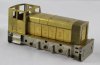
So with the startings of cab the loco parts so far when placed together look like this:

Which brings me up to date with the cab and it's lack of interior detail, with such large side and rear windows on these locos I cannot leave the interior without something resembling some workings. This is all I have so far, I have a feeling a trip to Aviemore could be happening soon:

The chassis so far looks like this:
As this is my first O gauge build I am keeping it simple with no springing/compensation/CSBs etc. Having said it was a simple approach this is the second attempt at the chassis, I first tried to build it using a few spare axles that I had to hand to keep things square.
After a visit to the gas stove with the first attempt I bought myself some foot long 3/16 stainless steel bars and used those to check for square. All axles now run smoothly and it sits square on a sheet of glass so fingers crossed.
Next up was the radiator casing and grill, I wasn't happy with the way the grill sat as designed. It meant that the slats were protruding out of the front of the casing, which looked odd to me. You can see what I mean if you look at the models here: http://www.modelrailways.tv/7mm-scale-diesels.html compared to the real thing here http://pwm651.blogspot.co.uk/2011_07_01_archive.html
So instead of front mounting the grill as suggested I used some fine L section to make a frame and rear mounted the grill etch. I'm much happier with the way it looks now.
I also closed off the square hole on the side and made a step for it from scrap etch.
Next the engine casing. Nothing much to say about this other than it's my first attempt at bending a part into shape (2nd if you count the radiator), this is where I started using the term 'fighting with the kit' as it took 3 attempts to get it to this shape. I've left the side panels off for now as I want to make it so that the body and cab is separate from the footplate and I think it might be easier to put the other body parts together before the side panels are on.
Footplate. The instructions say to solder the side valences into the half etched slots on the footplate. My footplate didn't have any half etched slots so I used some 2mm L section brass as I could think of no method that I was within my capability to get a 2mm strip of NS square to the inside edge of the footplate.
So with the startings of cab the loco parts so far when placed together look like this:
Which brings me up to date with the cab and it's lack of interior detail, with such large side and rear windows on these locos I cannot leave the interior without something resembling some workings. This is all I have so far, I have a feeling a trip to Aviemore could be happening soon:


 .
.


