7mm On Heather's Workbench - small and perfectly formed

Dog Star

Western Thunderer
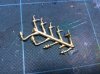
From what I can see, number 2 is the steam manifold that fits on the top of the back plate, this manifold just distributes steam to the rest of the " gubbins ".
Martyn has better eyes than me!

The cast whitemetal for the boiler backplate shows a regulator stuffing box of the Churchward/Collett pattern and hence the item on sprue 4 is suprefluous.... and hence the sprue 2 could well be the steam fountain fitted already with a number of steam cocks.
 

Dog Star

Western Thunderer
If I can confirm these items ought to be coiled, that's a quick fab with brass wire. I also need to confirm there ought to be a pair, and what they are attached to on the backhead.
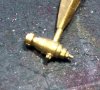
The early GWR design of hydrostatic lubricator had a condenser in the form of "chinese jumping jack". The first hydrostatic lubricators had a single oil glass / feed and, I think, that the condenser was a single copper tube as per a casting supplied in the kit . However, the introduction of piston valves lead to greater demands on the lubrication and a new design of hydrostatic lubricator - the 3-sight feed fitting. This item supplied oil to the regulator valve in the smokebox and oil to the cylinders (fed into the steam pipes between regulator and cylinder). The 3-sight lubricator had two steam feeds from the 3-way W-valve (operated by the lifting link from the regulator handle) and water (condensed steam) from two independent condensers - this may have been the time when the Chinese Jumping Jack was converted to the Catherine Wheel.

So where does this leave your current build? An interesting question... if the engine was built with a 3-way hydrostatic lubricator then that means a 3-way W-valve (connected to regulator handle) and two condensers. What is not clear to me is what would have been provided for the condenser... two of the zig-zag pattern or one of the coiled pattern? Which was used influences the number of steam cocks required in the fountain and the amount of plumbing associated with the lubricator.

Just be glad that you are not doing a middle period Castle with a 5-sight feed gallery... or a late build Castle with mechanical lubricators.

regards, Graham
 

SimonT

Western Thunderer
Here are my ideas based on current small GW loco builds. I will only mention changes or amplification
1. Lubricator and firebar rocker levers (goes on the floor to the left of the backhead. Can be two or four lever).
2. Agree with Graham, not sure why they are in the kit.
3. Lever at the top is for either the steam or vac brake. I think the steam brake valve is to the left and below the handle. The Vac valve is on the right.
4-12. Agree with Graham.
13. Most front sandbox lids had a rim at the top. About the right size for the job though.
As far as I know, the Masons valve is only required on steam heat locos.
Do you have the ATC bell for the right hand cab sheet?
Good luck!
Simon
 

Dog Star

Western Thunderer
Here are my ideas based on current small GW loco builds.
1. Lubricator and firebar rocker levers (goes on the floor to the left of the backhead. Can be two or four lever).
3. Lever at the top is for either the steam or vac brake. I think the steam brake valve is to the left and below the handle. The Vac valve is on the right.
13. Most front sandbox lids had a rim at the top. About the right size for the job though.
As far as I know, the Masons valve is only required on steam heat locos.
If 1/ is to do with the firebox then these are the levers for ashpan doors (the dampers). The 5700 engines have a single section ashpan as against GWR engines with the firebox over the rear axle in which case the ashpan has a front and a back section. A 5700 engine has two dampers (front and back doors) and hence two levers - an engine with two sections to the ashpan has four doors with two pairs of levers - one pair for one ashpan section.

Heather's pikkie suggest to me that the item at the top of sprue 3 is the rotating disk to be found on the front of any vacuum brake valve.

Simon could be correct about 13/, maybe JLTRT has included a list of expected castings.

I agree re Mason's valves and 5700 engines were fitted generally for steam heating of carriages. Heather, you have some photos of the trade-built engines and you ought to be able to see if there is a steam heat bag hanging under the buffer plank.

regards, Graham
 

Heather Kay

Western Thunderer
My cup runneth over. Many thanks for the input folks. :oops:

Okay, here's what I have. I've done some better detailed shots of the sprues that are not entirely identified, or mostly identified at this stage. I've left out the regulator, backhead and the firehole bits.
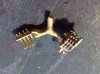
Sprue 1.jpg

Sprue 1: Oil pot lubricator/hydrostatic lubricator. Choose one or the other, apparently.

Sprue 2.jpg

Sprue 2: Steam fountain. Superfluous for this build?
Sprue 3.jpg

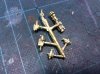
Sprue 3: From the top clockwise: vac brake handle / steam+vac brake ejector / clacks (x 2) / unidentified (x 2)

Sprue 4.jpg

Sprue 4: On the right, [alternative?] regulator stuffing box and whistle valves, with water gauge below. The top left seems to be a handle of some kind, and I wonder if it's meant to be the top of the sanding lever that lives on the front of the bunker. I wonder this, because there's nothing else remaining in the various bags and the box that fits the bill for this fitting. It's unclear what the other two items are.

Sprue 8.jpg

Sprue 8: Possibly a 3-way W valve?

Sprue 10.jpg

Sprue 10: Whistles, snifting valve and cylinder draincocks (not required for this build), steam lance cock.

Sprue 11.jpg

Sprue 11: Safety valve springs and tank filler bump stops.
Sprue 12.jpg

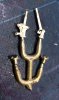
Sprue 12: Sanding gear lever, cylinder drain valve lever, backhead clack blanking plates.

Sprue 13.jpg

Sprue 13: Rear sandbox lids.

Unidentified.jpg

Unidentified, and new for this round!

As Graham and Simon noted:

I agree re Mason's valves and 5700 engines were fitted generally for steam heating of carriages. Heather, you have some photos of the trade-built engines and you ought to be able to see if there is a steam heat bag hanging under the buffer plank.

I can confirm the relevant lots were steam heat fitted from new.

I'm kind of hoping another contact has a good set of photos of a 57xx cab layout, but I'm waiting to see when he can sort them out for me. Sooner, rather than later, would be nice, though.

 

Steph Dale

Western Thunderer
Sprue 1. Changed my mind, the left hand bit is the ashpan damper controls.
Sprue 4. Regulator handle surely? Items on lower left are steam heat valve and blower valve.
Sprue 8. The valve is just below and to the right of the regulator. Link is on sprue 5
Sprue 10. I still think they're try cocks rather than draincocks!
Unidentified is perhaps a moisture trap - it goes at the bottom of the brake valve.
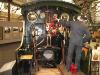
Here's a good view of a suitable backhead. there are others, but this is the best I could find with a 15-second search:
http://www.flickr.com/photos/curly42/5343926708/

And here's another:
index.jpg
Steph
 

Heather Kay

Western Thunderer
Sprue 1. Changed my mind, the left hand bit is the ashpan damper controls.
Sprue 4. Regulator handle surely? Items on lower left are steam heat valve and blower valve.
Sprue 10. I still think they're try cocks rather than draincocks!


Not sure these are ashpan damper controls. There are two dampers in the cab floor, left hand side.

The regulator is a complex affair, made of the parts on sprue 5. ;)

Try cocks, drain cocks, it's all Swindonish Greek to me! :D
 

Steph Dale

Western Thunderer
Try cocks:
All steam locos have to have two means of determining the level of water in the boiler. Most railways use two sight glasses, not so the GWR. So, all GWR locos have a set (usually three, but in the case above, two) try cocks on the backhead, they can be seen just to the right of the sight glass.

I agree with you about the damper controls; four would be right for a 4-6-0, but you only need a couple for a loco with a simple ashpan.

Agree with you on sprue 5 too; you replied before I'd finished flipping back and forward between the various posts. So yeah, sprue 4's handle might be for a sander, not sure how they're laid out on GWR tank locos!

Steph
 

alcazar

Guest
I find it a little difficult to understand how someone mastered that little lot, yet they seem to have forgotten to put in a where and a what, in the form of any instructions.
 

Heather Kay

Western Thunderer
I find it a little difficult to understand how someone mastered that little lot, yet they seem to have forgotten to put in a where and a what, in the form of any instructions.

Well, there is a casting list. However, not all the items are identified beyond a JLTRT part number.
 

Steph Dale

Western Thunderer
I find it a little difficult to understand how someone mastered that little lot, yet they seem to have forgotten to put in a where and a what, in the form of any instructions.


Not that uncommon a situation. I tend to provide quite a lot of info and instructions for any patterns I do and can only think of two occasions when any of what I wrote was used by the manufacturer/customer.

Steph
 

Heather Kay

Western Thunderer
Hopefully, Graham is now partaking of a particularly long and refreshing drink. Between us, we have explored the castings, the photos and other sources, and I now have a pretty good idea of what all the bits are meant to do, and how they are supposed to fit together. :thumbs:

We've identified various parts which are not pertinent to this class of loco, but seem to be included in the SDK because one part on the sprue is needed.

So, sprue 1 does have damper levers and the lubricator assembly. It seems they both come from a loco with more than two cylinders. The damper levers can be chopped down to replace the etched ones I have fitted. It turns out one of the unidentified castings on sprue 3 is the hydrostatic lubricator I need.

Sprue 10 has whistles intended for older designs, but also the steam lance and something that can be made to represent the pep pipe. The cylinder draincocks might find their way, via my bits box, into a personal build.

Tomorrow will be spent studying the various pipe runs around the cab, and selecting suitable copper wire to make them up.
 

Dog Star

Western Thunderer
They were in play during the research discussion with Graham last night.
Yup, we talked for over an hour last night and had a most enjoyable time flicking between pictures of castings, pictures of sprues and copies of frame plans / sections. In spite of all of that effort the location of the ATC battery box for a 5700 in the late 1930s is elusive.

What struck me about some of the photos of "restored/preserved" engines is how the current condition of some engines is different with respect to an "in-service" engine. For example:- most "large" GWR tender engines had one live steam and one exhaust steam injector. Whilst the patterns survived in the Swindon pattern store for the live steam variety... and the cost of manufacture is "reasonable"... very little survived for the exhaust injector and re-manufacture is probably prohibitive for most owners. In preservation such locos run with two live steam injectors and the appearance is impacted given that the exhaust injector sits below the frames and behind the LHS cab footsteps. For similar reasons, I think, photos of cab fittings of some preserved 5700 engines do not show Mason's valves for regulating steam pressure to carriage steam heating.
 

Dog Star

Western Thunderer
So, sprue 1 does have damper levers and the lubricator assembly. It seems they both come from a loco with more than two cylinders.
Not quite.

The four damper levers are intended for an engine where the firebox sits over the rear couple wheelset, in such cases the ashpan is formed in two sections and each section has front / back doors therefore there are two dampers for the front section and two dampers for the back section. Two section ashpans can be found on Halls and Manors as well as Castles and Kings. However, being a GWR discussion there is a sniggle to get you. Some of the tender engines which one might expect to have four dampers actually have just three - an example is the 2800 class.

When Heather provided a photo of the "other" side of sprue 1 we were able to decide that the lubricator is a five-sight feed lubricator and hence not the type fitted to 5700 class. The GWR standardised on 3-sight and 5-sight feed lubricators for engines from the Churchward and later eras... as a generalisation, the 3-sight feed version was fitted to tank engines and small tender engines (for example 2251 class) whilst the 5-sight version was fitted to the larger passenger tender engines. OK that does leave the 2800, 2884 and 47oo classes in limbo and as of now I am not sure which type of lubricator was fitted.

regards, Graham
 

Steph Dale

Western Thunderer
Yup, we talked for over an hour last night and had a most enjoyable time flicking between pictures of castings, pictures of sprues and copies of frame plans / sections. In spite of all of that effort the location of the ATC battery box for a 5700 in the late 1930s is elusive.

What struck me about some of the photos of "restored/preserved" engines is how the current condition of some engines is different with respect to an "in-service" engine. For example:- most "large" GWR tender engines had one live steam and one exhaust steam injector. Whilst the patterns survived in the Swindon pattern store for the live steam variety... and the cost of manufacture is "reasonable"... very little survived for the exhaust injector and re-manufacture is probably prohibitive for most owners. In preservation such locos run with two live steam injectors and the appearance is impacted given that the exhaust injector sits below the frames and behind the LHS cab footsteps. For similar reasons, I think, photos of cab fittings of some preserved 5700 engines do not show Mason's valves for regulating steam pressure to carriage steam heating.
Not quite,
The use of two live steam injectors is often made for operational reasons, Many preserved locos never get the chance to run on second regulator and so an exhaust injector is superfluous - Yes I know you can run an exhaust injector on live steam...
It's also worth noting that with the cost of the expertise necessary to keep locos running most railways take expediences: modern lubrication systems, drop grates, non-original fittings.
In the end it all comes down to cost and I can't blame people for taking the odd 'shortcut'. But we just need to keep our eyes (and minds) open when using preserved locos for research.
Steph
 
Top