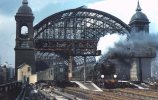
Monks Ferry: a layout for the Grandchildren.

John57sharp

Western Thunderer
Gosh, best of health to everybody above, and thank the NHS for being there. We had two friends over from the States a few weeks back and they bemoaned the eye watering insurance rates they have to pay for even basic cover….

I’m also pulled by the sea, my ancestors were all sea folk from Maryport, some way north of here, before migrating to Birkenhead, and I think my attraction to estuaries and inlets stems from that. Spent some time recently on the other channel, with appropriate precautions, reading about Bulldog Quay, by the same chap who made Janes Creek. Just super.

I also seemed to have ordered a 3DP rowing boat AND a Vincent Black Shadow, maybe a mid-life crisis setting in????

Get well soon everybody - Jonte keep up the good work.

PS - it must be endemic in modern cars - I had similar issues changing a main beam on a 56 Xsara Picasso. Never again!

John
 

jonte

Western Thunderer
Gosh, best of health to everybody above, and thank the NHS for being there. We had two friends over from the States a few weeks back and they bemoaned the eye watering insurance rates they have to pay for even basic cover….

I’m also pulled by the sea, my ancestors were all sea folk from Maryport, some way north of here, before migrating to Birkenhead, and I think my attraction to estuaries and inlets stems from that. Spent some time recently on the other channel, with appropriate precautions, reading about Bulldog Quay, by the same chap who made Janes Creek. Just super.

I also seemed to have ordered a 3DP rowing boat AND a Vincent Black Shadow, maybe a mid-life crisis setting in????

Get well soon everybody - Jonte keep up the good work.

PS - it must be endemic in modern cars - I had similar issues changing a main beam on a 56 Xsara Picasso. Never again!

John

Many thanks, John, for your support and well wishes, and for a most interesting post.

Good luck with the 3DP :thumbs:
 

jonte

Western Thunderer
Hi Jon,

Best of luck with the shoulder op, the regular raising of an appropriate coloured liquid from north of the border should help with the physio! I am at Clatterbridge tomorrow for a checkup on my twenty five year old replacement hips, been getting a nasty pain on the left hand side lately and have had to resort to using my stick (retained from the original ops) when walking which makes things more bearable.

Best wishes

Mike

Hi Mike, and thanks for your well wishes and support.

Sorry to hear that your discomfort is returning. I suppose any remedy is finite :(

Indeed, I shall be seeking comfort in another appropriately coloured liquid as you suggest, only mine hails from warmer climes….Lambs Navy :thumbs:

Funnily enough, I’ve employed its healing powers only recently for gum inflammation to one side of my mouth. A quick flossing followed by a Lamb’s mouthwash saves on dental charges ;)

Best,

Jon
 

76043

Western Thunderer
For what it's worth I recently hand painted my sleepers using Humbrol 173 enamel and the rails 113 enamel. I quite enjoyed it as I used 113 to dry brush the chair detail. Thankfully I was able to do it outside as the fumes are no fun.

But I have to comically confess it was the track on my Peco Rail 200 build so it didn't take long unlike the mammoth effort Jonte is undertaking.

Runs away now....
Tony
 

jonte

Western Thunderer
For what it's worth I recently hand painted my sleepers using Humbrol 173 enamel and the rails 113 enamel. I quite enjoyed it as I used 113 to dry brush the chair detail. Thankfully I was able to do it outside as the fumes are no fun.

But I have to comically confess it was the track on my Peco Rail 200 build so it didn't take long unlike the mammoth effort Jonte is undertaking.

Runs away now....
Tony
Hi Tony, and apologies for the late reply but for some reason, notification of your post didn’t appear in the bar above :confused: so only just discovered it whilst attempting to add another (laboured) post, which coincidentally, is regarding an update on sleepers (yet another!).

I find its best to make a start with a light to mid shade on anything, as ‘too dark’ is difficult to lighten I find with washes, but as I’ve now decided, the sleepers are simply too light when compared to the ‘real thing’ (please see photo of tracks at W’loo in my next post :thumbs:), so changes are afoot.

Indeed, 173 is a nice muddy shade of brown, one which I used on the rails (amongst others) in one of those ‘previous efforts’ shown earlier, and which will be called upon at some point :thumbs:

Dry brushing is a great technique, which as mentioned earlier, I’d enjoy attempting with rusty rails but as you wisely point out, Tony, there’s just too much track for a lone builder to attempt, so I’m opting for the easier and quicker way of washes ;)

Many thanks Tony for sharing and your much appreciated assistance.

Jon
 

jonte

Western Thunderer
As mentioned in my reply to Tony, above, I’ve given the paint mix on the sleepers a couple of days to dry, and I have to admit that now it’s applied, it’s simply too light, despite looking an appropriate shade on the (white) pad.

To remind you, here’s the first attempt again:

IMG_0094.jpeg

Here’s what the tracks at Waterloo actually looked like (shamelessly nicked from an online video):

IMG_2849.png

I still like the shade, but reckon it’ll serve better as a wash (amongst others) to be applied once I’m nearer the correct starting shade.

To that end, I’ve been out mixing up a couple of darker combinations which I now submit for your info. (please forgive the scrawl: trying to write around the wet paint with a blunt pencil instead of endorsing first……..too eager!). Oh yes, please try not to doze off………:

IMG_2850.jpeg

I think you’ll agree when I mention ‘my mix’ looks dark enough on paper but not really suitable as a dark base.

Anyway, the solution was to go back to using black (phoenixes weathered black and Matt black were chosen) as the base, with added amounts of a brown shade for which I’ve chosen 113 for no other reason than it is the basis of the rails (this will be applied in a series of mixed washes too) and was to hand on the bench (running low, but I’ve got some no. 62 handy, also a brown shade).

I’ve even tried adding it to my own mix, but think I’ll settle for the more straightforward Matt black and brown.

As I say, it’s just a base, the arty bit coming with the washes, which again will be a quick fix as there simply isn’t the time to agonise for too long as the children won’t be children for long!

You’ll be relieved to read that this will be the last on the topic, and I’ll provide further updates when I reach the enviable point of track laying.

Thanks for your perseverance.

jonte
 

Roger Pound

Western Thunderer
Looks good to me, Jon, and I'm sure the grandchildren will not mind if it is not an exact match. As you mentioned earlier, they'll be seeing how fast their train can go........ :eek:!

Roger
 

jonte

Western Thunderer
Whilst track painting by hand continues in earnest, thoughts have been turning once again to the topic of signalling.

And why now with track laying in sight at long last?

Surely some sort of running is long overdue, at least to satisfy the curiosity or concern even, that this return loop style layout of old will work with just two rail track?

Without doubt.

However, the truth is that this has been troubling me for some time and has turned into a chicken and egg situation that imminently needs addressing. Even before thoughts turn to what type of signalling will be needed, where will they be located and how they will be fabricated, indeed the priority here is how they will be attached to the board, bearing in mind that failures and perhaps maintenance will need to be addressed such that a prerequisite is that they must be detachable form the layout for wont of a better expression.

And it is to that end that holes will need to be cut into the board through which wiring must pass that need to be addressed. Perhaps a drill hole of some size will suffice, but what if a larger hole is required in the order of those that were cut for point motors? In that scenario, it would be back to utilising the jig saw, and with tracks in close proximity well, the thought breaks me out in a cold sweat……….

If indeed that is the case, then locations for the signals must be dealt with before the track goes down to save tears, but first I need to determine which type of signalling will be required (semaphore or coloured light), roughly what sort to determine their size(s) (two aspect? 3 or more? Feathers (not sure what this even means)?). Gantry? Single? Dual? See what I mean about the chicken and egg?

So, let’s break it down.

Although loosely (and I use the term loosely) based on BR Southern Region at Waterloo in the sixties, the concept has also borrowed from other London termini including Kings Cross in this period, which points firmly in the direction of coloured light type of signalling. A couple of tasters:

IMG_2112.jpeg

See post,207 of the attached link: Prototype - Tim Mills' Photos

So that’s that part of the equation solved. Now for the rest.

Frankly, signalling or at least the notion, has been on my mind for quite some time which has even seen me purchasing a couple of original Hornby Dublo light signals (in boxes); or at least two to be precise. Apart from being nowhere near enough for what is required, they’re, well, too boxy if you see what I mean (chunky?). Yes, it’s a traditional train set, but there are limits…..

So, and to this end, more recent thoughts have turned to something a little more pleasing to the eye, if not exactly to scale. There are some smashing RTR examples out there, but apart from being too expensive bearing in mind the quantity required, they’re simply too modern for the period modelled, so like it or not, I’ll have to make ‘em myself………

To that end, an online search about eighteen months or so ago revealed a rather bargain buy on an online auction site from a retailer in the Orient. For a tenner including postage, I received a bag containing ten (two aspect) rounded signal frontispieces similar to those of the Southern, replete with peaked type lens covers, supplied with sufficient green and red leds to fulfill the purpose and appropriate resistors. Included were two bags of umpteen green and red leds, again supplied with the appropriate resistors. A bargain indeed. But, it’s only lately whilst outside in my workshop painstakingly painting track with the quandary whizzing round my relatively vacant bonce, that I decided to dig ‘em out and give some thought to actually making the prospect a reality.

Again, fabrication in the main had already been decided: soldered construction in brass and nickel silver for strength, although how I was going to attach a plastic frontispiece to metal without making it too permanent was always a puzzle. In the end, after fiddling with the bits in the packet, I decided that any failures would be axed (and which is why I’ll be sending for more in the event of failures although I believe leds are quite long lasting - more on this later).

There’s been too much waffle already, so in an attempt to relieve you all, here’s a piccie of the bits in one of the bags mentioned, and some of them on the bench to aid:

IMG_2861.jpeg

So the first problem to get over was how are leds wired? With mention of anodes and cathodes abounding in line, the long and short wires were identified such that I quickly recognised where the resistor should go and how the wires should be attached both at the lens end and switch end. As I’d already decided that they were in the main going to be simple two aspect, especially in the station area, the electrical side was quite simple (I’m thinking of purchasing some of their three aspect varieties from the same supplier for one or two proposed gantries elsewhere).

The only initial problem from constructional side of things as far as I could see was how to run a lead at ninety degrees to the wires from the lenses. I worked out that they could be bent and shortened, but to save undue stress to the wire inside the lenses, some sort of ‘grab’ would be required to hold the wire just proud of the lens and in between the bend itself. I’m currently thinking of using suitably sized tweezers for the purpose and will dig some out in preparation. I’ve also got some suitably sized and colour coded wire en route especially for use with leds to keep the amount of ‘protrusion’ from the rear of the lenses frontispiece to a minimum (I’ve noticed with many examples rtr, that the wires are uncovered and showing as they exit the lens frontispiece which I don’t think is a good look!).

And it’s this ‘exit’ from the rear of the signal, as mentioned that really is the crux of the matter here,so much of my cogitation has been with this in mind.

The first problem in this respect is that the led bulbs supplied are slightly proud of the lens hole in the frontispiece such that the rear of the lens protrudes too far out as can be seen in the above photo. Initial thoughts were to reach for one of my reamers to open the hole out slightly to allow more of the bulb length to enter, thus reducing the length protruding from the rear. This is exacerbated somewhat when you consider that some of the wire will extend along the same plane until the bend is reached, a necessary evil if one is to avoid stressing the connection inside the bulb itself. Add to tjhis the soldered joint and wire, amd you see how vital,it is to shove as much of the bulb into the frontispiece as possible to avoid a boxy look at the rear (the real things were quite slim as can be seen in accompanying photos).

Now, even though opening out the holes alleviates some of the issue described, I’ve found that the rim on the rear of the led bulb catches on the moulding protruding from the rear of the frontispiece, as can be seen above. In the end, I decided that the best solution was to file off the moulding to allow the bulb to go further into the frontispiece without hinderance, thus reducing the amount of ‘stuff’ sticking out of the back, and in this way giving it a slimmer more streamlined look, something vaguely resembling the real thing. The idea is then to purchase some plastic U channel of appropriate size which can be glued onto,the frontispiece, acting as a cover for the rear protrusion. This can than be glued into the decking of the below which will be of a nickel,silver base, with brass I beams soldered below, with a brass square tube of appropriate size acting as an upright, itself soldered to a nickel silver base. (In case of failures, it would be a simple,task to remove the plastic u channel,from the main metal deck and replace it).

So how to attach it to the board such that it can be removed?

Well, the solution is to attach/adhere a piece of nickel,silver plate across the hole in the baseboard imto which holes habe previously been drilled and captive nuts soldered beneath. Matching holes in the signal baseplate will habe brass screws passed,through the, allowing them to fix into the captive nuts below.

And that’s it. Or at least the idea.

Apologies for the length of post, however it will hopefully give you an idea of why track laying amd signallimg has become a chicken and egg scenario.

Thanks for looking.

jonte
 

simond

Western Thunderer
Whilst track painting by hand continues in earnest, thoughts have been turning once again to the topic of signalling.

And why now with track laying in sight at long last?

Surely some sort of running is long overdue, at least to satisfy the curiosity or concern even, that this return loop style layout of old will work with just two rail track?

Without doubt.

However, the truth is that this has been troubling me for some time and has turned into a chicken and egg situation that imminently needs addressing. Even before thoughts turn to what type of signalling will be needed, where will they be located and how they will be fabricated, indeed the priority here is how they will be attached to the board, bearing in mind that failures and perhaps maintenance will need to be addressed such that a prerequisite is that they must be detachable form the layout for wont of a better expression.

And it is to that end that holes will need to be cut into the board through which wiring must pass that need to be addressed. Perhaps a drill hole of some size will suffice, but what if a larger hole is required in the order of those that were cut for point motors? In that scenario, it would be back to utilising the jig saw, and with tracks in close proximity well, the thought breaks me out in a cold sweat……….

If indeed that is the case, then locations for the signals must be dealt with before the track goes down to save tears, but first I need to determine which type of signalling will be required (semaphore or coloured light), roughly what sort to determine their size(s) (two aspect? 3 or more? Feathers (not sure what this even means)?). Gantry? Single? Dual? See what I mean about the chicken and egg?

So, let’s break it down.

Although loosely (and I use the term loosely) based on BR Southern Region at Waterloo in the sixties, the concept has also borrowed from other London termini including Kings Cross in this period, which points firmly in the direction of coloured light type of signalling. A couple of tasters:

View attachment 246695

See post,207 of the attached link: Prototype - Tim Mills' Photos

So that’s that part of the equation solved. Now for the rest.

Frankly, signalling or at least the notion, has been on my mind for quite some time which has even seen me purchasing a couple of original Hornby Dublo light signals (in boxes); or at least two to be precise. Apart from being nowhere near enough for what is required, they’re, well, too boxy if you see what I mean (chunky?). Yes, it’s a traditional train set, but there are limits…..

So, and to this end, more recent thoughts have turned to something a little more pleasing to the eye, if not exactly to scale. There are some smashing RTR examples out there, but apart from being too expensive bearing in mind the quantity required, they’re simply too modern for the period modelled, so like it or not, I’ll have to make ‘em myself………

To that end, an online search about eighteen months or so ago revealed a rather bargain buy on an online auction site from a retailer in the Orient. For a tenner including postage, I received a bag containing ten (two aspect) rounded signal frontispieces similar to those of the Southern, replete with peaked type lens covers, supplied with sufficient green and red leds to fulfill the purpose and appropriate resistors. Included were two bags of umpteen green and red leds, again supplied with the appropriate resistors. A bargain indeed. But, it’s only lately whilst outside in my workshop painstakingly painting track with the quandary whizzing round my relatively vacant bonce, that I decided to dig ‘em out and give some thought to actually making the prospect a reality.

Again, fabrication in the main had already been decided: soldered construction in brass and nickel silver for strength, although how I was going to attach a plastic frontispiece to metal without making it too permanent was always a puzzle. In the end, after fiddling with the bits in the packet, I decided that any failures would be axed (and which is why I’ll be sending for more in the event of failures although I believe leds are quite long lasting - more on this later).

There’s been too much waffle already, so in an attempt to relieve you all, here’s a piccie of the bits in one of the bags mentioned, and some of them on the bench to aid:

View attachment 246688

So the first problem to get over was how are leds wired? With mention of anodes and cathodes abounding in line, the long and short wires were identified such that I quickly recognised where the resistor should go and how the wires should be attached both at the lens end and switch end. As I’d already decided that they were in the main going to be simple two aspect, especially in the station area, the electrical side was quite simple (I’m thinking of purchasing some of their three aspect varieties from the same supplier for one or two proposed gantries elsewhere).

The only initial problem from constructional side of things as far as I could see was how to run a lead at ninety degrees to the wires from the lenses. I worked out that they could be bent and shortened, but to save undue stress to the wire inside the lenses, some sort of ‘grab’ would be required to hold the wire just proud of the lens and in between the bend itself. I’m currently thinking of using suitably sized tweezers for the purpose and will dig some out in preparation. I’ve also got some suitably sized and colour coded wire en route especially for use with leds to keep the amount of ‘protrusion’ from the rear of the lenses frontispiece to a minimum (I’ve noticed with many examples rtr, that the wires are uncovered and showing as they exit the lens frontispiece which I don’t think is a good look!).

And it’s this ‘exit’ from the rear of the signal, as mentioned that really is the crux of the matter here,so much of my cogitation has been with this in mind.

The first problem in this respect is that the led bulbs supplied are slightly proud of the lens hole in the frontispiece such that the rear of the lens protrudes too far out as can be seen in the above photo. Initial thoughts were to reach for one of my reamers to open the hole out slightly to allow more of the bulb length to enter, thus reducing the length protruding from the rear. This is exacerbated somewhat when you consider that some of the wire will extend along the same plane until the bend is reached, a necessary evil if one is to avoid stressing the connection inside the bulb itself. Add to tjhis the soldered joint and wire, amd you see how vital,it is to shove as much of the bulb into the frontispiece as possible to avoid a boxy look at the rear (the real things were quite slim as can be seen in accompanying photos).

Now, even though opening out the holes alleviates some of the issue described, I’ve found that the rim on the rear of the led bulb catches on the moulding protruding from the rear of the frontispiece, as can be seen above. In the end, I decided that the best solution was to file off the moulding to allow the bulb to go further into the frontispiece without hinderance, thus reducing the amount of ‘stuff’ sticking out of the back, and in this way giving it a slimmer more streamlined look, something vaguely resembling the real thing. The idea is then to purchase some plastic U channel of appropriate size which can be glued onto,the frontispiece, acting as a cover for the rear protrusion. This can than be glued into the decking of the below which will be of a nickel,silver base, with brass I beams soldered below, with a brass square tube of appropriate size acting as an upright, itself soldered to a nickel silver base. (In case of failures, it would be a simple,task to remove the plastic u channel,from the main metal deck and replace it).

So how to attach it to the board such that it can be removed?

Well, the solution is to attach/adhere a piece of nickel,silver plate across the hole in the baseboard imto which holes habe previously been drilled and captive nuts soldered beneath. Matching holes in the signal baseplate will habe brass screws passed,through the, allowing them to fix into the captive nuts below.

And that’s it. Or at least the idea.

Apologies for the length of post, however it will hopefully give you an idea of why track laying amd signallimg has become a chicken and egg scenario.

Thanks for looking.

jonte

Jon,

I spent much of my working life in the Automobile industry, design & development of brakes and body hardware. Cars rarely have the full range of potential features included at launch, the clever guys & girls in “packaging” leave space for bigger engines, and clever tricksy suspension but they build something that does everything, and get it onto the market.

This is called “Package Protection”.

It’s something that might help you resolve your dilemma; I wonder if drilling a suitable hole at each intended signal location (say big enough for a Dapol signal “root” to fit) and then putting a sticky label over each hole would be a solution, that would allow you to move on with your tracklaying, but would save major excavation in the future.

If and when the grandchildren appreciate the finer points of railway operation, it would be an extra, perhaps “do it together” project to install signalling. Small children are very much better at scurrying under baseboards than those of us with a lifetime of experience, bad backs and waistline :)

Whatever signalling solution you choose, it would be relatively easy to make a standard base to fit the pre-drilled holes.

HTH
Simon
 

Oban27

Active Member
Hi,

I have to ask, but is the layout for your grandchildren or yourself?

If it's for yourself then make it as perfect for yourself as you can, and if that means the correct signalling, perfect track and highly detailed rolling stock then fair enough, but if it's for your grandchildren then don't worry! In my experience the state of the track, signalling, or the lack thereof, and highly detailed stock don't matter one jot! Until they get old enough to start appreciating the finer points of operation and signalling all they want is to play trains, even if it means putting their favourite toys in wagons so they can have a ride! When they get older, and if they show the inclination, then you have lots of projects, such as signalling and improving the rolling stock, to do together.

I speak from experience. When she was five all she wanted was to see trains running, some with plastic animals "enjoying the ride"! When she was 8 I taught her to solder and she used to make 60' track panels in N gauge! When she started secondary school another interest of hers, art and drawing, which she'd had been interested in since before she started school, took over and trains and railways took a rather distant second place.

She still loves, and prefers to travel, by train, but she'll never build a layout of her own, but that's fine. She's her own woman, and maybe she'll surprise me, but I'm not holding my breath! In the meantime, I have a couple of projects I'm working on for me. I sometimes miss the plastic animals, though!

Roja
 

jonte

Western Thunderer
Hello Jon
Crumbs. That’s dedication! And I fir one appreciate the ‘warts and all’ approach of your post. Maybe you should ask the grandchildren what they’d like? Abdication of responsibility is a great boon for the mental miasma in some circumstances!

Cheers

Jan

Thanks as always for your kind interest and support, Jan.

‘tis much appreciated :thumbs:

I like the sound of your imparted wisdom, Jan, which would indeed absolve me if some of the ‘perplex-shun’, but I want this to be a surprise Christmas present they hopefully won’t forget. Perhaps I’m just looking at it through aged eyes…..I’m sure any initial interest will be superseded over the years by better and more up to date toys, but the thought keeps me motivated ;)

Cheers,

Jon
 

jonte

Western Thunderer
Jon,

I spent much of my working life in the Automobile industry, design & development of brakes and body hardware. Cars rarely have the full range of potential features included at launch, the clever guys & girls in “packaging” leave space for bigger engines, and clever tricksy suspension but they build something that does everything, and get it onto the market.

This is called “Package Protection”.

It’s something that might help you resolve your dilemma; I wonder if drilling a suitable hole at each intended signal location (say big enough for a Dapol signal “root” to fit) and then putting a sticky label over each hole would be a solution, that would allow you to move on with your tracklaying, but would save major excavation in the future.

If and when the grandchildren appreciate the finer points of railway operation, it would be an extra, perhaps “do it together” project to install signalling. Small children are very much better at scurrying under baseboards than those of us with a lifetime of experience, bad backs and waistline :)

Whatever signalling solution you choose, it would be relatively easy to make a standard base to fit the pre-drilled holes.

HTH
Simon

As always, Simon, I’m indebted to you for your practical and sensible advice. Thank you.

However, as I mentioned to Jan in my last post, I want this to be a surprise for the children, so I need to make it a ‘complete package’ - or at least as near to complete as I can in the time frame I’ve set (Christmas’26) :eek:

So these decisions need to be addressed forthwith :oops:

Thanks, Simon

Jon
 

jonte

Western Thunderer
Hi,

I have to ask, but is the layout for your grandchildren or yourself?

If it's for yourself then make it as perfect for yourself as you can, and if that means the correct signalling, perfect track and highly detailed rolling stock then fair enough, but if it's for your grandchildren then don't worry! In my experience the state of the track, signalling, or the lack thereof, and highly detailed stock don't matter one jot! Until they get old enough to start appreciating the finer points of operation and signalling all they want is to play trains, even if it means putting their favourite toys in wagons so they can have a ride! When they get older, and if they show the inclination, then you have lots of projects, such as signalling and improving the rolling stock, to do together.

I speak from experience. When she was five all she wanted was to see trains running, some with plastic animals "enjoying the ride"! When she was 8 I taught her to solder and she used to make 60' track panels in N gauge! When she started secondary school another interest of hers, art and drawing, which she'd had been interested in since before she started school, took over and trains and railways took a rather distant second place.

She still loves, and prefers to travel, by train, but she'll never build a layout of her own, but that's fine. She's her own woman, and maybe she'll surprise me, but I'm not holding my breath! In the meantime, I have a couple of projects I'm working on for me. I sometimes miss the plastic animals, though!

Roja

Hi Roja, and thank you for the benefit of your past experience with children and the hobby. It’s good to hear how children receive and enjoy it, and whether they grow into it or out of it as many shared experiences on line have shown.

I think your question about who the model is ultimately intended for is valid and one oft posed, mainly as a point of amusement within the household………..

Hand on heart, I can honestly state that this is a children’s train set in the traditional way: big layouts ain’t (usually) my thang, although I’m growing to like this one.
Indeed, I’m not really a railway modeller, despite building several (over the years) unfinished layouts; according to my ‘records’, I haven’t run a train since August 2021 when I tested a DCC 8F on a piece of short track! Prior to that I also ran a diesel (American) loco along a similarly short length of track, and prior to that, a ‘Percy’ model round a circular trainset I built fir my son more years ago than I care to remember (he never showed any interest after that).

In truth, a train set present as a child fascinated me and I became very fond of the hobby as I grew, mainly because it provided an opportunity for me to ‘make things’. I realise the trains were purely incidental. The fascination and enjoyment in making things continued and I suppose a railway provided an ideal excuse to just create, from woodworking to buildings, soldering to electrical etc. .

So I suppose I’m looking forward to seeing it running, but as I mentioned to Simon and Jan above, it’s intended ultimately as a Christmas present, thus I want it to be as complete as possible and a scene of ‘wonderment’ (if that’s even a word!).

Additionally, the colour light signals - apart from being reminiscent of Capital City railways in the chosen period- are similar to traffic lights, and with chikdren being familiar with red for stop, green fir go, will be quite apt fir the movement of ‘their’ trains me thinks, and reduce risks if ‘crashes’!

I think because I enjoy modelling, I just cant help adding the odd extra detail here ‘n’ there; it’s in my blood. However, the time frame is of tge essence here, so any ‘embellishments’ will be of the quick-fix sort. There simply isn’t the time to give it the detaik I would like.

And although the signals seem a complicated distraction, in truth, once I’ve decided a mode of construction, I can employ an order of assembly that represents a production line, thus it won’t take as long as it might appear, building several of the same components at a time to speed things up. Thinking takes longer!

Thanks again for your interest and advice.

Best,

Jon
 
Top