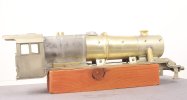
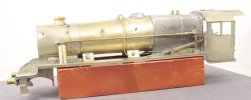
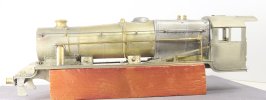
7mm MOK 8F - 8425

Rob Pulham

Western Thunderer
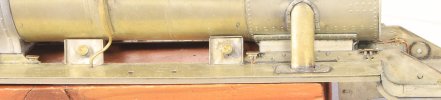
Having got the steam pipes in, I decided to work my way down one side at a time with the detailing. The vacuum ejector looked like it was going to be fun so yesterday I made start on that.

55274274692_7fa98c609a_h.jpg

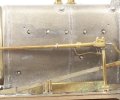
The elbow casting is provided in the kit but no provision is made for the small pipe and it's connector nut that comes out of the bottom of the elbow. A 0.4mm hole was drilled and some 28 gauge brass beading wire soldered in. With a slice of tube filed to a hex to represent the nut.

Then came the pipe clamps. There isn't any provision for this in the kit so I made some 'split pins' from 0.8mm half round brass wire and another slice of slightly thicker tube to create the flange.

55275588220_f716c62b2d_h.jpg

Next is the ejector itself. The casting as you might expect comes devoid of pipework so more 0.4mm holes ensued pipes again made from 28 gauge beading wire and another length of microbore tube. This was cross drilled on one side to take the vertical pipes. I still need to drill the thicker down pipe to accept the horizontal pipe but first I need to make sure that it fits to the footplate and is bent in the right planes. There is also another pipe to fit to the rear of the ejector casting that goes into the cab.
 

Dave Holt

Western Thunderer
Rob.
Do not drill the vacuum down pipe. The small bore drain pipe is clipped to the back side of the larger pipe, it does not connect to it.
Nice work with the drain pipes so far.
Dave.
 

Rob Pulham

Western Thunderer
Rob.
Do not drill the vacuum down pipe. The small bore drain pipe is clipped to the back side of the larger pipe, it does not connect to it.
Nice work with the drain pipes so far.
Dave.

Excellent, thanks Dave, that's just made this afternoon's job a whole lot easier.
 

Rob Pulham

Western Thunderer
Thanks to Dave's timely reply, my life was made so much easier when he said that the smaller pipe didn't actually feed into the down vacuum pipe but was clipped to the back of it. This saved another delicate 0.4mm drilling job.

55274919997_1d9eb15549_h.jpg

55274920002_23ba74c84c_h.jpg

55276066259_2632f61ad7_h.jpg

It's not exactly clipped, but it's out of sight behind the vacuum pipe when fitted so well hidden.

The observant amongst you will note, that the small pipe at the smokbox end was a casualty of my ministrations. So that will need reattaching.

Also, since the photos were taken I have shortened the union at the rear of the vacuum ejector which holds the pipe that goes into the cab. It's now more 'nut' like... Plus I've cleaned up much of the excess solder even though it's out of sight.
 

Rob Pulham

Western Thunderer
I seem to have missed a step or too in progress updates so this is to address those and bring the thread up to date.

In another of those mental build up moments I had imagined that the sandbox shields might be a bit difficult to get the pipes and holes in the right orientation. When it came to it, all my elaborate thoughts about milling oval slits etc. came to naught, as I drilled the right sized hole and then used a round file to chamfer the top and bottom edges while holding it it roughly the right angle that it would sit on the footplate and they were done. I did make a couple of minor adjustments to one of them but I got the rest soldering in right first time.

55273340568_c88e4e3f6b_h.jpg

55273340548_44acbda8b4_h.jpg

The etched shields as can be seen from the rear ones came without provision for a top lip but I soon made some up from scrap etch to fill the rather wide gap where the boiler tapers. I found a small piece which was just the right width so it was just a case of putting a right angle bend and then chopping it off on the guillotine.

55274479427_8f1778a64b_h.jpg
 

Rob Pulham

Western Thunderer
Still working away at adding details to the left hand side of the loco (although, I have added the solid blocks to the base of the firebox on either side).

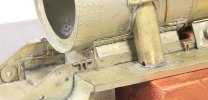
After much fiddling to get the vacuum ejector pipe to sit horizontal I got there and it's now fixed in place. As happens sometimes. I spent some time making the very visible pipe flanges that are fitted to the lower section of the vacuum pipe just above the footplate.

55284907189_ffb4501355_h.jpg

The best of these were soldered together in pairs and one pair fitted to the pipe. Then of course I discovered a pair of nice castings on a spru so my homemade ones are consigned to the spares box for now.

It was also kindly and discretely, pointed out that I had the dome on back to front. Which, was accompanied by a clear explanation of why it was thought to be so. As I read it, it made perfect sense and I could see clearly why it was on back to front. Life got in the way and I was unable to do anything in the workshop on Wednesday but I awoke early yesterday with my mind working on how I might safely remove the dome. I'd run elaborate scenarios of using the microflame while wrapping vulnerable bits in wet tissue ad using various items as heat sinks etc.

When I got into the workshop after breakfast I looked and realised that although I had fixed the boiler in place and removing it although not impossible would require undoing and refitting a number of parts. I could in fact get my low melt soldering iron into the base of the dome via the opening in the base of the firebox.

Then it was a relatively simple matter of starting to ease it off with my nails while heating the underside with the iron then once i had it move enough I used a pair of wooden coffee stirrers as pry bars to ease it off the rest of the way without damaging either the casting or the boiler. it was one of those situations where another couple f hands would have been helpful but I managed.

Oh what a few years of experience brings. Back when I started this build, if someone had told me then that I had the dome on the wrong way around. I would never have had the courage to remove and refit the dome and at that point the boiler was a separate entity.

55285124635_5b014eb08e_h.jpg

As a small side note not long after the Finney7 team took over the range I bought a set of etched pipe clips (a side product from the Duchess kit) and this is the first time I've remembered to use them. Of course as soon as I touched the first one after thinking it was fixed in place, it pinged off, never to be seen again.

55283803177_bf17aa4956_h.jpg
 

Rob Pulham

Western Thunderer
The last few days have been all about oil boxes.

Studying photos shows that there are quite a number of 2 port oil boxes dotted about the footplate and visible inside the upper frames. There were some castings provided but there were only four of them and they lack mounting plates. While I could and did make mounting plates I also elected to remake the oil boxes with a bit more detail.

55294421939_7a183c9c8b_b.jpg

Besides to large 6/8 port lubricators mounton the the right hand side there seem to be three different types of 2 port lubricators so i have replicated each type as best I can.

The types that I have identified (so far) are:

Rear mounted with pipes coming out of the bottom.

55288666734_1d584ff81a_h.jpg

Bottom Mounted presumably with the pipes also coming out of the bottom, but I haven't modelled them.

55291250292_92524b6ffc_h.jpg

The last type are those mounted at the front of the frames just under the end of the smokebox. These are very shallow and have a couple of prominent mounting nuts on top of the angle iron mounting plate.

55292718701_70749dfa3d_h.jpg

55294372394_2b85fe9714_h.jpg

What can't really be seen in the photos is that back edge of the angle plate also has two holes and after struggling to workout how I might hold all the other parts together while I added the last two mounting bolts (the brass angle doesn't take pressed rivets very well due to the proximity of the other leg) I elected to use the holes to drill the frames and then pass brass pins through to mount them.

After doing the initial rear mounted boxes with 180 degree solder it occurred to me, that I would make life much easier, if I soldered the others together using 296 degree solder. Thus making it less likely that they would fall apart if soldered to the frames with 145 degree solder. time will tell.
 

Rob Pulham

Western Thunderer
Ian Allen, fellow Guild member and font of knowledge for all things LMS kindly pointed out that the cladding band on the firebox only had the bottom four or five fixings, so the rest need filing off the firebox casting. He posted a photo showing his example and wile looking at it it reminded me that I still needed to do something with the washout plugs. I knew that I needed to do them but seemed to keep overlooking them as I progressed with detailing. So yesterday I got stuck in and made some.

My initial attempts were with a collet block but they came out asymmetrical and I couldn't understand why so I fitted the spin indexer to the mill and tried again. it was at the point that I realised that my bit of brass rod was bent - this particular piece of rod has caught me out before...

I checked stock and found a piece of similar sized (3mm) nickel rod and tried again. All was well so I got stuck in and set up a mini production run and a couple of hours later I had enough for this loco plus a few spares.

55297705122_1df2bf61c6_b.jpg

They are designed to be soldered in from the inside. So the next job is to drill out all the holes and fit them before starting to fit all the oil boxes.
 

Rob Pulham

Western Thunderer
Thanks Mike, the more I learn, the more they are growing on me.

Although predominantly an LNER modeller, I do have another two or three LMS engines in the pile.
 

Rob Pulham

Western Thunderer
Having made them I figured it made sense to fit them before fitting other more vulnerable bits.

Not sure why since I have been concentrating on the left side of the loco so far but I started on the right hand side.

All went according to plan

55302901179_a6a55cb2b8_h.jpg

55303076990_94f40033c3_h.jpg

Not so on the left hand side. I can only assume that the wall thickness of the firebox castings is thinner on this side.

55302901169_5a828f8aff_h.jpg

55302819493_94844dccc6_b.jpg

55301760567_04e57dba94_b.jpg

I couldn't live with them as is so I had a choice attempt to file them down or remake them a bit shorter and put the longer ones in the spares box.
Since I was still pretty much set up to make more, I elected for the latter.

Even with doing a test example to check that I had made the correct adjustments to my measurements it still took less than half an hour to make enough for the right hand side.

55302979468_c1eb559062_h.jpg

55301920677_cb13b7eecb_b.jpg

55302979463_df1070bb45_h.jpg

Much better.
 

LarryG

Western Thunderer
I admire your tenaciousness. I suspect most of us would have fined the excess off the washout plugs and removed the burrs. The 8F's make attractive models and yours has a particularly solid look about it.
 

Rob Pulham

Western Thunderer
After several sessions at them I finally have all the oil boxes on the footplate aside from the large Silvertown types on the right hand side of the locomotive - they are the next job.

I started with the ones at the front which needed the associated pipework down inside the front of the frames under the smokebox.
Again I made use of the Finney cable clip etches.

55326211018_60b5d8fe12_h.jpg

Then I fitted the ones that sit flat on the footplate including those that sit just inside the frames in front of the firebox. Lastly I fitted the ones at the rear of the smokebox that have pipes passing through the footplate.

55325134547_4c9e6f227b_h.jpg

55325134322_d0e9f15c6e_h.jpg

Finally I did the two that initially, I thought sat at the inside of the footplate. However upon closer inspection, they actually sit on a bracket mounted to the inside of the frames.

55326199466_b10fd5c8d3_h.jpg
 

P A D

Western Thunderer
Hi Rob,
Have you tried the 3d printed lubricators from
Fk3d? Much easier to drill the holes for the oil pipes and more detailed than any brass or white metal castings. They do them in 8, 12 and 16 feed varieties and are quick on the postage.

Cheers,
Peter


Rob Pulham

Western Thunderer
Hi Rob,
Have you tried the 3d printed lubricators from
Fk3d? Much easier to drill the holes for the oil pipes and more detailed than any brass or white metal castings. They do them in 8, 12 and 16 feed varieties and are quick on the postage.

Cheers,
Peter


Hi Peter,

I haven't tried his lubricators yet, but I have had other items from him for LNER coaches.

By coincidence of timing, I dug out the MOK castings yesterday with a view to doing something with them. Although they are not too bad but no doubt they will be a beggar to drill out, they don't have enough ports for the 8F. So last night I ordered some of those that you link to from Fk3d.
 

Rob Pulham

Western Thunderer
Still working away on detailing the loco body, while awaiting the lubricators I decided to fit the handrails Oridinarily I would fit the hand rails last but with LMS engines having small finials on each end of the hand rails I thought it prudent to do them before paint so that when I fit and file them back I don't damage the paint work.

I started with the smoke box door and fitted both the handrail and the lamp iron.

55340607069_55a540043c_h.jpg

The finials (or whatever they're actually called) are made from 1.4mm nickel rod drilled out .8mm to accept the 0.8mm piano wire which I use for the handrails. They are soldered on to one end of the hand rail and filed back to size the handrail is then fed through the handrail knobs via the cab and having cut the piano wire to length the second finial is soldered on and again carefully filed back.

55342920616_a0e0e603ba_h.jpg

55343336355_4b3e0e2cc5_h.jpg

From the photo it looks like the left hand, handrail rises up slightly at the front. I had to resolder this end knob in as it has loosened during fitting. So I will revisit it to make sure that's it's aligned better.

Finally yesterday I made and fitted the two small grab rails on the dropped section of footplate.

55343134549_014c7582ad_h.jpg

55341996302_a3c23a4698_h.jpg

In some of the photo that I have these grab handles have small washers around the base of the rods. These were turned from 1.6mm rod drilled to accept the rod and parted off at 0.5mm thickness

As and aside, due to the lack of rigidity in something as small as 1.6mm a normal 1/8" or thinner metric 2mm parting tool still exerts a lot of tool pressure meaning that the work piece is more likely to bend than part of. To get around this I ground up a very thin parting tool which is excellent for parting thinner material.

55344404491_5676a011a9_c.jpg

The cutting tip of the tool is only 0.8mm thick so tool pressure is greatly reduced

55344621414_b2c024d757_b.jpg

I also ground it to the left hand side of the tool meaning that I can get very close to the chuck which reduces stick out and increases rigidity.
 
Top