4mm Milford-On-Sea - was Plumtree Cross

Pencarrow

Western Thunderer
Sorry to hear about your ballasting woes Nick. I've always used a 50:50ish mix of water to bog standard PVA, with a touch of washing up liquid. Adjust the thickness of the mix until it flows and soaks nicely. I place and shape the ballast, mist with water and then drop on the PVA mix. Takes a day to dry solid.

Never had a problem with it being conductive (almost sounds like the glue you have used was formulated for static grass use). I use Woodlands Scenics ballast which is ground up from nuts (or something) but means the result adds very little weight to the board compared to stone. An advantage of the PVA is that applying drops of water afterwards will soften the glue and enable the ballast to be easily removed.
 

simond

Western Thunderer
Interesting thought that the glue was made for static flock use. When I bought my flock tool, the seller convinced me to try the special glue. I couldn’t detect any difference in performance, but then again, I wasn’t running trains over it.

I guess if I were making a PVA specially conductive, I’d probably start by adding a bit of salt… (though how that would affect its behaviour is any one’s guess)
 

Andy P

Western Thunderer
I'm with Pencarrow and Sheepbloke re greening of the Ballast, I use the same method and no problems.

BUT, I use mainly Gaugemaster and a little Woodlands Scenics mix.
DSCF0125.JPG
BUT I also heard one that yellow washing up liquid is better for a natural colour than green, but I use green of the best known brand well diluted.

IMG_8302.JPG
 

Nick C

Western Thunderer
Thanks all, plenty of ideas to try! Of course firstly I have to get the track up and cleaned off without damaging too much...
 

Stephen Freeman

Western Thunderer
I found out a long time ago that real granite chippings, secured with watered down PVA, washing up liquid etc will definitely go green. Strangely enough PVA spread out undiluted, track plonked down, ballast applied and weighted down doesn't seem to change colour.

Personally I prefer to use chinchilla dust if I can find it in the right grade. Cheaper, no adverse glue problems and colour preferred. The problem is finding a suitable grain size, it isn't always the same and can vary depending on the brand. Otherwise Woodland Scenics is very good, Carrs is similar though not sure where thy get it from these days as the mill (Bosley mill) that supplied the ground down fruit shell burnt down a few years ago, with some loss of life.

Certainly made the news in these parts. Several prosecutions.
 

Nick C

Western Thunderer
Hot water…

Messy, very, very messy; sadly the photos of my Greater Windowledge Railway’s demise were lost in the great RMWeb data storm of 2022…
Made a start this afternoon. I've got all the track up, the plain track all disintegrated, but most of the rail and sleeper bases are salvageable. The points are proving trickier though, they came up intact, but I don't think I can get the ballast off without dismantling them - which will be tricky without breaking the fragile chairs. I've left the to soak in hot water with washing up liquid for a bit to see what happens...

Worst case is I can save the rails, point blades and tie bars, then use copperclad sleepers to build some home-made ones instead.
 
Milford - back to the big layout

Nick C

Western Thunderer
It's been a while without any posting - mostly because I've not really done any modelling since dismantling the abortive Plumtree Cross - work, the allotment, a holiday, and catching Covid took up most of the summer...

I've come back to the 'big' layout, the boards for which were visible under the other in earlier photos. Originally, the plan was to build Lyme Regis, but I've realised I simply don't have the time, or skill, to do an accurate model of a real place to the standard I'd like, so I decided instead to move it along the coast a bit - which also gives me an excuse to make a few changes to include different buildings and features that I like, instead of being constrained by a prototype, as well as adjusting the track plan slightly to give more operational interest, including making the bay platform fully signalled and adding a carriage siding for through stock.

Being off sick with Covid this last week has given me plenty of time to think about alternative locations, and I've picked Milford, as being somewhere that never had it's own railway, and so didn't really develop until the private car came along, unlike it's neighbours at Lymington or New Milton. A line could have come off the main line at Sway, passing through Everton, then finishing to the North-East of the current village.

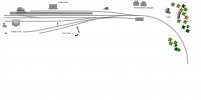
The plan therefore looks something like this - buildings being placeholders from the Anyrail libary...:
Milford.jpg.954182edc2c9362bd7a235d92b9e4759.jpg
Thoughts very much welcome, in particular:
- Should I stick to having a loco shed rather than the headshunt, as many LSWR branches did? Or should I extend the headshunt off-scene to a private industry (perhaps a boatbuilder at Keyhaven?)
- Would the 'box be better off at the end of the platform, or on the opposite side by the double-slip?
- Does the goods yard look too cramped? Would it be better with just two sidings? I could shorten the one through the shed and move that onto the shorter siding off the loco release crossover, drop the one by the crane, and then lengthen the coal siding.
- I'm not sure about the location of the cattle dock either - but can't work out where it would look best...
 

daifly

Western Thunderer
The headshunt is only really necessary if you want to have more than one loco moving at the terminus at the same time. Otherwise, the yard would use the main line to the 'limit of shunt' and the headshunt could be removed or made an engine shed road. Either way, the double slip would be replaced with a single slip.
It would possibly be more logical to place the signal box closer to the single/double slip where goods yard movements would be more easily observed and the point rodding and signal cabling would have shorter runs.
The carriage siding looks like a luxury - particularly as the station already has two platform faces.
Have you considered access to the cattle dock? It's not so much where it would 'look best' as where it would be sufficiently easy to get cattle etc. to the pens.
The 'back siding' could probably be longer as long as there is enough room for vehicles to manoeuvre into the goods shed doorway and up to the crane.
Dave
 

Flaxfield

Western Thunderer
Top stuff, Nick. I have a long term plan to model Lamb Regis, pretty much as was. I have the locos and stock for a 1950s layout to depict same but keep having to suppress a desire to do it as per opening.........Terriers, 4 wheelers et al..........

However, back to yours.......I'm with Dave re the carriage siding. It could be dispensed with and the cattle dock moved to the opposite, rear side, of the bay, as per Lyme.

I'm a bit troubled by the goods shed. It's more or less as per the original position at Lyme but if viewing the layout across the coal yard, it'll obscure the station building.

How would it look if turned through 180° to go over the inner 'coal yard' siding which could be extended to run through.....

If not, the coal sidings at Lyme were quite extensive, both, I'm sure, could be lengthened.

Two final observations, even if the goods shed were to be left in situ, or not, I'd stagger the length of the platform road, adjoining road and goods shed road. More interesting than uniform buffer stops.


Finally..............I'd definately have an engine shed at the end of the 'headshunt'. More operation but could also serve to mask the exit to the fiddle yard.


Rob.
 

Nick C

Western Thunderer
Thanks both for the comments.

The headshunt is only really necessary if you want to have more than one loco moving at the terminus at the same time. Otherwise, the yard would use the main line to the 'limit of shunt' and the headshunt could be removed or made an engine shed road. Either way, the double slip would be replaced with a single slip.

Finally..............I'd definately have an engine shed at the end of the 'headshunt'. More operation but could also serve to mask the exit to the fiddle yard.

That makes sense, I'll go back to having a shed there. Regarding the slip, it seems to have changed a few times at the real Lyme - originally two points, then a double slip, then later a single slip with a separate trap point - I don't have room for the latter, so will stick to a double so it can trap both the loop and the sidings.

It would possibly be more logical to place the signal box closer to the single/double slip where goods yard movements would be more easily observed and the point rodding and signal cabling would have shorter runs.

Indeed so - really the only reason not to is that you'd be looking at the back of it!

The carriage siding looks like a luxury - particularly as the station already has two platform faces.

However, back to yours.......I'm with Dave re the carriage siding. It could be dispensed with and the cattle dock moved to the opposite, rear side, of the bay, as per Lyme.

Have you considered access to the cattle dock? It's not so much where it would 'look best' as where it would be sufficiently easy to get cattle etc. to the pens.

The main reason for the carriage siding is that I've ended up with an extra RH point (and short a LH at the moment) due to space constraints - the point for the middle siding should be a RH, but it doesn't fit nicely when I tried laying it! I'll have another try and see if I can get it to line up better, and put the cattle dock back where it was...

The 'back siding' could probably be longer as long as there is enough room for vehicles to manoeuvre into the goods shed doorway and up to the crane.
Dave

I'm a bit troubled by the goods shed. It's more or less as per the original position at Lyme but if viewing the layout across the coal yard, it'll obscure the station building.

How would it look if turned through 180° to go over the inner 'coal yard' siding which could be extended to run through.....

If not, the coal sidings at Lyme were quite extensive, both, I'm sure, could be lengthened.

The goods shed I'm using is one I was given, a rather nice model albeit not suitable for Lyme itself. The board is quite narrow (2'), and there's not room for the back siding to go the full length and still allow vehicular access. Saying that, I've not laid any of the yard yet, so I'll try it in a few different positions and see if anything else looks better...

Two final observations, even if the goods shed were to be left in situ, or not, I'd stagger the length of the platform road, adjoining road and goods shed road. More interesting than uniform buffer stops.

Good idea, I like that!
 

Nick C

Western Thunderer
Slightly updated plan - Carriage siding removed, cattle dock in the original location and loco shed back. I've also moved the goods shed along slightly - given the main viewing position is from in front of the coal yard area, it doesn't restrict sight lines to the station building too much:IMG_20220907_203959567.jpg:
Milford.jpg
 

Nick C

Western Thunderer
Cattle dock at Milford-on-Sea? The area ceased any serious agricultural activity In the ‘30s as it became a genteel retirement centre to rival Barton next door, at one stage the most notable residents were senior merchant mariners and shipping owners based at nearby Southampton. After ‘45 the housing market changed to cater almost exclusively for retirees with the demographic rising to 78+ by the time the swathes of bungalows and flats took over the place.

Good luck
How would that have changed had there been good rail access though? Either way it gives me a good excuse for plenty of through trains to London and Southampton for the benefit of said shipping owners!
 

Nick C

Western Thunderer
I can't believe it's been nearly a month since I last updated this - in between work, digging potatoes on the allotment and clearing out the loft and insulating it, there's not been much time for modelling - and it'll soon get to the point where it's too cold to work out in the shed, even with the insulation I added last year.

There has been a bit of progress though, albeit invisible - I've started the wiring, and decided to go with servos for point operation, using MERG CBUS to control them. I did electronics at University, so it's good to keep my hand in with a bit of circuitry once in a while!

Also got permission to have a micro-layout in my 'office' area indoors, so that'll probably be the winter project, hopefully more successful than the last one... Rather than starting a new thread I'll pop any updates for that on here too.
 

Nick C

Western Thunderer
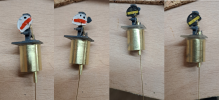
I really ought to update this more often - though I've not had time to do much modelling recently. I did make two ground signals yesterday though:
ground_signals.png
Wizard discs and counterweights on shapeways posts - and as show, they both work, even with my hamfistedness! Paint needs touching up though...

Otherwise on the layout, I've re-aligned the bay as it was too close to the main road for the starter to fit, and I've fitted servos to the points. I built a set of MERG boards to control the points and signals, but the setter board I've got has stopped working (it was fine for the little layout, which I'll write about later, but only managed one of the four boards here before simply refusing to do anything...)
 
Top