
You are using an out of date browser. It may not display this or other websites correctly.
You should upgrade or use an alternative browser.
You should upgrade or use an alternative browser.
Mike G's Workspace.
- Thread starter Mike Garwood
- Start date

Chas Levin
Western Thunderer
I know, it was harsh, wasn't it? I got carried away: I do occasionally drink Marmite, which is very similar...Yes, a Happy New Year all. Ooh, harsh Chas, I quite like Bovril…!! I guess each to their own!
Nigel


Mike Garwood
Western Thunderer
Life rumbles along and as it does, I've managed to grab a few hours this week to get things moving on the Grange chassis.
New coupling rods (Brassmasters - why o why, do they make everything as complicated as possible - it all fits though, but it seems such a long tortuous process).
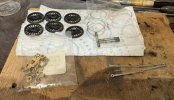
The wheels have been blackened, although, I shall have to rub off the blackening from the wheel treads and I still have to put the crank pins in. The backs of the wheels have been attended to. I've also blacked the axle ends.
Also the bearings and sub-horn blocks are ready to be installed, so tomorrow will see the red box onto the desk. After that, I'll strip the chassis...joy!
If you're wondering how the 16xx has performed, since it's been completely finished (I did remove the hose from the cab side), it hasn't been out of it's box. The grand children are back into schooling routine. Our dinning room has once more become an art studios! I can't even get my plank onto the dinning room table. But, I do have a cunning plan, as cunning as a fox!
Stay safe
Mike.
New coupling rods (Brassmasters - why o why, do they make everything as complicated as possible - it all fits though, but it seems such a long tortuous process).
The wheels have been blackened, although, I shall have to rub off the blackening from the wheel treads and I still have to put the crank pins in. The backs of the wheels have been attended to. I've also blacked the axle ends.
Also the bearings and sub-horn blocks are ready to be installed, so tomorrow will see the red box onto the desk. After that, I'll strip the chassis...joy!
If you're wondering how the 16xx has performed, since it's been completely finished (I did remove the hose from the cab side), it hasn't been out of it's box. The grand children are back into schooling routine. Our dinning room has once more become an art studios! I can't even get my plank onto the dinning room table. But, I do have a cunning plan, as cunning as a fox!
Stay safe
Mike.


Mike Garwood
Western Thunderer
All the prep is now finished for the Grange. Wheels, coupling rods, pick ups and removal of the brakes.
The chassis has been stripped, it didn't take as long as I thought and wasn't as difficult as I anticipated it would be.
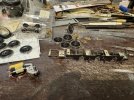
When I removed the bearings from the wheels I found out why the build had gone so wrong. I must have used an angled reamer on the bearings and gone too hard at them, to the extent that the axle was loose in the bearing, allowing the axle to move from side to side...should have used my one-eighth parallel reamer. Live and learn! So rather than have built a chassis that was the 'dogs b@ll@@cks' it was a 'dogs dinner'.
Since this photo was taken (and Mrs G had travelled up the wooden lane) out came the cellulose thinners and the chassis is now back to bear metal. Hopefully, tomorrow will see the bearings and horn blocks soldered into the chassis.
My cunning plan is still on track and Friday should see some movement and video.
Stay safe
Mike.
The chassis has been stripped, it didn't take as long as I thought and wasn't as difficult as I anticipated it would be.
When I removed the bearings from the wheels I found out why the build had gone so wrong. I must have used an angled reamer on the bearings and gone too hard at them, to the extent that the axle was loose in the bearing, allowing the axle to move from side to side...should have used my one-eighth parallel reamer. Live and learn! So rather than have built a chassis that was the 'dogs b@ll@@cks' it was a 'dogs dinner'.
Since this photo was taken (and Mrs G had travelled up the wooden lane) out came the cellulose thinners and the chassis is now back to bear metal. Hopefully, tomorrow will see the bearings and horn blocks soldered into the chassis.
My cunning plan is still on track and Friday should see some movement and video.
Stay safe
Mike.
Mike Garwood
Western Thunderer
It's been quite the week...
In between family highs and lows, I've managed to get some work done. Chassis, balance weights and replacement wheel springs have all been painted - bit of a rush job as SWMBO was only out for a couple of hours, and I like to really clean the air gun before it's put away. Wheels quartered and I'm thrilled to say no wobbly wheels - I used a different method this time, which will be documented in due course.

Here are the bearings and horn blocks going into the chassis, using the red box. If you're wondering why it's in mid air - that's because the brake hangers won't allow the chassis to sit flush to the jig.
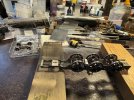
The bearings are now seated in the chassis and they turn freely...with no discernable horizontal movement within the sub-horn block, which is a good sign. When I reamed the bearings out I used the parallel reamer - so lesson learned.
Tomorrow morning will see the spring wire going into the sub assembly (not looking forward to this as it's going to be fiddly) and if time permits the pick ups will be re-soldered in as well. So apart from some really minor additions, I'll be in a place to add the rods and see if I've made a better job of the chassis this time. I really hope so!
Yesterday evening I met with some like minded friends at Mr Newitts home, a grand time was had, including some very nice sausages! There was green stuff as well, but I don't do green. Thank you Justin, an excellent time.
Stay safe
Mike.
In between family highs and lows, I've managed to get some work done. Chassis, balance weights and replacement wheel springs have all been painted - bit of a rush job as SWMBO was only out for a couple of hours, and I like to really clean the air gun before it's put away. Wheels quartered and I'm thrilled to say no wobbly wheels - I used a different method this time, which will be documented in due course.
Here are the bearings and horn blocks going into the chassis, using the red box. If you're wondering why it's in mid air - that's because the brake hangers won't allow the chassis to sit flush to the jig.
The bearings are now seated in the chassis and they turn freely...with no discernable horizontal movement within the sub-horn block, which is a good sign. When I reamed the bearings out I used the parallel reamer - so lesson learned.
Tomorrow morning will see the spring wire going into the sub assembly (not looking forward to this as it's going to be fiddly) and if time permits the pick ups will be re-soldered in as well. So apart from some really minor additions, I'll be in a place to add the rods and see if I've made a better job of the chassis this time. I really hope so!
Yesterday evening I met with some like minded friends at Mr Newitts home, a grand time was had, including some very nice sausages! There was green stuff as well, but I don't do green. Thank you Justin, an excellent time.
Stay safe
Mike.
Last edited:

Captain Kernow
Western Thunderer
So not a fan of the Southern then, Mike?!There was green stuff as well, but I don't do green.
Mike Garwood
Western Thunderer
What gave it away?So not a fan of the Southern then, Mike?!
Mike Garwood
Western Thunderer
Today has been a mixed bag on the running front with the 2 new engines.
Disappointingly, the pannier failed to run...at all. So some investigation will have be carried out. My first instinct was to throw it at the wall, but then I remembered how much effort I'd put into this !
However, the Grange was a definite success. The tender needs some more weight, but it runs ok, almost smoothly and can only improve with further running in.
Morgan has suggested to put a new chassis into the tender as there is a bit of a wobble. Think I'll have a play first before committing anymore money to this project. Collett tender £22 from High level.
All in all a good visit to Barrow Road...sort of. Thanks to Robin and Morgan for putting up with my whinges . Hopefully, the Pannier will be running by the next time I visit. But I have already started work on a GWR Mink D so it might be a while.
Stay safe
Mike.
Disappointingly, the pannier failed to run...at all. So some investigation will have be carried out. My first instinct was to throw it at the wall, but then I remembered how much effort I'd put into this !
However, the Grange was a definite success. The tender needs some more weight, but it runs ok, almost smoothly and can only improve with further running in.
Morgan has suggested to put a new chassis into the tender as there is a bit of a wobble. Think I'll have a play first before committing anymore money to this project. Collett tender £22 from High level.
All in all a good visit to Barrow Road...sort of. Thanks to Robin and Morgan for putting up with my whinges
. Hopefully, the Pannier will be running by the next time I visit. But I have already started work on a GWR Mink D so it might be a while.Stay safe
Mike.
Last edited:

Mike Garwood
Western Thunderer
Before I move on with what's happening right now, perhaps I should explain what else had to happen to the Grange to get it to where it is...
Having got to the stage where the chassis ran smoothly by pushing, it was a case of adding the remaining parts to the chassis...the steam chests, connecting rods, brakes and all the other things that make a completed and competent model. As I've said the coupling rods came from Brassmasters. This brand prides itself on giving scaled products for the modeler to use. This is a great move forward, or is it? Having built the coupling rods, it was clear that the bosses on these rods was going to cause a problem when it came to fitting the connecting rods. Why? Because the screws in the wheels (Gibson) were not long enough to accommodate the extra thickness of a scale boss. In order to get the connecting rods to fit and then be locked in place I had to file down the boss on the connecting rods - severely! It took a while and I don't mind admitting that there was a period where I thought this was never going to work, but work it did.
Was this the end of the problems? Well, I wouldn't be asking the question if the answer was 'yes'.
Once the connecting rods were in place the space behind the cross head and the connecting rod wasn't sufficient to allow the rod to pass. More filing...this time I had to file away a complete lamination on the con rods in order to get a half decent clearance. In my haste to get on with things I forgot to file down the remainder of the screws and this is what is causing the engine to stop in the video in my last posting.
I still have not found the time in order to do this.
What have I been up to since then, well I've had an 'ongoing' project on my desk for over a year. A GWR Mink D with DC2 brakes. The chassis came from The Brian Morgan range and the body from Parkside.
The design chosen left me a bit mystified (it's a sprung chassis, I say sprung, it's only sprung on 3 axles (?)), so going my own way I cut out these axles and replaced them with Bill Bedford sprung units RCH 1907 pattern. The instructions provided on the S4 website are very substantial, lots of words and not much in the way of diagrams - which is what I prefer.
It has to be said the etches in the kit are excellent. 10/10.
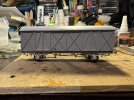
This is what I built from what I've been able to find by way of photos and trying to decipher the instructions. If you can see any mistake (And I suspect there are some), please let me know so this can be put right.

And this is the finished model...
Having finished this - Mrs G goes on her hols in a weeks time, so no prizes for guessing what happens then - I started another pannier, A 94xx.
This one has has pedigree...High Level.
Today I finished the triple laminated coupling rods.

This will go under neath this...

One of Bachmanns' best models - in my opinion - as is usual with Mr Higgs chassis, there's a lot to do.
Stay safe
Mike.
Having got to the stage where the chassis ran smoothly by pushing, it was a case of adding the remaining parts to the chassis...the steam chests, connecting rods, brakes and all the other things that make a completed and competent model. As I've said the coupling rods came from Brassmasters. This brand prides itself on giving scaled products for the modeler to use. This is a great move forward, or is it? Having built the coupling rods, it was clear that the bosses on these rods was going to cause a problem when it came to fitting the connecting rods. Why? Because the screws in the wheels (Gibson) were not long enough to accommodate the extra thickness of a scale boss. In order to get the connecting rods to fit and then be locked in place I had to file down the boss on the connecting rods - severely! It took a while and I don't mind admitting that there was a period where I thought this was never going to work, but work it did.
Was this the end of the problems? Well, I wouldn't be asking the question if the answer was 'yes'.
Once the connecting rods were in place the space behind the cross head and the connecting rod wasn't sufficient to allow the rod to pass. More filing...this time I had to file away a complete lamination on the con rods in order to get a half decent clearance. In my haste to get on with things I forgot to file down the remainder of the screws and this is what is causing the engine to stop in the video in my last posting.
I still have not found the time in order to do this.
What have I been up to since then, well I've had an 'ongoing' project on my desk for over a year. A GWR Mink D with DC2 brakes. The chassis came from The Brian Morgan range and the body from Parkside.
The design chosen left me a bit mystified (it's a sprung chassis, I say sprung, it's only sprung on 3 axles (?)), so going my own way I cut out these axles and replaced them with Bill Bedford sprung units RCH 1907 pattern. The instructions provided on the S4 website are very substantial, lots of words and not much in the way of diagrams - which is what I prefer.
It has to be said the etches in the kit are excellent. 10/10.
This is what I built from what I've been able to find by way of photos and trying to decipher the instructions. If you can see any mistake (And I suspect there are some), please let me know so this can be put right.
And this is the finished model...
Having finished this - Mrs G goes on her hols in a weeks time, so no prizes for guessing what happens then - I started another pannier, A 94xx.
This one has has pedigree...High Level.
Today I finished the triple laminated coupling rods.
This will go under neath this...
One of Bachmanns' best models - in my opinion - as is usual with Mr Higgs chassis, there's a lot to do.
Stay safe
Mike.

simond
Western Thunderer
Mike,
you’ll have to allow for your scale, but relevant numbers for crosshead clearance here
just be grateful it’s not a 136x!
hth
Simon
you’ll have to allow for your scale, but relevant numbers for crosshead clearance here
SimonD’s workbench
With a hole and pins instead of the spigot for coupling rods to deal with variation in rod hole diameter?
www.westernthunder.co.uk
just be grateful it’s not a 136x!
hth
Simon
Jeremy Good
Western Thunderer
Mike,
The Bachmann 94XX is a difficult one to convert to P4. There is not enough room for the wheels in the splashers and the cast footplate is somewhat thicker that the old plastic Lima one that the kit was, I think, designed for.
On mine, I’ve filed away the tops of the frames at the front and rear of the loco to compensate for the thickness of the footplate.
The speakers have been ground out from the inside and the front removed completely. I’ve then used a 30 thou plasticard overlay to replace the outside faces of the splashers. It’s a pain but does reduce the gap between the front of the splashers and the edge of the footplate.
It’s not finished yet but I’ll try and take some photos so you can see what I had to do. If you are heading to the Society Jubilee Event in Derby this coming weekend, I’ll put it in my bag to show you.
Jeremy
PS - I’m pleased to hear that I’m not the only one who finds the bosses on Brassmasters coupling rods too thick!
The Bachmann 94XX is a difficult one to convert to P4. There is not enough room for the wheels in the splashers and the cast footplate is somewhat thicker that the old plastic Lima one that the kit was, I think, designed for.
On mine, I’ve filed away the tops of the frames at the front and rear of the loco to compensate for the thickness of the footplate.
The speakers have been ground out from the inside and the front removed completely. I’ve then used a 30 thou plasticard overlay to replace the outside faces of the splashers. It’s a pain but does reduce the gap between the front of the splashers and the edge of the footplate.
It’s not finished yet but I’ll try and take some photos so you can see what I had to do. If you are heading to the Society Jubilee Event in Derby this coming weekend, I’ll put it in my bag to show you.
Jeremy
PS - I’m pleased to hear that I’m not the only one who finds the bosses on Brassmasters coupling rods too thick!
Mike Garwood
Western Thunderer
Hi Jeremy,Mike,
The Bachmann 94XX is a difficult one to convert to P4. There is not enough room for the wheels in the splashers and the cast footplate is somewhat thicker that the old plastic Lima one that the kit was, I think, designed for.
On mine, I’ve filed away the tops of the frames at the front and rear of the loco to compensate for the thickness of the footplate.
The speakers have been ground out from the inside and the front removed completely. I’ve then used a 30 thou plasticard overlay to replace the outside faces of the splashers. It’s a pain but does reduce the gap between the front of the splashers and the edge of the footplate.
It’s not finished yet but I’ll try and take some photos so you can see what I had to do. If you are heading to the Society Jubilee Event in Derby this coming weekend, I’ll put it in my bag to show you.
Jeremy
PS - I’m pleased to hear that I’m not the only one who finds the bosses on Brassmasters coupling rods too thick!
Yes I’ll be there on Saturday.
Looking forward to it!!
Mike
Mike Garwood
Western Thunderer
Having started and completed the coupling rods, it was time to move the build on.
But first a thank you to Jeremy Good for bring his 94xx (whilst demoing at the Scale 4 Jubilee event in Derby), which is a WIP, but gave an indication on how much effort is going to be required to get the body to fit a wheeled chassis. Spoiler alert, it doesn't fit once the wheels are on the chassis.
The bearings have been put into the chassis sides and I have made a number of sub-assemblies to be added in a few days time. The springs are a triple laminate, there are some devilishly fiddly bits for the dummy valve gear and con rods. Having put a few of the Pannier chassis together I didn't make the same mistake I made some years ago...get as much fitted into the spacers before they go in the chassis sides. If you don't, it is a painful process to fit them after.
The gearbox is good fun and if you follow the instructions all is well. Pay attention to the way the gears are placed, there is a right way and a wrong way - don't ask how I know. I do, however, have reservations about the gearbox. Everything lines up and it runs so sweetly, but, the gears are kept in sync by their fit to the gears above and below. There are no spacers/ washers that support the gears from falling out of sync. I did put a 1mm brass washer next to the final drive, because there's one thing I cannot stand...a wandering gearbox across the axle. Time will tell if my fears are founded.

Mrs G leaves the building on Saturday morning (the only fly in the ointment is that she is now coming back 2 days earlier, is there no justice for married men), first job will be to get the Mink D into primer. Then some weathering to be done while the primer dries. There are now a number of candidates for that. 51xx, Grange, 16xx and a M set of coaches. Nothing too heavy, just enough to take the shine off the paint work. After that's done it's back to the 94xx.
Whilst I was at the Scale 4 Jubilee meet, I had the opportunity to talk to several people demoing at the meet, who had appeared at several shows but were completely swamped by other interested parties. This was a skills day - no traders - I have to say firstly, that the location chosen was superb, the atmosphere generated was really laid back and friendly (there was a bar (!)) and food was available. Secondly, the people I spoke to were so willing to discuss, debate and advise. I came back knowing I had an answer to a lot of my modeling misgivings - especially about buildings - having been settled and answers were now in hand. A fabulous day out and one that I hope the society repeats in the near future. Hopefully in the same place! If this is repeated, put it into your diary and gain max brownie points before you go, it is a full day out.
Thanks to all who put it together and thanks to those who did the demoing, absolute class.
Stay safe
Mike.
But first a thank you to Jeremy Good for bring his 94xx (whilst demoing at the Scale 4 Jubilee event in Derby), which is a WIP, but gave an indication on how much effort is going to be required to get the body to fit a wheeled chassis. Spoiler alert, it doesn't fit once the wheels are on the chassis.
The bearings have been put into the chassis sides and I have made a number of sub-assemblies to be added in a few days time. The springs are a triple laminate, there are some devilishly fiddly bits for the dummy valve gear and con rods. Having put a few of the Pannier chassis together I didn't make the same mistake I made some years ago...get as much fitted into the spacers before they go in the chassis sides. If you don't, it is a painful process to fit them after.
The gearbox is good fun and if you follow the instructions all is well. Pay attention to the way the gears are placed, there is a right way and a wrong way - don't ask how I know. I do, however, have reservations about the gearbox. Everything lines up and it runs so sweetly, but, the gears are kept in sync by their fit to the gears above and below. There are no spacers/ washers that support the gears from falling out of sync. I did put a 1mm brass washer next to the final drive, because there's one thing I cannot stand...a wandering gearbox across the axle. Time will tell if my fears are founded.
Mrs G leaves the building on Saturday morning (the only fly in the ointment is that she is now coming back 2 days earlier, is there no justice for married men), first job will be to get the Mink D into primer. Then some weathering to be done while the primer dries. There are now a number of candidates for that. 51xx, Grange, 16xx and a M set of coaches. Nothing too heavy, just enough to take the shine off the paint work. After that's done it's back to the 94xx.
Whilst I was at the Scale 4 Jubilee meet, I had the opportunity to talk to several people demoing at the meet, who had appeared at several shows but were completely swamped by other interested parties. This was a skills day - no traders - I have to say firstly, that the location chosen was superb, the atmosphere generated was really laid back and friendly (there was a bar (!)) and food was available. Secondly, the people I spoke to were so willing to discuss, debate and advise. I came back knowing I had an answer to a lot of my modeling misgivings - especially about buildings - having been settled and answers were now in hand. A fabulous day out and one that I hope the society repeats in the near future. Hopefully in the same place! If this is repeated, put it into your diary and gain max brownie points before you go, it is a full day out.
Thanks to all who put it together and thanks to those who did the demoing, absolute class.
Stay safe
Mike.
Mike Garwood
Western Thunderer
Mrs G went off on her hols at 10:30. I had a few errands to run before I started, but by 13:00 this is how the dinning room looked.

I started the Mink off with a black undercoat. 1 part etching primer, 1 part celly gloss thinners and 1 part gloss black celly. I left it to harden over 4 hours before putting on a top coat. The top coat was a 3 parts thinner and 1 part paint. I've had a few half litre tins made up for me of BR rail freight and roof grey. Then a bit of toning down with some black, the Rail freight grey is really light. I didn't go in too hard with the top coat, which has had the effect of allowing the primer to show thru in all the iron and wood work gaps. When you're spraying the top coat on you can see the colour build up on the planks and because it's light strokes, the black stays. Going to save some time on the weathering with this technique.
Weathering will start tomorrow, as soon as I come back from taking my amazing Mother to lunch.

The roof colour appears to have been taken out by the over head light. TBH, I'm not to sure that the roof is dark enough and may well be recovered with something darker. Next job will be to cover the sides in a gloss varnish. That's a job for tomorrow, all in all, looks ok.
Stay safe
Mike.
I started the Mink off with a black undercoat. 1 part etching primer, 1 part celly gloss thinners and 1 part gloss black celly. I left it to harden over 4 hours before putting on a top coat. The top coat was a 3 parts thinner and 1 part paint. I've had a few half litre tins made up for me of BR rail freight and roof grey. Then a bit of toning down with some black, the Rail freight grey is really light. I didn't go in too hard with the top coat, which has had the effect of allowing the primer to show thru in all the iron and wood work gaps. When you're spraying the top coat on you can see the colour build up on the planks and because it's light strokes, the black stays. Going to save some time on the weathering with this technique.
Weathering will start tomorrow, as soon as I come back from taking my amazing Mother to lunch.
The roof colour appears to have been taken out by the over head light. TBH, I'm not to sure that the roof is dark enough and may well be recovered with something darker. Next job will be to cover the sides in a gloss varnish. That's a job for tomorrow, all in all, looks ok.
Stay safe
Mike.


Mike Garwood
Western Thunderer
You’re not wrong Dave! I was hoping to bump into you on the jubilee weekend. Had a really good chat with David Clarke - mostly about Led Zepplin )
)