Liver & Fry's workbench

GER Dia.1 Brake Vans

Liver & Fry

Western Thunderer
In other news, I needed to let out some pent up frustration, so I chose violence against the Dia.1 brake vans by removing the incorrect doors with a Dremel!

20251105_191444.jpg20251105_200427.jpg

(Obviously I tidied up after with a file...)

This will allow me to make up new doors, at the correct height.

It has also been brought to my attention that by the turn of the century, the GER had ceased using vermillion on headstocks of brake vans and so when the tin of grey arrives, these will be reverted back to the body colour (the new doors will need painting anyway).

- James
 
Achieving a wood effect (recap)

Liver & Fry

Western Thunderer
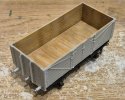
What brand of paint have you used to create the worn timber appearance? What colours?

Thank you. Graham

Hi Graham,

I use enamels, but the choice of original colours used was very much "what do I have available" and that became the standard thereafter.

The base colour is Revell SM382 'Wood Brown' - This is a generic, slightly teaky/golden shade but it makes a good base coat to build upon.

I then go darker, using Revell SM381 'Brown' - the idea being to dry brush this into crevices, corners and plank gaps where dirt would accumulate.

From there I go progressively lighter. First with a sandy colour - My choice ended up being a tin of Phoenix P504 'GER Loco Tan', but I'm sure similar sandy shades can be found elsewhere. Whilst I apply this all over, I sometimes emphasise areas of wear with this shade and contrast it against the darker bits.

The final layer is a light grey, which currently is Revell 75.

Whilst there are defined stages in my process, I often find myself touching in bits where I'd like a bit more dark/sandy yellow/grey and theres a bit of blending and general fettling until I'm happy with the final appearance. Some come up better than others but each one is fairly unique which I believe helps the cause!

I've realised when I discussed this before, way way back in post #7 that I never specified the exact colours used, so I apologise to any and all who may also have been wondering!

I hope this helps!

- James

 
GER Dia.1 Brake Vans

Liver & Fry

Western Thunderer
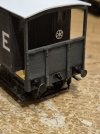
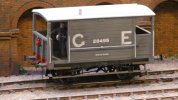
And last but not least in this trio of updates, having received the grey, I have corrected the headstocks on the brake vans. After vermillion was abandoned on brake vans built after July 1886, the buffer casings were painted black in line with other stock on the GE:

20251112_184350.jpg

Next job is to make up some new doors...

- James
 
GER Dia.55

Liver & Fry

Western Thunderer
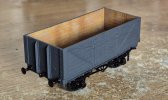
Painting was completed on the Dia.55 today meaning I will be able to crack on with lettering once dry:

20251113_150246.jpg

This will likely be what I focus on now as the end is in sight and it'd be nice to get a project done and off the bench (you all know how I dislike having too much on the go at once, and yet I currently have six wagons at various stages of completion!).

- James
 

Liver & Fry

Western Thunderer
One side of the Dia.55 has been lettered this afternoon. Very few GE era reference photos exist for these wagons, so my thanks must go to @Buckjumper once again for pointing me towards a photo of GE No.3124 at Yarmouth South Town on 26th September 1911.

20251114_175308.jpg20251114_175824.jpg

The white rectangle above the G is thought to be a pasted label, and I'm told these can be seen on various photos of GE wagons during the Edwardian period.

- James
 
GER Dia.1 Brake Vans

Liver & Fry

Western Thunderer
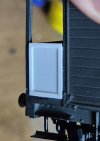
Having finished the Dia.55, attention has turned back to the brake vans and trying to work out how best to make new doors for them.

The real things had an outer frame, with raised beading surrounding five planks internally.

To replicate this I first cut out the back of the door itself and plugged the gap with this, before using 1mm plastic strip to mark out the outer frame:

20251121_134223.jpg

I then used 2mm plastic strip to fill the space in the middle with five planks:

20251121_142845.jpg

Beading was then adding using wire (I do not know the thickness of the wire - It's just a reel I had spare that fit the purpose):

20251121_153008.jpg

I'm happy that, once painted, this should look the part.

Only seven more to go...

- James
 

simond

Western Thunderer
I know we shouldn't make models of models
because we would inadvertently incorporate the errors, and potentially compound them, and so promote inaccuracy.

very laudable. I'm sure we are all in agreement that getting to the original drawings and photos of the prototype are the best way to go.

Now, could someone please explain AI to me...?

:))
 
Top