JLRT 45/55xx Build in S7

Steph Dale

Western Thunderer
John,

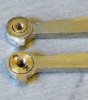
That area around crankpins and slidebars/crossheads is always a bit of pain. I can't see what crankpins you're using on the front driving axle - have you got them recessed into the rod or are you using a conventional nut?

One other quick thing - you have insulated the suspension wires from the frames (and each other) haven't you, I can't see it in the photos? Otherwise the split axles will remain a purely academic exercise as power zips along the suspension wires and through the frame spacers...

Steph
 
Last edited:

jc2001

Western Thunderer
Hi Steph

I'm using some that came with the superdetailing kit which are meant to look like the real thing. I tapped them 10BA to fit on the steel bolt crankpins. The bushes are slaters also tapped 10BA and are fractionally wider than the rods. The crankpin nuts fit on the end tight up against the bushes.

Yes the springs run in insulated fulcrums and there is some gapped PCB to restrain the ends. The central bearings have some plugs for the power takeoff.

John
 

SimonT

Western Thunderer
John,
as usual the kit doesn't quite get things right with the rods. Hopefully this sketch, copied from the 42XX GA, will give a clue.
Rods.jpg
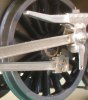
Firstly the rods are relieved behind to clear the boss and this also requires them to be built up behind on the face that touches the crankpin seating. The back of the rods and the forked joints have to clear the bosses. On the eight wheelers, the rear crankpin has a thick spacer to hold the rod away from the bosses. In addition, the leading crankpin nut is different to the others. It is far thinner and really is nothing more than a threaded washer. The others are far thicker and have flat bosses where the cotter pin goes through the pin and nut.

We are not helped by the bosses on the Slaters wheels being thicker than scale. Where the correct back to the bosses of the rod is not present on the etch, I use a 10BA washer to provide the necessary clearance. The front crankpin nut is secured in place with thread lock and it is then thinned down to provide clearance to the back of the crosshead. This filling will leave a small part of the representation of the cotter pin on the nut and I rely on dirt to hide that mistake.

Hope this helps

Simon
 

jc2001

Western Thunderer
Thanks Simon, very helpful.

I never realised that the front rod could be offset from the rear. As assembled mine isn't but given the trauma thus far I'm inclined to leave as is unless it is clear I need more clearance - and I can probably thin the nut a tiny bit more.

John
 

oldravendale

Western Thunderer
Yes, that's a magic set of photos.

I did this on the leading driving wheels on a Black 5 and immediately solved the conflict at the front end!

Brian
 

jc2001

Western Thunderer
I realise that it's been nearly a year since my last update, however the main reason for the delay is I've been building some track to test the chassis before progressing with the bodywork. Last night I finally wired up c. metres of track (including 3 turnouts) to give the chassis a spin. Initially it went very well but today I added weights to match the anticipated finished weight (c. 1400g) and have had no end of trouble with the pony trucks derailing - mainly on the curve but also on straight sections.

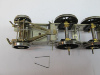
These are sprung with a single spring wire as in the photo below. I have tried a thicker wire without success. I would really like some suggestions as to what to try - and are there better methods of springing?

John

15951424180_715862bb6f.jpg
 

richard carr

Western Thunderer
John

I would have expected that to work, although the pony truck seems to be compressing the spring in the photo which suggests to me that it is too weak.
personally I would have fixed the spring near to the top of the pony truck and tried to keep the wire straight.

Richard.
 

jc2001

Western Thunderer
Thanks Richard,

I am now using a thicker spring wire than that in the photo. I've lost the original reference but the spring mount below the axle is meant to give a turning moment that holds the wheels down on a curve. It is clearly not working as intended. I'm wondering if it is better to have independent springs for suspension and centering? All suggestions very welcome.

John
 

JohnFla

Western Thunderer
John, I'm no expert at all but on the photo there are two bars below the axle ( its upside down ) could you get a strip of lead wide enough to epoxy to them, That would add some weight and you wouldn't see it when running.
 

jc2001

Western Thunderer
Thanks John. Adding some weight is definitely possible. I've been experimenting today to see if I can add extra springs to bear down on the top of the trucks which seems promising. I need to be careful to avoid reducing the weight on the drivers and CSB suspension. I'll try and get some new pics soon.

John
 

jc2001

Western Thunderer
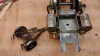
I revised the springing of the pony trucks using pieces of flat spring (probably from an old clock) which initially pressed up against a horizontal plate added under the chassis with the intention it would slide and the original spring wire still providing the centering force. Despite adding graphite etc. it didn't slide properly so I changed to the spring fitting in a slot which meant it also provided centering. This seemed to work well so I removed the original spring wire.

This shows the pony truck with spring and the slot and the following photo showing the chassis loaded up for running trials:

23941383290_bed5834000.jpg

24210875146_65576f8a54.jpg

And this is my first proper S7 pointwork which is being tested along with 5519:

24210853556_bb9f7fbec4.jpg
 

rusty

Active Member
John
I built a Mitchell 45 and a JLTRT 4575 (with s/d parts) both to S7 standards, years ago but I did keep a note of 'construction issues' that may be of use. I hope the instructions have improved! Outside steam pipes were short; chimney casting had a excessive taper, rear sandboxes ok for early condition but later type not included; cylinder block benefits from having two fixing points rather than one; the buffer beams appear to have been drawn with different buffer castings in mind rather than the type supplied (holes too big); cosmetic tank/cab overlay omits handrail holes on r/h side though 'structural etch does make provision - perhaps due to lowering of handrail after shutters were added(?); had a problem with bunker top beading in two sections that should be handed but I got two l/h etches; my footplate overlay included a 'ridge' for location of an etched motion plate as on 45xx but needed removal for the 4575 casting; exact position of tank vents and top feed pipes seem to vary - try to find a good photo; some parts of the linkage to front sandboxes need to be fabricated.
I replaced some parts using Springside castings (eg outside steam pipes) and some from Laurie Griffin. There is a useful photo of parts of a 4575 tank top in GW Journal 39 page 416. NOTE all the above was from a few years back so some of the castings and etching may have been revised.
Good luck. Give me a 'shout' if there is any point that needs expanding.
Julian
 

jc2001

Western Thunderer
Thanks for all the likes and kind comments. It's been a long journey and I'm looking forward to getting on with the bodywork. And thanks Julian for these notes. I don't know the class that well although I have acquired some plans and photos. I may well come back to you as I progress.

I added a small weight in the top of each pony truck for good measure and the loaded chassis seems to run very sweetly. The track is not very clean or polished but there has been hardly any hesitation in starting or running so I think the split axle pickup and collection through the CSB is proving sound. I'm running on DC for now but it will ultimately be DCC. I'm thinking of moving to Zimo chips - I've been a long time user of CT Elektronik on my O14 narrow gauge (including a dual chipped K1 Garratt).

John
 
Top