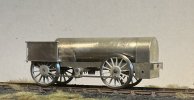
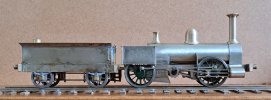
Ian@StEnoch’s workbench. Smellie’s finest!

John57sharp

Western Thunderer
I've just read through all of this thread with my first coffee of today. What a craftsman you are - these are wonderful models and your work does you proud.
Cheers!
John
 

Ian@StEnochs

Western Thunderer
I've just read through all of this thread with my first coffee of today. What a craftsman you are - these are wonderful models and your work does you proud.
Cheers!
John

Thank you very much for your kind words John. When I compare my work with others on here though, I am more of a practiced artisan than craftsman.

Ian.
 

Ian@StEnochs

Western Thunderer
It’s been a wee while since I posted any progress on Smellie’s finest but there has been a fair bit. As I explained earlier my plan is to build two versions of the 153 class or ‘Big Bogies’ and it’s predecessor, the 2-4.0. Both share a lot of common parts so batch building is the way to go.

As is my usual practice I set to to make the tenders and spent a wet day cutting out all the underframe components, frames and brake gear etc.

0C19F398-3B72-407F-B4A8-B455B043D38B.jpeg

While I was in the mood and full of enthusiasm I made the basic tender bodies. The sides are 15thou with a step milled top and bottom for the riveted angle and flaired top. The rivets were embossed along the edge of a sheet of 10thou NS before soldering them to the prepared side. This way the rivet strips stay straight and don’t curl like they do when riveting a narrow strip. The flairs were done the same way and curved, I have a jig, after attaching. The rear corners were trimmed to 45 on a belt sander and soldered round an inner floor. Next job should have been adding the beading but I found that I didn’t have enough so that is on hold until I get some at Stafford in September.

3219B924-3D5B-4C50-8A4A-CEA3D0406D57.jpeg
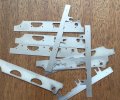
With tender work on hold I let myself slip and cut out the bits for the Apostle, and some of the common bits for the BB. For a scratch builder the beaded splashers are probably the most trying. In the past I have made a bit of a dogs breakfast trying to bend beading to follow the curves. Now I just mill out a shaped beading.

8A44FFF3-C884-4643-9CDB-0D1AF19BDBAA.jpeg

Assembly is quick and easy. A top strip is bent and soldered to the fronts and the beadings cover the joints. A clean up with a scraper and Scotchbright and they are ready to fit. These are the BB ones for stock.

8FE33B6C-2F28-4D37-9ADF-D9471EDD7092.jpeg

With the main components for the Apostle to hand I just had to put them together and this is the state of play as of today.

70CD6D3F-D024-4244-8875-A1709616BA43.jpeg

The Chimney is a casting I had done when I built the Wee Bogie and I have enough for the 3 engines. It is only just plonked for the photo, it still needs to be cleaned up and the seat fitted to the smokebox.

For the curious among you the wires behind the front wheels are attached to the insulated bearings for split axle pickup. They will be concealed later!

Ian.
 

paulc

Western Thunderer
Hi Ian , curiosity has got the better of me or is it confusion , I'm not sure .
Can you expand on the sentance ' now i just mill out a shaped beading '. Do you use a bit of kit on the mill that follows the profile of the splasher ?
 

Ian@StEnochs

Western Thunderer
Hi Ian , curiosity has got the better of me or is it confusion , I'm not sure .
Can you expand on the sentance ' now i just mill out a shaped beading '. Do you use a bit of kit on the mill that follows the profile of the splasher ?

Hi Paul,

I am still old school and use one of these to mill out parts.

353201C7-5DA9-491E-B216-43C677B0DA22.jpeg

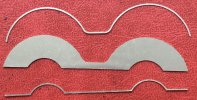
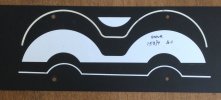
I bought mine a long while ago now and it has been invaluable. Second hand so it wasn’t expensive as most commercial users were moving onto CNC machines. I just prepare a pattern from plastic sheet and trace round it with the follower, the cutter mills out a perfect copy, but to scale. This is the pattern for the splashers, made 4 times the finished size so any errors in measuring are reduced by a factor of 4.

12C093DA-B6A3-4859-9CC0-AE7182B07072.jpeg

The alternatives would be fretting our with a piercing saw, highly skilled work and slow, or drawing up for an etch. The first is ok if you are only making a one off. The 2nd great if you have the drawing skill, the cad package and are prepared for the long lead time at the etchers plus the cost.
Other plus points of a pantograph are the ability to use the most suitable gauge of metal rather than be stuck with one thickness of etch. There is no cusp to remove, the edges are all square, and I can make the pattern in the morning and have the parts cut out that same afternoon.

Ian.
 

simond

Western Thunderer
And if you had a laser, you could draw on CAD, cut, and mill in a day

The alternative, getting an affordable CNC miller that has the rigidity of your old pantograph machine, will be a challenge…
 

Crimson Rambler

Western Thunderer
I also use a pantograph machine so I am at one with Ian@StEnochs. I find the machine invaluable - but no doubt others will say the same about their preferred methods CNC and 3D printing. Horses for courses I guess.

Crimson Rambler
 

Robin

Member
If anyone would like a pantograph machine just like that, floor standing, I have one that I no longer use. Free to a good home. Fully working, though the on/off switch can be dodgy!
Mike
Hello Mike

This is something that interests me - I would have contacted you privately but have no idea how to begin a private message.

Hopefully I would be considered a good home!

Best wishes
Robin
 
Last edited by a moderator:

45609

Western Thunderer
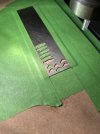
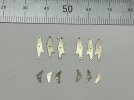
I love my Taylor Hobson K. I do exactly what Ian does. Make the pattern in the morning and mill it out in the afternoon. A couple of weeks ago this was the job for a 4mm scale Ivatt 2MT that I’ve been building from a Comet kit. The replacements for the inferior kit parts are from 15 thou nickel silver. I used a 14:1 master and a 0.4mm carbide slot drill so I could get into the tricky internal corners. I was a bit nervous about breaking a cutter but it was misplaced. All done with one cutter.

IMG_2528.jpeg

IMG_2535.jpeg

IMG_2536.jpeg

Cheers...Morgan
 

Ian@StEnochs

Western Thunderer
Four months since my last update. Progress has been made and the Apostle is almost finished, just the brake pipes and sanders to complete and she/he will be ready for paint. That will wait until the better weather.

Sorry no photo but I did find one of his/her stablemate, the 22 class or ‘steam brake goods’ on the wintery Ochiltree light railway turntable.

D5D7F824-E2EA-4562-9ABE-1E27C7105509.png

Incidentally, and it isn’t very well known, No 300 was one of the engines loaned to the Great Western during the Great War.

Merry Christmas to everyone.

Ian
 

Ian@StEnochs

Western Thunderer
The weather has been dreich in these parts so no chance of any painting. However I have not been idle and got started on what is turning out to be a bit of a tricky project.

My long standing aim has been to reproduce in miniature all of the major locomotive classes of the G&SWR. Progress has been steady and I only have a few of Manson and Drummond engines to build, the Smellie Apostle just needs paint and the tender is finished for the Big Bogie. My recent foray into early Stirling engines prompted me to look at something else, a bit more esoteric perhaps, but this is where I am.

IMG_4071.jpeg

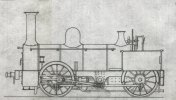
Patrick Stirling’s 99 class of 1854. Four engines intended for mineral traffic. Little is known of them except they were not very successful and didn’t last long. No known photos of them but the above engraving from Ahrons, and a damaged GA from Hawthorns, the builders, exist. I also have a frame plan and end sections from Cook Street, works signed by Stirling himself. The sketch above corresponds well with the GA though some details are different and some difficult to understand.

I thought this would be a quickie but as there is no continuous footplate, the boiler sits very low, with the feed pumps attached, there are various braces between frames and boiler and I cannot find how the weigh shaft is attached to the frames. Anyway if I waited until I had complete information I would never start so this is progress so far.

IMG_4138.jpeg

Next task is to fit a drive system onto the rear axle and a motor in that tiny firebox.

Ian.
 

Ian@StEnochs

Western Thunderer
Five months since my last update. However I have not been idle and made a bit of progress with the 99 class and got the Apostle ready for paint. It is all stripped down and cleaned but with this dismal damp weather I am not keen on firing up the airbrush just yet.

On the 99 I managed to cobble a drive system in the firebox. Not a lot of space but I got a small can motor driving a first stage worm and wheel with final drive to the axle with a salvaged set of crossed helical gears. It doesn’t run very fast but I don’t suppose the original did either.

Alongside the drive system I made the eccentrics and got the valve gear working. 6 sheaves 2 for feed water pumps. It all waggles nicely but as the loco trundles past it is difficult to see the movement! At the same time I made the cylinders and slide bars each of which is attached with a couple of screws so they can come off for painting.

For a bit of variety I then turned my attention to the tender which is now virtually finished, just tool boxes and a fall plate to make. The tender has 3 point suspension and split axles for current collection. As is my usual buffer planks are boxwood, ex broken rulers, sandwiched between sheets of Nickel Silver.

Attention has turned again to the engine and today I got the lathe working and turned up the boiler fittings. It now looks a bit more interesting hence the record shot below. The tender looks a bit tarnished but that will disappear under the paint.

IMG_4268.jpeg
 
Top