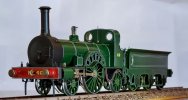
Ian@StEnoch’s workbench. Smellie’s finest!

Ian@StEnochs

Western Thunderer
Modelling time has been short of late what with holidays and a week volunteering, and enjoying sampling, at Scotland’s biggest cask ale festival. However this week I managed a fair few hours so I think that is the build complete. I left off the pipework and handrails for a bit of running in on my test track which went better than anticipated. She started a train of 4 six wheeled coaches on the level which is as much as she is ever likely to be called on to handle.

520CF533-C864-4775-87DD-F8258BCEA13B.jpeg

I’ll now strip everything down for cleaning and paint plus a bit of weathering as I want to finish her in the condition she would be in near the end of her working life.

Ian.
 

Ian@StEnochs

Western Thunderer
10 weeks later and the paint is on! I am still waiting on the works plates to be delivered so that I can give her a spray of varnish and a bit of weathering. My intention is that she should be portrayed near the end of her working life, clean and cared for but with some worn and scuffed paint, and still able to act as pilot in front of an Apostle or Big Bogie.

No 40,  Patrick Stirling 40 class Single.jpg
 

paulc

Western Thunderer
Hi Ian , will we see a picture of this loco after you've weathered it . Nice as it is now i love to see a loco after it's had a bit of 'use' .
 

Ian@StEnochs

Western Thunderer
Hi Ian , will we see a picture of this loco after you've weathered it . Nice as it is now i love to see a loco after it's had a bit of 'use' .
Hi Paul. Yes once I get the works plated delivered and fitted plus I need to source a crew. That is proving a little difficult as almost all the figures on the market depict modern ‘tall’ people. My loco needs chaps about 5’6” to look right.
Ian
 

Ian@StEnochs

Western Thunderer
Thanks folks.

I admit that I hadn’t thought about looking for a smaller scale crew. I will contact Alan after the holidays and see what he can offer.

My preference has always been for whitemetal figures to add that bit of extra traction weight to my small engines. However this one will haul all I want from it already so a heavy crew are not so important.

These are the two individuals I hope to replicate!

F3A69FA5-4D84-4497-9347-89EF40570444.jpeg
 

Ian@StEnochs

Western Thunderer
Not a lot of progress to report on the crew of the single but I have not been completely idle. The next subject in my programme of building is to be the product of one of locomotive engineerings forgotten masters. That engineer was Hugh Smellie.

But first a bit of his histrophy. Smellie was apprenticed at Kilmarnock works, then under the control of Patrick Stirling, so may well have been involved in the construction of the singles. 10 years after becoming a journeyman he succeeded James Stirling as works manager and 8 years later went to the Maryport & Carlisle as locomotive superintendent. Returning to Kilmarnock in 1878 to replace James Stirling who had gone to the South Eastern.

Smellie, no sniggering there, was a common Ayrshire name, sometimes gentrified in pronunciation as Smillie, started his career at Kilmarnock works as the boss by modifying and completing a small class of 0-4-4 tanks started by Stirling then produced 4 classes of engine before being headhunted by the Caledonian to replace Dugald Drummond. First up a 2-4-0 with 6’9” drivers, the twelve Apostles intended for work on the Stranraer line where the turntables were too short for a 4-4-0. Next came an 0-6-0, the 22 class of which 64 were built, and then two classes of 4-4-0, the Wee Bogies with 6’0” drivers for the hilly Greenock road and the Big Bogies with 6’9” wheels for express services everywhere else.

I have already built a Wee Bogie and a 22 class but the lack of correct 6’9” wheels for the other two has been holding me back. Having made the wheels for the single I concluded that what was do-able for a wee engine would not be viable for my sanity if nothing else. Having explored a number of option I finally settled on 3D modelling and lost wax castings. The CAD took some time to get my head round but in the end I got some excellent brass centres with correct rectangular section tapered spokes back and front. Tyres I had to make so over the last few days I have been machining wheels and while set up reprofiling a batch of Slaters wheels for other projects.

Having a Myford made the task relatively straightforward but still time consuming. I was lucky to obtain some free cutting steel tube of suitable diameter, machining from solid bar would have tried even my patience!. This is the setup.

FEC90E53-9F1E-4C4B-AF6A-BA8128039141.jpeg

The sized tube is laid out as four wheel blanks and roughed out before profiling with the form tool in the rear toolpost. The end blank is then bored for the cast brass centre which is pressed in and the wheel parted off. Repeat.

8E4C6059-5AD2-4CBF-937D-1F57367AE747.jpeg

This is just some of the drivers, some plain and some with balance weights plus a couple of unused centres. Not finished yet as I need a different setup to machine the split axles.

The plan is to build the tenders first, 3 identical and one modified, before the engines. The Apostle first and then 3 versions of the Big Bogie. More later!

Ian
 

paulc

Western Thunderer
Hi Ian
Not a lot of progress to report on the crew of the single but I have not been completely idle. The next subject in my programme of building is to be the product of one of locomotive engineerings forgotten masters. That engineer was Hugh Smellie.

But first a bit of his histrophy. Smellie was apprenticed at Kilmarnock works, then under the control of Patrick Stirling, so may well have been involved in the construction of the singles. 10 years after becoming a journeyman he succeeded James Stirling as works manager and 8 years later went to the Maryport & Carlisle as locomotive superintendent. Returning to Kilmarnock in 1878 to replace James Stirling who had gone to the South Eastern.

Smellie, no sniggering there, was a common Ayrshire name, sometimes gentrified in pronunciation as Smillie, started his career at Kilmarnock works as the boss by modifying and completing a small class of 0-4-4 tanks started by Stirling then produced 4 classes of engine before being headhunted by the Caledonian to replace Dugald Drummond. First up a 2-4-0 with 6’9” drivers, the twelve Apostles intended for work on the Stranraer line where the turntables were too short for a 4-4-0. Next came an 0-6-0, the 22 class of which 64 were built, and then two classes of 4-4-0, the Wee Bogies with 6’0” drivers for the hilly Greenock road and the Big Bogies with 6’9” wheels for express services everywhere else.

I have already built a Wee Bogie and a 22 class but the lack of correct 6’9” wheels for the other two has been holding me back. Having made the wheels for the single I concluded that what was do-able for a wee engine would not be viable for my sanity if nothing else. Having explored a number of option I finally settled on 3D modelling and lost wax castings. The CAD took some time to get my head round but in the end I got some excellent brass centres with correct rectangular section tapered spokes back and front. Tyres I had to make so over the last few days I have been machining wheels and while set up reprofiling a batch of Slaters wheels for other projects.

Having a Myford made the task relatively straightforward but still time consuming. I was lucky to obtain some free cutting steel tube of suitable diameter, machining from solid bar would have tried even my patience!. This is the setup.

View attachment 242836

The sized tube is laid out as four wheel blanks and roughed out before profiling with the form tool in the rear toolpost. The end blank is then bored for the cast brass centre which is pressed in and the wheel parted off. Repeat.

View attachment 242837

This is just some of the drivers, some plain and some with balance weights plus a couple of unused centres. Not finished yet as I need a different setup to machine the split axles.

The plan is to build the tenders first, 3 identical and one modified, before the engines. The Apostle first and then 3 versions of the Big Bogie. More later!

Ian
Hi Ian , nice work . Do you use the tailstock to push the centre in ?
 

Ian@StEnochs

Western Thunderer
Hi Ian

Hi Ian , nice work . Do you use the tailstock to push the centre in ?

Hi Paul,

Thanks. Yes I did. I had a tin lid shaped pusher which sat on the rear of the rim to press it in. The brass casting didn’t need any machining, just a few strokes of a file on the edge to clean them up. As a belt and braces exercise I tinned the brass first with 188 solder and sweated the centre and rim together to ensure they never part company.

Ian.
 
Top