Hobbyhorse. Some more work on the Stirling Single

Hobbyhorse

Western Thunderer
After sorting the photo posting issues it's good to get back to some workshop time.

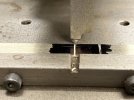
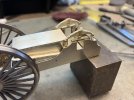
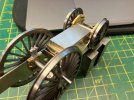
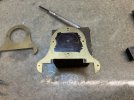
Assembly of the frames was straightforward, copying the first build. The bearings required didn’t take much time to knock out, machined from round bar and milled square, drilled, reamed and parted off.
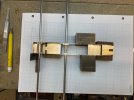
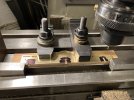
First job with the bogie was to produce more horns as I didn’t have enough castings left over, a straight forward job with eight needed, made from some 3mm square brass with milling, slotting, drilling and a bit of hand work, a good afternoon’s work.

Quick reminder for this Thursdays Online Modellers Meeting, from 18:00 all members welcome. Details can be found on the Guilds WEB site Diary page.

Simon


FullSizeRender.jpegIMG_0901.jpegIMG_0903.jpegIMG_0905.jpeg1E91BB65-8912-46DA-93FD-28B7E9C28FFB.jpeg692EBCE5-7924-4942-A6C0-D4D69E3BE21D.jpegIMG_0909.jpegIMG_0912.jpeg
 

45609

Western Thunderer
This is a fascinating build and great precision work. I have one question on the horn cheeks you've made. Did you silver solder or soft solder the webs into the L shaped section?

KR...Morgan
 

Hobbyhorse

Western Thunderer
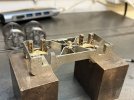
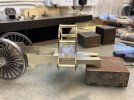
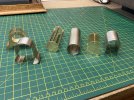
Studying my drawing I’d mapped out the inner framework on the bogie, and for some reason I didn’t include this on the first build. As it adds a lot of detail it’ll be good to incorporate it, centred around the pivot which was made mostly on the mill, and finished on the lathe it was an interesting job, and I couldn’t resist adding the securing pin into the end of the studding. To achieve crisp bends in the plate work for the internal frames, small V’s have been cut into them. With the four springs added it’s nearly complete.

Simon
54824541361_335be922ae_b.jpg
54824820968_41d4b41ca4_b.jpg
54824811393_4d757a2b04_b.jpg
54824791449_fbbecb707d_b.jpg54824876535_c7f8793d5b_b.jpg54823694257_de3615a65f_b.jpg54824876810_a110074d96_b.jpg
 

Hobbyhorse

Western Thunderer
The construction of the Firebox bottom and ash pan was fairly straightforward, basically 2 tapered boxes with 10 thou nickel silver overlays providing the rivet details. The two springs have a fixing on this as it’s easier with the space limitations that should fix to the frames, the rear fixings are correctly located on the frames. This unit is removable with two fixings located on the top of the frames, the rear wheel are also held captive.
Additional details added are the 5 washout plugs, and the boiler expansion/fixing brackets.
Also added the white metal springs to the driving wheel keeper plates.

At a recent Online Modellers Meeting we had a discussion around forum posts, and how easily information is given. You will know for my post are fairly well descriptive with lots of photos, it was apparent that video content on building projects was well liked and in some cases preferred to show techniques easily. I’ve not really considered this approach but are willing to give it a go on some of the more complex jobs, plus it could be useful for quick updates. It’s not going to be super slick videos but hopefully show what’s needed. It’ll be interesting to hear if you have any views.

Simon
54824811228_70636d678a_b.jpg
54824541191_d9031b56b7_b.jpg
54860830769_1da6086d3b_b.jpg
54859717927_6b3d4711f1_b.jpg
54860843388_d4a6065273_b.jpg
 

richard carr

Western Thunderer
Hi Simon
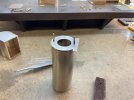
I think videos would be a really good idea, a small tripos that you can mount your phone on should all that you need.

Richard
 

simond

Western Thunderer
Funny, isn’t it.

My kids (in their twenties) always say “just YouTube it, someone will show you how to do…”

Personally, I hate videos, mainly because they take so long showing you stuff you know or don’t care about, just to get to the bit you really want to see, which is over and done in the blink of an eye. Much prefer photos and text. Can skim read to get to the important bit, (always recognising that what I’m ignoring might be pure gold for someone else) and dwell on the photos, rather than have to stop and scroll back.
 

James Spooner

Western Thunderer
That is lovely work! On the video front, I must admit I had shied away from whitemetal soldering until I firstly bought a cheap(ish) wagon kit and secondly watched a G0G video on YouTube demonstrating same. It gave me the courage to start so I would add a vote for… The thing about YouTube is you can always scroll through the boring or irrelevant bits and rewind if you need to…

Nigel
 

Hobbyhorse

Western Thunderer
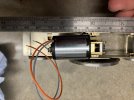
Fixing the motor is normally straightforward but as can be seen in the photo its very out of square, so a conversation with the maker is needed, I also checked another one I ordered at the same time and it’s the same.
Machining the slot in the gear for the axle fixing pin, and the cradle to keep the motor vertical has been done.
The design of the smokebox incorporates the cylinders which are fixed to the main frame, leaving the smokebox removable. For this model I’m incorporating the speaker into smokebox, which needs access so I’ve open out the rear.

This Thursday 6th November we have another Online Line Modellers Meeting from 18:00, all Guild members welcome.

Simon

54898640608_c0a1c001f6_b.jpg
54890224254_1a47feeceb_b.jpg
54898713435_4afeeb4d9d_b.jpg
54890216534_211d179a4b_b.jpg
54890265335_df5e828311_b.jpg
54890216334_436888782d_b.jpg
54890216294_51a29180c4_b.jpg
 

mickoo

Western Thunderer
I gave up on ABC a couple of years ago to be honest, but never had one twisted like that to be fair.
 

Hobbyhorse

Western Thunderer
The most elegant part of the loco is the running plate and the very distinctive driving wheel splasher. I can remember spending a lot of time measuring and drawing these parts, with two visits to York required to get them right. The running plate is constructed around a frame that incorporates the 4 valances, this ensures everything is square and flat. I hadn’t cut the frames when the original models were constructed so an hour on the panto produced these, strangely I had cut the spacers. Once the slots had been cut into the frames assembly of them was straight forward.
Next job is the running plate and boiler.
Simon

54890265340_030710dc94_b.jpg
54889971896_9d7d39cf7f_b.jpg
54890216509_142b676f54_b.jpg
54889971881_19d8ca56b1_b.jpg
54890265590_6cf64d6b17_b.jpg
 

Hobbyhorse

Western Thunderer
Assembling the boiler and running plate is an important milestone as all the various levels can be checked.
Luckily I’d already cut out the running plate, which was made slightly over length to allow for small adjustments to be made. The footplate and valance won’t be removed until the boiler/firebox has been made and checked on the frame.
Screwing together all the boiler frames and checking the alignment holes showed up a couple of small errors, especially around the smokebox and boiler which are screwed together, easily corrected adjusting the hole centres and retapping 12ba.
Pre forming the skins for the three sections using 10 thou nickel silver and assembling was straightforward, and once checked on the running plate the firebox and boiler section were soldered together, and then the fixings to the running plate added.
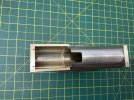
To allow for the fitting of the motor and gearbox quite a lot of material has to be removed, having just invested in a new portable rotary micromotor this made light work of this.
The graceful line of the loco are beginning to appear, next is to add the splasher.

Simon
54898637003_6f66ef2be7_b.jpg
54897539297_091192554f_b.jpg
54929501015_db6901fef1_b.jpg
54929501455_e2a4674ddd_b.jpg
54928328762_38c1ab39c0_b.jpg
54928328737_82deb6a2bd_b.jpg
 

lankytank

Western Thunderer
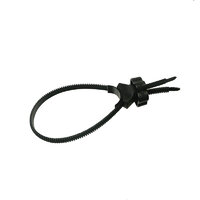
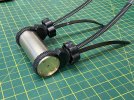
Simon, those black plastic screwy, grippy, clampy things look interesting..... can you remember where you got them from & would you care to share said information, please.

As the above was being tryped - the little grey cell was whittering away to the fact that they've been 'discussed' before, around here somewhere, could someone put a silencer on the grey cell, please - I don't seem to be able to lay the digit on said discussion. @daifly you're usually good at this sort of thing.....
 
Top