Garden railway in 16mm: Wilmington Light Railway

Greengiant

Western Thunderer
One year later, July 2023!

Progress with the garden railway has been somewhat sporadic, with a number of other things getting in the way.

I am pleased to say my PVC Foamex buildings survived last summer's heat very well.

52515507775_7ae0b3c577_c.jpg

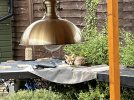
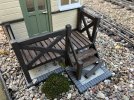
Unfortunately the signal box steps did not fair so well, not helped by the antics of a certain fox!
53046059964_0a77ee88d7_c.jpg

Who?

Me?

53046170870_12705b9692_c.jpg

Who produced rather a lot of cubs, ten in total!
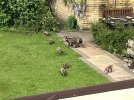
53046276243_c90ed975a3_c.jpg

Martin
 

Greengiant

Western Thunderer
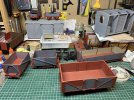
Over the winter months 0f 2023, as a break from work and to keep things moving with the line, I made a start on painting 30+ wagons that I had built and had sat in primer for a few years.

It was something that I could pick up and put down at will, whether I had 10 mins spare or a few hours, which will explain the various stages each item is at.

53046422647_1e8193508a_c.jpg

53045784616_0c9aed06f5_c.jpg

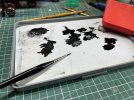
These days I work mainly in acrylics for the basic painting. A recent game changer for me is the discovery of Wet Pallets and brush soap.

The wet pallet is, as the name suggests, a pallet that is permanently wet (damp). I found out about these while following various military modelling forums and pages. It is basically a small (Mine is about A5 in size) container with a sealable lid. Contained within is a sponge base layer, on top of which is a permeable replaceable sheet that holds the acrylic paint, these sheets can be washed a number of times before they need replacing. The container is filled with water to the top of sponge, this keeps the permeable sheet damp and dramatically reduces the speed with which acrylic on the pallet dries out. I used to waste a lot of acrylic because it dried out on the pallet before I could use it all.
With the lid sealed on, the acrylic can last up to 1-2 weeks staying workable, very useful when you have created various weathering mixes.

This is my Redgrass Wet Pallet.

53047414110_c74693f49b_c.jpg

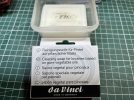
Something else I learnt about was da Vinci brush cleaning soap, this helps with cleaning the brushes and keeps the tips in good condition. For many years I have used mild hand soap, some of my sable brushes are over 40 years old from my early art school years, but this brush soap works even better and should well last me out!

53047204184_0220722e6e_c.jpg

Martin
 

Greengiant

Western Thunderer
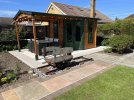
In early summer of 2024, I did actually get some track laying done, but it was 1:1 scale with an odd gauge of 22 inches.

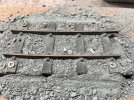
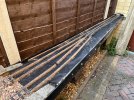
It all started when my daughter said it would look good if there was a short length of track in front of the cabin, then it would look like an old station. After sharing that conversation with my friend Ken, a few days later he turned up with a delivery of some sleepers, short lengths of rail, fishplates, a wagon and some ballast.

Some sleepers and rail, there are longer lengths behind the sleepers that you can just make out.

53045200472_46ceab998d_c.jpg

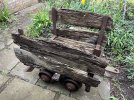
And a wagon which has been standing on a bank of the zig zag of Ken's own 2 foot gauge railway for as long as I can remember.

53045200467_48098f2029_c.jpg

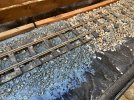
I wasted no time in getting the sleepers and ballast laid.

53046171090_437c633fc5_c.jpg

Followed shortly after by rail and the wagon. I was short of rail fixings, but sourced the bolts and plates off Amazon, being bright zinc I need to weather them down at some point.

53045200357_4eb579daba_c.jpg

I have managed to sell the idea to my wife as a sort of art installation, luckily some of her friends who have visited liked it, so that is an approval gained for me!

Ken was always puzzled by the provenance of the wagon and where it originated. He cannot even remember getting it, other than as a one of many job lots he bought years ago, but being 22 inch gauge would not run on his own line, so was just dumped on the bank and engulfed by nature for many years.

It is only recently the mystery has been solved as to provenance. Ken found out it is from the Purbeck ball clay mines, having seen some at the Purbeck Mineral & Mining Museum while visiting the Swanage Railway.

Here is a photo of one.

53047072176_59660e6b00_c.jpg

Martin
 

Greengiant

Western Thunderer
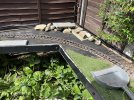
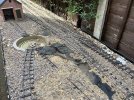
The engine shed area took a bit of a battering!

It is a shame, if it was not for foxes and cats it would have worked reasonably well, more of which shortly.

Very tempted to rip the whole lot up and return it back to garden and just stick with indoor lines. Will give it one more go though, but if that fails, I will admit defeat and move on.

53123288576_b45963375c_c.jpg

I made an error when building this railway, I had not allowed for the PVC edging strip to expand more than the metal frame and base. The consequence of this is the gap created on expansion, gravel and stones drop through and catch preventing the return of the PVC edging to flat. Gravel then washes down the gap when it rains.

53130804928_060751f2d6_c.jpg

I have virtually cured the problem on the front edge by doubling up the number of bolts holding it on. Also with membrane cloth and edging strip screwed down. If the PVC does bow, the membrane and edging strip stop the gravel flushing away. I had quite a session last year and made good progress with preparing the rest of the line.

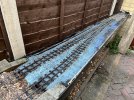
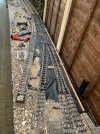
Work in progress along the fence side.

52515507785_bfd2ce0e2c_c.jpg

52514556777_1c042dbe23_c.jpg

Even if I did miss a bit of track and laid over it!

52515298759_1ee6a8f026_c.jpg

My joy was short lived, overnight it got ripped up.

53046276393_f02e22c9cc_c.jpg

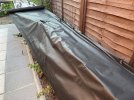
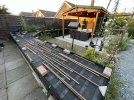
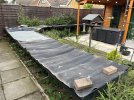
I have had to resort to covering it in felt, until I can get the track down and ballasted.

53045784781_4f05a3ed7f_c.jpg

Martin
 

David B

Western Thunderer
I’m loving this journey Martin - you’re using innovative techniques that I’ve never seen described elsewhere and your buildings are truly excellent. I really feel for you with the destruction caused by wildlife - on my old line, which was partly on ground level, I had an ongoing battle to keep the tracks usable - cats and foxes again, but also my own flock of free range bantams, who covered the rails in seconds with their scratching and foraging. In the end, I had to install stainless steel fencing, as per the photo below:

IMG_0152.jpeg

My current line is between 1 and 3 feet above ground and has so far hosted the bantams (again), pheasants, hedgehogs, a muntjac and (this morning) a mallard. Ants use the tracks as a quick way of getting about, which means having to clean off their squashed corpses after each running session, while pigeons bomb the line and the trains from the horse chestnut tree above…..there are definitely times when it feels as if nature is determined to win, so I completely understand why you have felt like moving back indoors at times.

I’m really looking forward to seeing how you won through - thanks for sharing the war stories as well as the great photos of your progress.

David
 

Greengiant

Western Thunderer
I’m loving this journey Martin - you’re using innovative techniques that I’ve never seen described elsewhere and your buildings are truly excellent. I really feel for you with the destruction caused by wildlife - on my old line, which was partly on ground level, I had an ongoing battle to keep the tracks usable - cats and foxes again, but also my own flock of free range bantams, who covered the rails in seconds with their scratching and foraging. In the end, I had to install stainless steel fencing, as per the photo below:


My current line is between 1 and 3 feet above ground and has so far hosted the bantams (again), pheasants, hedgehogs, a muntjac and (this morning) a mallard. Ants use the tracks as a quick way of getting about, which means having to clean off their squashed corpses after each running session, while pigeons bomb the line and the trains from the horse chestnut tree above…..there are definitely times when it feels as if nature is determined to win, so I completely understand why you have felt like moving back indoors at times.

I’m really looking forward to seeing how you won through - thanks for sharing the war stories as well as the great photos of your progress.

David

Glad you are liking the thread. Nature has been the biggest battle with the line, but I learn at each stage. Currently I am working on making a start with the indoor section, hoping soon to get the 40 foot section that will join the outside to the inside done this summer, but that does involve a couple of bridges and an incline.

Martin
 

Greengiant

Western Thunderer
I have never been really happy with the look of the ballast, so did an experiment with Grano dust, which is about £5.00 for 25kgs locally.

Here spread dry on a test section.

53045200202_442d732093_c.jpg

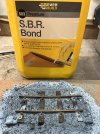
Stuck it down with SBR in the good traditional way of model railway ballasting.

53046276268_b6a0131550_c.jpg

It dries a darker colour. Stuck firm and lasted well when left out for a few weeks. Will do another one mixing in some of the original ballast which is RHS potting grit.

If it works this should stop any digging up and will be very easy to brush clean. The only downside is drainage, will have to leave some drain holes and maybe just fill those with loose gravel or use more artificial grass.

53125325094_8e717ee67b_c.jpg

Martin
 

Greengiant

Western Thunderer
Along with making the track fox proof, I need to address the problem with PVC edging expanding more than metal, then allowing stones to drop through and prevent it returning flat.

I got on with the first eight feet and the railway. My start point at the beginning of the line, some of the artificial grass has been lifted.

53130320511_65e1163cb5_c.jpg

Track unscrewed, gravel removed.

53130804908_b6d520dc6e_c.jpg

Using a 90 degree drill adapter to drill new bolt holes to prevent fascia expanding.

53130804743_1f0662bfba_c.jpg

You can see the extra rear bolts in each recess of the base to hold the rear fascia flat. The rest of the gravel was hoovered out using an AquaVac fitted with a reusable canvas bag.

53130320521_65b1f9385b_c.jpg

Troughs now filled with rubber I had kicking around in the shed.

53130736035_943d64d684_c.jpg

Membrane (cheap weed membrane bought from Amazon) fitted, ready to be clamped down with hardwood strips.

53130320526_ed5b972c1a_c.jpg

Clamping strips and track support strips now in place.

53130530279_85d1eacefc_c.jpg

Track screwed back down.

53130320641_c04009cbbf_c.jpg

I will be making this change to all the points. Firstly to give somewhere to mount a Point lever, secondly I will not ballast under the tie bar to reduce the risk of any stray gravel locking up the point switch. This was an annoying problem I had with loose ballast. Rain and animals would dislodge small grains and they would get stuck in the tie bar mechanism and jam it up. Much time would be spent with tweezers trying to clear the problem before running could take place.

53130805098_fd4e277997_c.jpg

Martin
 

Greengiant

Western Thunderer
I have never been happy with the ballast. In the middle is now my preferred version which is a 50:50 mix of the original RHS potting grit and Grano dust (Although that changes again later!).

53129728592_602a3dcd06_c.jpg

The 50:50 mix in place.

53130805123_43fbb33cfc_c.jpg

Wetted with water with a drop of washing up liquid to break water tension.

53130736200_42b8f4197f_c.jpg

SBR neat from the can, dropped in place with a pipette.

53130736115_cafaa3d32f_c.jpg

I had a slight change of plan. Grano dust is cheaper than potting grit, so I used Grano dust to do the basic filling. When this has cured it will be topped off with the final 50:50 mix. Note the under tiebar area has been kept clear.

53130805133_3610064d54_c.jpg

Glued in place just past the point.

53130320666_d8bd6c878a_c.jpg

A close up showing the difference in method. This will need a top layer of the 50:50 mix when dry.

53130736210_54eaaffeef_c.jpg

The first eight feet took 2-3 hours to ballast to this stage. It is now covered with plastic sheet and timbers to deter our night time visitors!

53130530484_ec43f30fb4_c.jpg

Only another 150 feet to do before I reach the first 90 degree turn, this could take a while!

Martin
 

simond

Western Thunderer
Martin,

I‘m concerned about your approach to the differential expansion.

I don’t think you can prevent the expansion, so if you fix it in one place, it’ll simply move elsewhere, or something else will give way.

Hopefully the black textile will prevent errant gravel, in any case.

best
Simon
 

simond

Western Thunderer
You’ve spent a lot of effort to make the layout fox-proof but was it not possible to make the garden fox-proof? It’s what I did successfully several years ago for my quarter-acre back garden.
Dave
I wish I could stop badgers digging up our patch of grass (too small to be a field, too rough for a lawn…) as they seek grubs. The holes they leave behind are pretty much exactly the size of the castor wheel on our robot lawnmower, and trap it most effectively.
 

daifly

Western Thunderer
I wish I could stop badgers digging up our patch of grass (too small to be a field, too rough for a lawn…) as they seek grubs. The holes they leave behind are pretty much exactly the size of the castor wheel on our robot lawnmower, and trap it most effectively.
The badgers were stopped at the same time as the foxes. It’s the old technique of making your neighbours’ gardens easier to access and dig up than yours. They learn quickly!
Dave
 

Greengiant

Western Thunderer
Martin,

I‘m concerned about your approach to the differential expansion.

I don’t think you can prevent the expansion, so if you fix it in one place, it’ll simply move elsewhere, or something else will give way.

Hopefully the black textile will prevent errant gravel, in any case.

best
Simon
Simon,

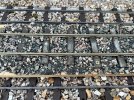
The textile and wood strip, allong with artificial grass eventually worked thankfully.

Martin
 

Greengiant

Western Thunderer
You’ve spent a lot of effort to make the layout fox-proof but was it not possible to make the garden fox-proof? It’s what I did successfully several years ago for my quarter-acre back garden.
Dave
Dave,

I made a mistake early on when I had the then new workshop installed, instead of having a solid base cast, I went the skinflint route and had concrete strips where the floor bearers were. What I had not considered was foxes would dig under the shed between the bearers! It took a few years of making sure they were out and screwing mesh pieces across the earth based bits to keep them out and airflow under. Reading up about it at the time, they also make a reserve den near the main one as a back up, and sure enough I found that under the first part of the railway. Pleased to say we rarely see a fox in the garden these days. The battle these days is with next doors cats leaving packages on the railway, although that is getting less.

Martin
 

Greengiant

Western Thunderer
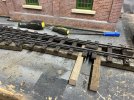
A productive day, stripped out a 12 foot section of track. Fixed the rear fascia, put down the membrane, relaid track with added point switch timbers.

Ballasting next on the list.

53134261120_4b48ac6547_c.jpg

53134333253_70004762c2_c.jpg

It was easier to do the point timbers on the bench in the workshop.

53133255447_9aa8957dc5_c.jpg

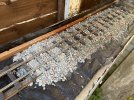
Membrane laid, track back in position. Interestingly some of the Peco fishplates had fractured, so they were replaced. I have moved on to using their G45 fishplates, they are longer and stronger.

53133255462_516573973f_c.jpg

This now needs to be ballasted, The signal box and engine shed have been removed to improve access. The engine shed area will have a different treatment of ballasting, of which I have not finalised how yet.

The goods yard will probably be a mix of main line and engine shed ballast, early days yet though.

Martin
 
Top