Stevers
Western Thunderer
Well hopefully not, although it's bound to fall off YMRG's South Junction at some point if I can make it go fast enough. So no, this is a thread about modelling the vans and coaches of this ill-fated train in 3D CAD with a view to getting them 3D printed.
As a child I lived for a short time in Downton which happened to be after closure of the Salisbury & Dorset during the period when the track was being lifted, so I'd seen the track down from the bridge in Moot Lane and seen the smoke above the trees from the school playground from the demolition trains oblivious to what was about to happen to something so apparently permanent. However the urge to model this unfortunate train only arose after an impulse purchase of one of those K's Milestone Falcon Class kits on Ebay that was missing all the dodgy underpinnings that I would have discarded, making it a curiously attractive purchase. Although this feeling was somewhat tempered when I realised that the driving wheels originally provided had the 24 spokes not available commercially!
Falcon Class engines were used on the Salisbury & Dorset in 1880s and 1890s, and Siren (being a Bournemouth engine) was my initial choice. A splendid photo in Bradley from this period shows it shorn of almost all Beattie weirdness, with a purposeful looking stovepipe chimney, painted domes and modestly extended cab. Although as it happens Sirius a Salisbury engine might be a better choice for reasons outlined below.
So with a layout supposedly set in the 1950s, what sort of train could this late condition engine pull, for pull a suitable train it must? The latest products from Hattons and Hornby were quickly discounted as being too modern for the sort of train that I had in mind, and then I remembered the Downton Train Crash (actually across the river from Downton) and wondered if there was a BoT Accident Report online - and there was! It's a fascinating document giving a voice to all sorts of people who had been witness to that dreadful event that took five lives. From my point of view though it gave a lot of information about the vehicles in the train, including running numbers, build dates, lengths, braking and coupling arrangements, all of which I could cross-reference to drawings and photos in Gordon Weddell's LSWR Carriages Volume 1. From this I produced a montage of that fateful Salisbury to Weymouth train that included the close coupling of pairs of carriages for stability. My chimp brain liked what it saw and generated considerable enthusiasm for me recreating it as a good example of what an early train through Verwood would have looked like, albeit with a Salisbury engine hence Sirius.
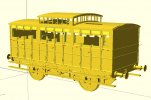
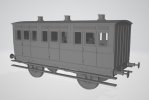
On Christmas Eve I started on the 1865 Third Class coach by scanning in Gordon's drawing, then importing it into and scaling it in QCAD. From this I made a 'regularised' trace of it to winkle out any inconsistencies in the drafting, and then started to create suitable 2D drawings in QCAD ready to recreate the coach body in 3D using OpenSCAD. Some of you may know that I've previously generated a yard crane and LSWR Type 1 signal box using this method, but a whole coach body? Anyway, as there were three of these in the train, it seemed a good place to start. The body came out OK, so I gave it compartments, seats, a roof, then buffers, leaf springs and axle boxes to go underneath with some full length footsteps and Mansell wheels all following the Weddell Drawings. By News Year's Day the coach in 'late' condition with long buffer shanks and two full length footsteps each side was complete.
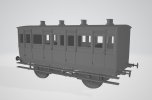
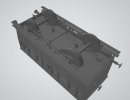
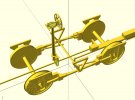
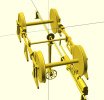
It's a simple little thing with conventional panelling and uncomfortable wooden seating. It is shown here fitted with my interpretation of the not very Continuous Newall Mechanical Brake that will be the subject of the next not very exciting instalment. As an aside all the coaches have similar springing arrangements, wheels, W Irons, lamps. and braking arrangements, so these items are created once and shared by the vehicles that need them, with any variations like wheelbase, brake standard positions, and control arrangements specified using input parameters.
As a child I lived for a short time in Downton which happened to be after closure of the Salisbury & Dorset during the period when the track was being lifted, so I'd seen the track down from the bridge in Moot Lane and seen the smoke above the trees from the school playground from the demolition trains oblivious to what was about to happen to something so apparently permanent. However the urge to model this unfortunate train only arose after an impulse purchase of one of those K's Milestone Falcon Class kits on Ebay that was missing all the dodgy underpinnings that I would have discarded, making it a curiously attractive purchase. Although this feeling was somewhat tempered when I realised that the driving wheels originally provided had the 24 spokes not available commercially!
Falcon Class engines were used on the Salisbury & Dorset in 1880s and 1890s, and Siren (being a Bournemouth engine) was my initial choice. A splendid photo in Bradley from this period shows it shorn of almost all Beattie weirdness, with a purposeful looking stovepipe chimney, painted domes and modestly extended cab. Although as it happens Sirius a Salisbury engine might be a better choice for reasons outlined below.
So with a layout supposedly set in the 1950s, what sort of train could this late condition engine pull, for pull a suitable train it must? The latest products from Hattons and Hornby were quickly discounted as being too modern for the sort of train that I had in mind, and then I remembered the Downton Train Crash (actually across the river from Downton) and wondered if there was a BoT Accident Report online - and there was! It's a fascinating document giving a voice to all sorts of people who had been witness to that dreadful event that took five lives. From my point of view though it gave a lot of information about the vehicles in the train, including running numbers, build dates, lengths, braking and coupling arrangements, all of which I could cross-reference to drawings and photos in Gordon Weddell's LSWR Carriages Volume 1. From this I produced a montage of that fateful Salisbury to Weymouth train that included the close coupling of pairs of carriages for stability. My chimp brain liked what it saw and generated considerable enthusiasm for me recreating it as a good example of what an early train through Verwood would have looked like, albeit with a Salisbury engine hence Sirius.
On Christmas Eve I started on the 1865 Third Class coach by scanning in Gordon's drawing, then importing it into and scaling it in QCAD. From this I made a 'regularised' trace of it to winkle out any inconsistencies in the drafting, and then started to create suitable 2D drawings in QCAD ready to recreate the coach body in 3D using OpenSCAD. Some of you may know that I've previously generated a yard crane and LSWR Type 1 signal box using this method, but a whole coach body? Anyway, as there were three of these in the train, it seemed a good place to start. The body came out OK, so I gave it compartments, seats, a roof, then buffers, leaf springs and axle boxes to go underneath with some full length footsteps and Mansell wheels all following the Weddell Drawings. By News Year's Day the coach in 'late' condition with long buffer shanks and two full length footsteps each side was complete.
It's a simple little thing with conventional panelling and uncomfortable wooden seating. It is shown here fitted with my interpretation of the not very Continuous Newall Mechanical Brake that will be the subject of the next not very exciting instalment. As an aside all the coaches have similar springing arrangements, wheels, W Irons, lamps. and braking arrangements, so these items are created once and shared by the vehicles that need them, with any variations like wheelbase, brake standard positions, and control arrangements specified using input parameters.
Last edited: