DJH 9F 2-10-0

oldravendale

Western Thunderer
I've threatened this for a while now, but as it's back on the bench alongside the A3 I thought it was about time I started it's tread.

It was purchased by the club as a partly completed kit. I was asked to complete it.

So far it's proven to have all the parts. Many of the etches had been separated in to parts ready for fitting which has proven to be a bit of a trial but fortunately the instructions include schematics of the etches and so fr I've been able to identify everything. Unfortunately the chassis was assembled, perfectly well but rigid. I guess I could have stripped it and started again, but it was too far advanced to make this a sensible option.

IMG_2420.JPGIMG_2421.JPGIMG_2422.JPG

I started by finishing the tender. Nothing too problematical there and it's square and runs sweetly. Basic assemble was already complete but I've fitted all the twiddly bits. Just the handles on the tender front to complete.
IMG_2405.JPG
IMG_2406.JPG IMG_2407.JPG

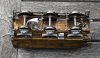
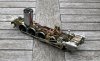
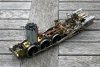
The brake gear was already fitted but the valve gear was unstarted. The situation in which you see it now is the initial trial fit. All the parts are fitted using screws and nuts, and the screws will eventually be removed and replaced with pins and rivets. It sort of operates but will now be stripped and each component checked in turn. I initially set it up to test the Delrin drive to the midde axle (that's a strange drive system to start with) and found that the drive sprocket had been butchered to the extent that there was no way to make it run smoothly. I removed it from the axle, cleaned it up and refitted using a grub screw into a drilled and threaded hole in the axle and that has solved this first problem.
IMG_2409.JPGIMG_2408.JPG

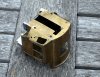
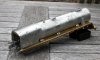
For some reason the top of the firebox had been filled with solder to such an extent that I couldn't get the motor in. It was the work of a full afternoon to grind that out which obviously had to be done with grea care to avoid grinding right through the pewter firebox. The footplate is mounted on a white metal base and regrettably that was already complete. I say regrettably because it makes fitting parts, including the smoke deflectors, to the footplate a good deal more difficut. The loco is wanted as "Evening Star" so one of the first jobs is to remove the large front foot step and replace it with the two small ones carried by 92220. Work has started already on the detailing. Future posts will catch up with that.

IMG_2418.JPGIMG_2419.JPG
The front bogie was complete as purchased. It'll need some small modification to equip it for ATC rather than AWS but the build is quite reasonable and true.

IMG_2411.JPGIMG_2412.JPGIMG_2413.JPGIMG_2414.JPG
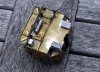
The cab had been started and the main parts shaped and soldered. I am frankly amazed at how complex this cab has proven to be. Again, a small alteration needed to change it from AWS to ATC. I finished the spiders web of support brackets underneath the cab and fitted the rain strips to the roof.

IMG_2410.JPG

The smoke deflectors were ready shaped. I fitted the top brackets and used these to make up a Plasticard pattern so I could mark up the boiler ready to drill it to fit. (A Steph suggestion which seems to have worked well - we'll see how it goes together later).

Additionally there are three trays of castings which I photographed but can't post at the moment as I've exceeded my photo post limit! Fortunately the lost wax ones are easily identified as they have matching tabulated photos in the instructions. The white metal ones are a bit more difficult because they are simply listed although the instructions - with one exception so far - give a good idea of the appropriate part to fit.

I now need a full day so I can take a run at stripping the chassis and rebuilding the valve gear. I may well paint the chassis at the same time so I will not need to strip it again when completed. This means fitting the balance weights and chemically blacking the wheels and valve gear components.

I'll post more as significant steps are made. As usual, all comments and advice gratefully received.

Brian
 

oldravendale

Western Thunderer
I'm interested to see this Brian - I have 3 to build in the near future.....

Only three........? So far it's gone together well. It's an all soldered construction, so it's out with the low temp solder although I guess you could use cyano and/or epoxy for much of it. My comments so far, for what they are worth, is that there is a reliance on creating screw threads in material which is too thin for the purpose. An example is the cranks on the valve gear. You will need to find a better way of ensuring that these either don't strip or come undone of their own volition. (I had the same problem with the A3). The valve gear is designed to go together using BA screws and nuts. That can be helpful when separating in to component parts but may be better substituted with soldered pins for the final assembly.

Finally there's a problem with the reversing gear. On one side (I can't remember which immediately, but it will come back to me) you can't set the full offset on the crank as it causes excessive movement to the radius rod and then the expansion link which clouts the inside of the supporting block (can't remember what that's called.) Potentially the radius rod could be shortened a bit although as I've not done it I can't be certain that would work.

This problem is interesting because it only occurs on one side. The other is perfect.

I met up with Bob Alderman earlier this year who has built at least one of these and took it to show him. He had suffered the same problem. His answer was to do nothing and use the amount of movement which the expansion link allows, and in truth it looks OK. I also mentioned this to the DJH guys at Reading but they didn't recognise the problem.

If I come across any more issues on the way I'll write them up.

Brian

Brian
 

Ressaldar

Western Thunderer
I also mentioned this to the DJH guys at Reading but they didn't recognise the problem

now there is a surprise, a kit manufacturer not knowing how one of their kits go together. My experiences with DJH have certainly put them in the same category as Ace Kits - the never to touch with a barge pole one.

cheers

Mike
 

oldravendale

Western Thunderer
I also mentioned this to the DJH guys at Reading but they didn't recognise the problem

now there is a surprise, a kit manufacturer not knowing how one of their kits go together. My experiences with DJH have certainly put them in the same category as Ace Kits - the never to touch with a barge pole one.

cheers

Mike

Hmm! I think that's a bit hard on them. This is the second DJH kit I've built. The first (the A3) was missing the back part of the cylinders (it was a second hand kit and was all a bit mixed up when it arrived so I suspect that the original owner still had the part). I then proceeded to melt the motion bracket for the 9F by having the iron on too high a temperature so sent the spare parts sheets for both locos back to them and they came up with the missing parts, no problem. That's pretty good service I think.

The instructions can leave a bit to be desired, but then even Finney instructions can sometimes be a bit hard to follow. However, for all their "clunkiness" DJH kits build in to reasonable and recognisable models. In fact I think that even a reasonably new kit builder could tackle a DJH kit and get something recognisable out of it. (The Fairburn tank being a notable exception!)

In saying this I have built some locos which gave me real problems, an Oakville Black 5 being among them. I remember the instructions for the tender interior being something along the lines of "Here are some bits and we're not quite sure how they go together but you'll probably be able to work it out". The slide bars and cross heads were both made out of white metal too and making new slide bars out of nickel silver was one of the first scratch jobs I did. Nevertheless, there have been some really nice Black 5s built from the Oakville kit.

Having said which, would I prefer to be tackling a DJH or a Finney kit? The Finney every time!

Brian
 

Ressaldar

Western Thunderer
Hi Brian,

I think that it is probably down to individual experiences.

I have built three DJH kits - Fairburn 2-6-4t, a Clan 4-6-2 and a Deltic, in that order and problems became progressively worse, culminating in the strange shape of the two halves of the Deltic when taken out of the box being so out of shape I asked for replacements, which was agreed with a change over at the Guild show at Halifax, I saw the person that I had been e-mailing who then flatly denied all knowledge of the matter but soon changed his tune when I produced the e-mails - not a way to conduct business.

I agree that at the end of the day the models look fine, but as with many kits, there is more effort required in some than others and a good deal of this effort is as a result of a lack of forethought by the kit manufacturer.

Best of luck with your build.

regards

Mike
 

Heather Kay

Western Thunderer
Not wishing to drag the topic further OT, but this is why we should cherish those manufacturers who realise their customers are important. I'm thinking of JLTRT here, chiefly, though there are others who also bend over backwards to help when they can. It's in their own interests to keep the customers happy, one would have thought, instead of making it seem like we're an annoyance which should go away once they've taken our money.

Meanwhile, back on topic… ;)
 

oldravendale

Western Thunderer
Hi Brian,

I think that it is probably down to individual experiences.

I agree that at the end of the day the models look fine, but as with many kits, there is more effort required in some than others and a good deal of this effort is as a result of a lack of forethought by the kit manufacturer.

Best of luck with your build.

regards

Mike

I sympathise, Mike. Three kits of that type is more than enough!

I'll keep fingers crossed that I don't hit any major issues from where we are now. As mentioned, though, there are some strange issues - the motor/gearbox/Delrin drive is, to my mind pretty weird and over complicated, although it seems to work. The fit of the motor in the firebox is really tight - un-necessarily so bearing in mind the size of powerful motors nowadays, although I suppose I could have change the motor/gearbox if I'd felt it was that important. The screwing in to tapped but thin metal is not good practice, and as just mentioned the fit of the valve gear is questionnable.

There were some similar issues with the A3, screwing in to thin metal being one of them.

Mind you, if you've built the Fairburn tank all else pales in to insignificance.....

Overall I'll leave my final comments until I have two complete locos running!

Best regards.

Brian
 

Dikitriki

Flying Squad
Hi

My 2p worth. I think DJH kits are by and large very good for the undiscerning modeller who wants something to go together quickly and well out of the box, and bears a passing resemblance to what it's meant to be.

For the discerning modeller, the steam locos are no more than relatively poor starting points, some worse than others, especially below the footplate, where some are woeful.

The diesels (OK not my area of expertise) seem better, especially the warship which I thought captured the loco very well, and the 31, based on Tony Geary's example.

So, I think they have their place.

Richard
 

Steph Dale

Western Thunderer
I'm with you exactly on that Richard.

And I've found my experiences with DJH and JLTRT in resolving problems are completely reversed from those of Heather and Mike: I've always found DJH to be very helpful, even when resolving problems that are 100% my cause ( like wanting a different tender in a loco kit).

Steph
 

Heather Kay

Western Thunderer
I can't speak for DJH. First contact goes back to when they first ventured into 7mm kits, and we walked away as quickly as possible. They didn't like the fact someone might have a problem with the motion brackets being out of gauge by quite a margin. If they've improved since then - which it does appear they may have - then well done to them.

I've found JLTRT to very helpful at every turn. I've just had replacement 10001 sides sent to me, no quibbles, and plenty of other parts for other kits as required. I don't think that's just because I've built a good relationship with Laurie over the past couple of years.

Apologies for the hijack, Brian. :oops:
 

oldravendale

Western Thunderer
Apologies for the hijack, Brian. :oops:

Apologies not needed, Heather. It's all grist to the mill of helping someone who's not built DJH before to decide whether it's what they want to try. I think our own Dikitriki summed it up pretty well as far as the models themselves are concerned and I'm looking forward to re-starting the Finney A3 as a comparison.

I found DJH very heplful on two occasions now, although they are not at all happy about supplying castings unless you have the orignal kit for them. That's not unreasonable in my book - they have taken that decision as it's probably not economic for them to deal in penny numbers. Let's not forget that the model railway side of their business is tiny compared to the total.

As far as JLTRT is concerned I've no first hand experience although I fancied their 2F 0-6-0 at one time. (I would have fancied the LMS Twins, but already had a couple of RJH kits which actually made up passably well). I've heard comments sometimes about "Not Quite Like the Real Thing" so will be cautious, but I suspect some of this is down to having so many original makers under the JLTRT banner that there must be some less good ones among them (and we can go on for all we like about them reworking the kits before they go to market, but sometimes people like us create a demand.....)

In fact, as with pretty well any kit manufacturer, we have to be grateful to them. We'd be the poorer if they didn't exist although there are exceptions. Even then, though, if the kit they produce is unique it may well be an assistance to a scratch build.

And can I suggest that we don't use this as the beginnings of another of those interminable "bad kits should be reported to the GOG/Trading Standards/ Dept of Agriculture (that's for the more agricultural kits, of course :)). The kits we are discussing clearly have some followers.

Brian
 

mickoo

Western Thunderer
Brian,

Just want to pick up on one point in your first post, nice model by the way:thumbs: , I'm edging toward the Seven models myself, probably not a lot to choose between them if I hear the grapevine correctly LOL, it'll be good to compare the two when (and if) I get mine.

Back to the point, was there one? oh yes I remember now (long day!), the front footplate step, don't be in too much of a rush to remove it, the large single footstep is correct, a lot of 9Fs had the large footstep added in place of the original small ones. These were exchanged later in the loco's lives, late 50's/early 60's onward I think, so it'll depend on the date your model is set, as to which set of steps it has.

A real quick web trawl shows 92220 not fitted in 60 but fitted by Aug 63, I may be able to narrow that date down a little better if you so wish by trawling through the tomes on my shelves.
 

oldravendale

Western Thunderer
Brian,

Just want to pick up on one point in your first post, nice model by the way:thumbs: , I'm edging toward the Seven models myself, probably not a lot to choose between them if I hear the grapevine correctly LOL, it'll be good to compare the two when (and if) I get mine.

Back to the point, was there one? oh yes I remember now (long day!), the front footplate step, don't be in too much of a rush to remove it, the large single footstep is correct, a lot of 9Fs had the large footstep added in place of the original small ones. These were exchanged later in the loco's lives, late 50's/early 60's onward I think, so it'll depend on the date your model is set, as to which set of steps it has.

A real quick web trawl shows 92220 not fitted in 60 but fitted by Aug 63, I may be able to narrow that date down a little better if you so wish by trawling through the tomes on my shelves.

Interesting.....at least one of my 9F references says that Evening Star was withdrawn with the two small foot steps. I'll have to check it to confirm which reference it is. A quick check of my photos of the loco on this PC confirms the two small steps.

Certainly the same book agrees with you that many - probably most - of the 9Fs had the small footsteps replaced but states that 92220 was an exception. It ran in service for such a short time, after all.

I've now taken the large step off! Not a huge problem to put it back, just a bit of a pain in the bum. Worth re-checking though.

Best regards.

Brian
 

mickoo

Western Thunderer
Brian,

Hmm suspect something amiss here, the loco is preserved at York and has the large step up front, but that's no indication it carried it in service;)

Not fitted
http://www.sdrt.org.uk/news/article.php?article=117
http://railphotoprints.zenfolio.com/p945932623/h5760B38#h158b9cb5

Fitted
http://www.malsphotos.com/1960-s-steam..html
http://www.bluebell-railway.co.uk/bluebell/pics/locos/92240_southall1965_jfrench.jpg

Withdrawn at Severn Tunnel Junction 1966
https://www.flickr.com/photos/80572914@N06/7443918520/
http://railphotoprints.zenfolio.com/p945932623/h5760B38#h5760b38

It looks like it was fitted late 62 early 63 so far.

Hope that helps:thumbs:
 

oldravendale

Western Thunderer
Brian,

Hmm suspect something amiss here, the loco is preserved at York and has the large step up front, but that's no indication it carried it in service;)


It looks like it was fitted late 62 early 63 so far.

Hope that helps:thumbs:

No doubt about that, is there? I'll check which book it is which tells me that 92220 was withdrawn with small steps, and then note that if it's incorrect in that regard it's probably incorrect in others. I have a photo in September 62 which has small steps.

I'll check this out this afternoon and hopefully follow up on this thread this evening. Nevertheless, I can either go back to the big step or leave it as it is.

Thanks for the research, Mick.

Brian
 

oldravendale

Western Thunderer
Mea culpa, Mick.

I've re-read the description attached to the photo which was my reference and it says that, at the time of the photo (late 1962) the loco retained the small footsteps. It did not say that it retained them until withdrawal.

I remembered this as saying what it clearly didn't. I apologise and am grateful for your additional research which has put me back on the road of righteousness and honesty.

I'll probably still leave the small foot steps, though. 1962 probably suits us well for the layout.

Brian
 

mickoo

Western Thunderer
Brian,

No worries or apologies necessary, I frequently manage to shoot myself in both feet with one bullet;) In fact I have it down to a fine art now:thumbs: In fact it's so worrying that I check and recheck before posting here, the checking often takes longer than the actual writing LOL.

If it suits your chosen period then two steps will do nicely, your 1:43 loco men may not thank you for it mind LOL

Over the years I've come to hold written details with a wry eye, a long standing classic involves AC locos, urban and popular myth states that when fitted with dual pantographs, one is for 25Kv, the other for 6.25Kv, the fact that both are joined with one big bus bar and affix to the same tapping on the transformer is of little consequence, until said 6.25Kv tapping is connected to 25Kv, in which case said transformer turns into a 3 ton hand grenade. The rows over that I've had over the years is painful, but, because Colin Marsden (as was often thrown up as fact) said so in a book in 1970 or what ever then it must be true:eek: In defence CM probably quoted some other misguided soul.
Now I just let the great unwashed carry on in oblivion, they seem to like it better that way;), and reserve comment...where possible...to those who are more receptive.

Back to the 9F, the cab looks very nice and your right, it's a really complex shape, more complex than most realise I think, I had a devil scratch building the Std 5 which follows a similar form, there are a lot of angles and that takes some deft art work so that it all fits nicely and it's nice to see details underneath, often forgotten or not modelled in our predominately gods eye view of toy trains. I also like the double chimney, it suits the 9F so well as it does many classes to my eye.
 

oldravendale

Western Thunderer
Thanks Mick. I'm certainly responsive to comments and it seems that most members of this forum are. It seems very sad to miss out on the opportunity to improve one's knowledge and modelling when there are so many people with the knowledge to help. That, of course, does not mitigate against sensible discussion and comparison of data when there is a conflict.

Anyway, moving on, the cab has been footed to the fitplate fitted to the footplate and the front window frames soldered in place. I've also fitted the wash out plugs. Then I used the resistance soldering iron to fit the small strengthening plates which can just be seen over the holes in the cab front. No problem so far. I forgot to take a pic of the front footsteps which look good IMHO, and I've taken off the large footstep and replaced with two small ones on the front footplate. Something to look forward to, then!

But now I've hit the first issue of prototype vs model, and in my view this is pretty unforgivable. It would surely have been picked up quickly if they'd made one. But they do, don't they? And sell them as RTR models. So they must be aware.

IMG_2427.JPGIMG_2428.JPG

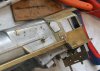
The issue is with the regulator linkage, outside on the 9F. You can see the linkage here and the .7mm wire representing the link to the regulator in the cab. At first sight it looks good. However, it's at about a 1 in 3 angle up hill from cab to the linkage. In fact it should be very slightly down hill. The regulator hole in the cab front is the one within the etching and has a nicely etched gromit (probably the wrong word, but you probably know what I mean) around the hole. Cab height is correct - note the fit to the footplate - and there are no other linkages or pipes that enter the cab this high up.

IMG_2429.JPG
You can see the linkage and where the rod enters the cab in this photo. Clearly the etched hole is just too low on the cab front on the model. I'll have to drill a new 'ole! Not really a huge issue, but very irritating.

IMG_2430.JPG

And here's the really remarkable bit. The illustration above is from the DJH instructions. So they know how it should look. I wonder if they ever did a test build?

Brian
 

Yorkshire Dave

Western Thunderer
Looking at the photo above and others it appears the linkage comes out of the cab front higher up from the plate at right angles to the firebox rather than the angled piece with the spectacle plate.

David
 
Top