

Richard H
Western Thunderer
Locomotives for Craster – introduction and first progress report
While researching the ficts about Craster I was shown a very tattered ‘Book for Boys’ in which, inside the cover, an unidentified boy living in Craster had from time to time listed engines he had seen in the station. We know he lived in Craster because part of a childlike address is visible beside a torn corner of the flyleaf:
The list is incomplete and undated, and not particularly organised, but when compared with information gleaned from NER documents it confirms that services on the Craster branch were operated by unassuming “workhorse” engines of the NER.
It is possible to extrapolate the following ficts with some certainty: Class B 0-6-2Ts usually worked the good services and, occasionally, passenger trains. Passenger services were more usually worked by 0-4-4Ts of Class BTP, originally hauling “old carriages” but later with autocoach trains. From time to time Class A 2-4-2Ts also appeared, as well as other types including examples of Class O 0-4-4T and Class E1 0-6-0T, and tender engines such as Class C 0-6-0 and Class 398 0-6-0. Occasionally the lad’s notes give tantalising glimpses of more exotic engines, usually older and small passenger classes perhaps seen on excursions trains or summer specials. He also noted one of NER’s two petrol-electric Autocars appearing on the branch for a short time.
For my interpretation of Craster I decided that the first locomotive to build had to be a Class B 0-6-2T. This class included engines built both as compounds and as simples, but all were eventually converted to singles. Originally intended as goods engines, some were fitted with Westinghouse brakes and proved to be effective mixed-traffic engines; over an extended period all the engines were modified with enlarged tanks and bunkers. Compound and simple engines were both designated as ‘B’ and ‘B1’ at different times in a series of confusing changes but, for convenience, I am using the term ‘Class B’ to include both types, as this was the final NER designation after the entire class was rebuilt. In LNER and BR days they were designated Class N8.
I plan to construct a ‘simple’ Class B in unrebuilt condition with low tanks and bunker. It’s a long time since I last made a locomotive and I feel some sense of apprehension. I shall describe the work at intervals, and this first posting illustrates initial progress on the chassis.
The model is made from the London Road Models (LRM) etched-brass kit. I made a conventional start by collecting as much information about the prototype as I could find, then reading the instructions, naming the parts, trying to identify things on the frets and in the bags, and making provisional decisions about basic compensation, choice of motor and gearbox, etc., before ordering the additional components I needed.
Starting work on the chassis, I had to re-discover skills long unpractised, and this led to my first Big Mistake … I was so engrossed in almost regaining control of a piercing saw while cutting out the apertures for the hornblocks that I forgot to stop (!) after the two front axles and I cut out all the apertures, thereby removing the location for the fixed, driven rear axle, which also provided the datum for the ride height. (Imagine here a scream, as torn from Dante’s tortured souls, fading slowly into the stygian darkness of self-recrimination.)
Luckily I’d marked the axle centre line on the frames as a guide for the compensation beam so I could still establish the datum (visible in the photograph below). My solution was to fit hornblocks and bearings for all the axles but to solder up the bearings for the rear axle to make it rigid. I used hornblocks from High Level Kits (HLK) and reinstated the rear axle bearings:
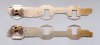
The next stage was to align the mainframes and solder in the first spacers:
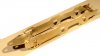
Supporting the chassis whilst I manipulated both LRM axle alignment jigs and the forward hornblocks required several more fingers than I have at my disposal. I do not have a chassis jig, but I devised a simple but level support by mounted pieces of extruded aluminium angle strip on a substantial piece of softwood:
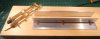
In use, it simply supports the axle jigs at the same height, and overcomes one of the variables in holding things securely:

By using small clamps made from aluminium hair grips (easily cut and bent into useful shapes) components can be held in place:
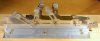
Having established that this seemed to work in principle, the next step was to solder the bearings to fix the rear axle in place. I found that the HLK hornblocks gave the right height for the axle when they were aligned with the bottom edge of the mainframe, which made setting them comparatively easy. Using an LRM jig to align the bearings across the frame I positioned them carefully, checking in as many ways as I could devise that the axle would lie level and horizontal (e.g. ensuring the axle was in the right place, using a stop to align the hornblocks to the frames, and sighting along the chassis to match axle to the front spacer), then clamped and finally soldered them.
With the rear axle bearings spot-soldered in place I felt able to construct the coupling rods and use them to set the distances between the axle bearings in the hornblocks, clamp everything in place, and apply solder:
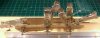
... resulting in this:
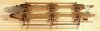
The hornblocks are fixed, the bearings on the forward axles move freely, and the axles are aligned to the coupling rods. The structure will remain weak, though, until cross-members such as the motor mount and pivots for the brakes are fitted.
At this stage I was able to assemble and test-fit the pony truck, which fits directly below the rear spacer on the mainframes. In doing so I realised that the rear spacer was slightly out of true, and had to re-align it. For the first time I could see the overall length of the chassis ...

… and examine the fit and action of the pony truck under the rear spacer:

Using a ruler to ensure that each side frame was straight, together with LRM axle jigs to retain alignment between each pair of bearings, the brake pivots were soldered across the frames. This had an immediate stabilising and stiffening effect on the mainframes.
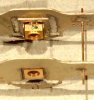
The brake pivot wire is seen to the right of the hornblocks. This photograph also shows that I need to refine my soldering skills further, and that the work still needs some cleaning. The green splodge on the top of the bearing and the hornblock are marks I applied when matching bearings to hornblocks.
The next posting will deal with the gearbox and the drive to the rear axle.
While researching the ficts about Craster I was shown a very tattered ‘Book for Boys’ in which, inside the cover, an unidentified boy living in Craster had from time to time listed engines he had seen in the station. We know he lived in Craster because part of a childlike address is visible beside a torn corner of the flyleaf:
Whi
Craste
Northum
England
Great Brita
The World
The Universe
Craste
Northum
England
Great Brita
The World
The Universe
The list is incomplete and undated, and not particularly organised, but when compared with information gleaned from NER documents it confirms that services on the Craster branch were operated by unassuming “workhorse” engines of the NER.
It is possible to extrapolate the following ficts with some certainty: Class B 0-6-2Ts usually worked the good services and, occasionally, passenger trains. Passenger services were more usually worked by 0-4-4Ts of Class BTP, originally hauling “old carriages” but later with autocoach trains. From time to time Class A 2-4-2Ts also appeared, as well as other types including examples of Class O 0-4-4T and Class E1 0-6-0T, and tender engines such as Class C 0-6-0 and Class 398 0-6-0. Occasionally the lad’s notes give tantalising glimpses of more exotic engines, usually older and small passenger classes perhaps seen on excursions trains or summer specials. He also noted one of NER’s two petrol-electric Autocars appearing on the branch for a short time.
For my interpretation of Craster I decided that the first locomotive to build had to be a Class B 0-6-2T. This class included engines built both as compounds and as simples, but all were eventually converted to singles. Originally intended as goods engines, some were fitted with Westinghouse brakes and proved to be effective mixed-traffic engines; over an extended period all the engines were modified with enlarged tanks and bunkers. Compound and simple engines were both designated as ‘B’ and ‘B1’ at different times in a series of confusing changes but, for convenience, I am using the term ‘Class B’ to include both types, as this was the final NER designation after the entire class was rebuilt. In LNER and BR days they were designated Class N8.
I plan to construct a ‘simple’ Class B in unrebuilt condition with low tanks and bunker. It’s a long time since I last made a locomotive and I feel some sense of apprehension. I shall describe the work at intervals, and this first posting illustrates initial progress on the chassis.
The model is made from the London Road Models (LRM) etched-brass kit. I made a conventional start by collecting as much information about the prototype as I could find, then reading the instructions, naming the parts, trying to identify things on the frets and in the bags, and making provisional decisions about basic compensation, choice of motor and gearbox, etc., before ordering the additional components I needed.
Starting work on the chassis, I had to re-discover skills long unpractised, and this led to my first Big Mistake … I was so engrossed in almost regaining control of a piercing saw while cutting out the apertures for the hornblocks that I forgot to stop (!) after the two front axles and I cut out all the apertures, thereby removing the location for the fixed, driven rear axle, which also provided the datum for the ride height. (Imagine here a scream, as torn from Dante’s tortured souls, fading slowly into the stygian darkness of self-recrimination.)
Luckily I’d marked the axle centre line on the frames as a guide for the compensation beam so I could still establish the datum (visible in the photograph below). My solution was to fit hornblocks and bearings for all the axles but to solder up the bearings for the rear axle to make it rigid. I used hornblocks from High Level Kits (HLK) and reinstated the rear axle bearings:
The next stage was to align the mainframes and solder in the first spacers:
Supporting the chassis whilst I manipulated both LRM axle alignment jigs and the forward hornblocks required several more fingers than I have at my disposal. I do not have a chassis jig, but I devised a simple but level support by mounted pieces of extruded aluminium angle strip on a substantial piece of softwood:
In use, it simply supports the axle jigs at the same height, and overcomes one of the variables in holding things securely:
By using small clamps made from aluminium hair grips (easily cut and bent into useful shapes) components can be held in place:
Having established that this seemed to work in principle, the next step was to solder the bearings to fix the rear axle in place. I found that the HLK hornblocks gave the right height for the axle when they were aligned with the bottom edge of the mainframe, which made setting them comparatively easy. Using an LRM jig to align the bearings across the frame I positioned them carefully, checking in as many ways as I could devise that the axle would lie level and horizontal (e.g. ensuring the axle was in the right place, using a stop to align the hornblocks to the frames, and sighting along the chassis to match axle to the front spacer), then clamped and finally soldered them.
With the rear axle bearings spot-soldered in place I felt able to construct the coupling rods and use them to set the distances between the axle bearings in the hornblocks, clamp everything in place, and apply solder:
... resulting in this:
The hornblocks are fixed, the bearings on the forward axles move freely, and the axles are aligned to the coupling rods. The structure will remain weak, though, until cross-members such as the motor mount and pivots for the brakes are fitted.
At this stage I was able to assemble and test-fit the pony truck, which fits directly below the rear spacer on the mainframes. In doing so I realised that the rear spacer was slightly out of true, and had to re-align it. For the first time I could see the overall length of the chassis ...
… and examine the fit and action of the pony truck under the rear spacer:
Using a ruler to ensure that each side frame was straight, together with LRM axle jigs to retain alignment between each pair of bearings, the brake pivots were soldered across the frames. This had an immediate stabilising and stiffening effect on the mainframes.
The brake pivot wire is seen to the right of the hornblocks. This photograph also shows that I need to refine my soldering skills further, and that the work still needs some cleaning. The green splodge on the top of the bearing and the hornblock are marks I applied when matching bearings to hornblocks.
The next posting will deal with the gearbox and the drive to the rear axle.
Last edited: