Cookie's Workbench - 7/8ths Alan Keef K40

ceejaydee

Western Thunderer
I blame a solitary school holiday/trip to the Blue Peris Mountain Centre right next to the Dinorwic quarry system.
Must have been around 1984/5 so the wholesale destruction remodelling of the area was only partially complete with narrow gauge trackbeds seemingly going everywhere.

Did I mention a liking for quarry Hunslets too :thumbs:

The Dewinton is pretty tasty, I wonder what its like to build...?
View attachment 11670
Have a look at this Steve - http://www.narrowgaugeandindustrial.com/resource/dewin53.pdf
 

Steve Cook

Flying Squad
Cheers for the link CJD, a good read :thumbs: Can see why you are tempted too ;)

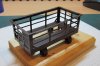
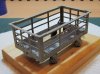
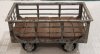
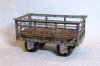
A change of plan for the weathering on the slate wagon today, thought I'd have a bash at the hairspray method as I figured it would probably be slightly easier than trying to get the salt to stick to the various strips of steel which make up the wagon body.

The top of the body frame and some of the cross pieces were bent out of shape and the body was given three thin coats of hairspray, each one being dried using a hairdryer

Hairspray1.JPG

A rough coat of grey acrylic was brush painted over the top and again dried using the hairdryer

Hairspray2.JPG

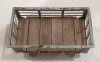
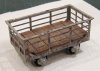
A couple of stiff short bristled paint brushes (dipped in water than dried off on a piece of kitchen roll) were then used to start lifting the grey paint off the various edges of the bodywork. I gradually worked from top to bottom, picking, moving and stippling over the paint until I saw the rust colour underneath come through. A slighter longer bristled brush was then used, slightly dampened, in a downward direction over all of the paintwork.

Hairspray3.JPG

Hairspray4.JPG

Hairspray5.JPG

I think its fair to say it looks pretty rough :eek: Hopefully some drybrushing and weathering powder work tomorrow will mellow the contrast out a bit.
Steve
 

ceejaydee

Western Thunderer
I'd not heard of the hairspray method before but it looks like less hassle than using maskol.
I reckon that drybrushing and weathering powders will give you what you are looking for Steve - question - do you matt varnish or dulcote your models after applying weathering powders?

Still loving the effect on those planks :thumbs:
 

Steve Cook

Flying Squad
I'd not heard of the hairspray method before but it looks like less hassle than using maskol.
I reckon that drybrushing and weathering powders will give you what you are looking for Steve - question - do you matt varnish or dulcote your models after applying weathering powders?
I did the once, and it ruined it :)) Never again...
It changed the effects of the powders (making it much more subtle) and gave a uniform finish which I didn't like - I ended up applying the powders again and have never repeated it. I also tend to use ground pastel as opposed to powders, making up the colour I want for each model and working it pretty hard into the surface. A run over with a damp brush helps to seal it in - have to be a bit careful with this method as I've found it almost impossible to get the pastels back off the model without ruining the underlying finish.
Still loving the effect on those planks :thumbs:
Ta, playing around with wood dyes and creating those type of effects is one of my favourite modelling tasks :)

Maskol or any other liquid latex type product can also be applied with an old sponge (as opposed to a brush) etc. for ease of use and variation...you may wish to try salt, Marmite etc. etc. as 'masks' too:));):thumbs::)
Cheers CME :)
Interesting that you point out maskol can be applied with a sponge rather than brush - I cannot use it with any type of porous implement or brush, it just sets up too quickly. I'm at the point that I only apply it with a cocktail stick, shaped if necessary, to get the effects I'm after - trying to use a brush drove me to distraction :))

Using table salt was interesting, I have rock salt and brown sugar on the 'to do' list..the marmite can stay in the jar though ;)
Steve
 

28ten

Guv'nor
Salt works very well, but it can leave some deposits behind. I find the cheapest sainsburys hairspray the best, the expensive stuff doesn't seem to work as well
 

Steve Cook

Flying Squad
Aye, you can get a bit of a silvery effect off the salt if not careful. I'm using Harmony hairspray because it was left over from tree making and had an 33% extra free - bloomin' stinks though :)) I shall try a cheaper and unscented version next...cheers Guv :)

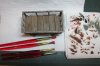
Had a run at the drybrushing tonight, it hasn't photographed very well though, guess some of the colours are too subtle to pick up under the harsh light of the modelling lamp. First up is the colour palette used (the kitchen roll the majority of the paint ends up on) and the state of the brushes for the job

Drybrush1.JPG

Plus a shot of each side of the wagon (wood and wheels still mocked up until I've done the powders / pastels)

Drybrush3.JPG

Drybrush2.JPG
 

Steve Cook

Flying Squad
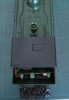
A quick job after work today - chipping the Pannier up in preparation for the arrival of the Multimaus Pro :) Not much to say other than despite being a big model, it still only just houses a Lenz Gold Maxi widthwise in the bunker (lined with insulation tape). A simple four wire job for the moment to get it up and running - I've a multitude of functions to use if I want later, along with a sound interface and a USP connection.

Lenz Gold Maxi in location.JPG
 

Steve Cook

Flying Squad
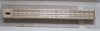
I've spent a large part of this weekend building a 'Multi-Gauge Scattergun Programming Track' for my NCE DCC system. The arrival of a Multimaus Pro for use in the garden gave me the incentive to make a permanent test base in the modelling room so I can test stuff without having to go outside to do so.

All of the wood was from offcuts that used to be in the garden storage bin and had mainly been lying round in the shed and getting in the way since then. The copper clad sleepers are 8mm wide and 2.4mm thick and were kindly cut for me a few years back by a chap called Julian (I think) when I was on RMWeb. The code 75 rail is flat bottom nickel silver, the code 180 is Cliff Barkers nickel silver stuff.

Overall dimensions are 1040mm (l) x 110mm (w) x 93mm (h). In its completed but unpainted / unwired state

PT1.JPG

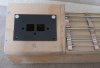
The hole on the front left takes the standard NCE Panel

PT4.JPG

Whilst the hole at the rear takes a small homemade switch panel

PT5.JPG

The switch toggles the track supply between either the NCE system or the external input which is the socket next to the switch. The socket on the far right is a parallel output to the track supply so can be used to power a rolling road or such like with the addition of a flying lead. The external input socket allows me to fit any other DCC system or power supply for the purposes of checking stuff works.

Gauge wise, I reckon I've covered most of the things I'm likely to build in the future, but given the ease at which I'm distracted there is no guarantee :rolleyes: Still, its about as future proof as left over materials will allow.

PT3.JPG

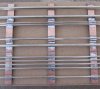
Its set up with three common rails and then a selection of accompanying rails for each common rail.
Starting at the bottom of the above pic, the lowest rail is the common, followed by rails at 9.42mm (N and 2mm FS), 14mm (2' 7mm NG), 18.2mm (EM) and 22.45 (0.884" S Scale).
The next rail up is Code 180 and is the common rail for the top two rails of the photo set at 33mm (O, S7 and 16mm NG) and 45mm (G1 et all) respectively.
Sitting between the 33mm rails are three more rails, the lower one the common, then rails at 16.5mm (HO/OO) and 19mm (2' 3/8"scale NG and P4).

Its all been quickly wired up for test (no shorts found :) ) so its been used to program the Pannier ready for some garden running. The woodwork has all been masked off and the whole trackbed area primed ready for a coat of satin black tomorrow - I'll then choose a suitable colour for the rest of the woodwork.

Like I mentioned above, the Multimaus Pro wireless DCC system arrived on Saturday. I'd like to be able to tell you how it works, but having bought the wrong size batteries for the handset by accident, then got the correct ones, I came to plug it into the mains and realised I don't have a Euro two pin to UK three pin adaptor. I found this out just as all the shops shut today. Subsequently I have awarded myself the Western Thunder Brown Star for Incompetence :shit: :oops:

I'll be adding the adaptor to tomorrows shopping list then...
 

Simon

Flying Squad
I've spent a large part of this weekend building a 'Multi-Gauge Scattergun Programming Track' for my NCE DCC system. The arrival of a Multimaus Pro for use in the garden gave me the incentive to make a permanent test base in the modelling room so I can test stuff without having to go outside to do so.

All of the wood was from offcuts that used to be in the garden storage bin and had mainly been lying round in the shed and getting in the way since then. The copper clad sleepers are 8mm wide and 2.4mm thick and were kindly cut for me a few years back by a chap called Julian (I think) when I was on RMWeb. The code 75 rail is flat bottom nickel silver, the code 180 is Cliff Barkers nickel silver stuff.

Overall dimensions are 1040mm (l) x 110mm (w) x 93mm (h). In its completed but unpainted / unwired state

View attachment 11792

The hole on the front left takes the standard NCE Panel

View attachment 11794

Whilst the hole at the rear takes a small homemade switch panel

View attachment 11795

The switch toggles the track supply between either the NCE system or the external input which is the socket next to the switch. The socket on the far right is a parallel output to the track supply so can be used to power a rolling road or such like with the addition of a flying lead. The external input socket allows me to fit any other DCC system or power supply for the purposes of checking stuff works.

Gauge wise, I reckon I've covered most of the things I'm likely to build in the future, but given the ease at which I'm distracted there is no guarantee :rolleyes: Still, its about as future proof as left over materials will allow.

View attachment 11793

Its set up with three common rails and then a selection of accompanying rails for each common rail.
Starting at the bottom of the above pic, the lowest rail is the common, followed by rails at 9.42mm (N and 2mm FS), 14mm (2' 7mm NG), 18.2mm (EM) and 22.45 (0.884" S Scale).
The next rail up is Code 180 and is the common rail for the top two rails of the photo set at 33mm (O, S7 and 16mm NG) and 45mm (G1 et all) respectively.
Sitting between the 33mm rails are three more rails, the lower one the common, then rails at 16.5mm (HO/OO) and 19mm (2' 3/8"scale NG and P4).

Its all been quickly wired up for test (no shorts found :) ) so its been used to program the Pannier ready for some garden running. The woodwork has all been masked off and the whole trackbed area primed ready for a coat of satin black tomorrow - I'll then choose a suitable colour for the rest of the woodwork.

Like I mentioned above, the Multimaus Pro wireless DCC system arrived on Saturday. I'd like to be able to tell you how it works, but having bought the wrong size batteries for the handset by accident, then got the correct ones, I came to plug it into the mains and realised I don't have a Euro two pin to UK three pin adaptor. I found this out just as all the shops shut today. Subsequently I have awarded myself the Western Thunder Brown Star for Incompetence :shit: :oops:

I'll be adding the adaptor to tomorrows shopping list then...

The programming track should cover all eventualities, a good job well done:thumbs:

Bad luck on the old adapter front.

I am wondering how to rebuild the supplied transformer to a more UK friendly format, as the way it flops about in the adapter quite irritates me. I suspect that the transformer as supplied is the same as any number of other UK ones for trains etc so long as the output power is matched, or is there some DCC related "specialness" built in there too I wonder?

Crappy weather here, we all went to the "Widcombe Rising" this aternoon. I took a sandwich board and a signal like erection in order to do some "guerilla marketing" for the shop:eek: We saw Bill Smarme and the Business on stage at 5.30 - excellent and the Titfield Thunderbolt got a name check courtesy of the dollop near the front row with his large, er, you get the picture;)

Simon
 

Steve Cook

Flying Squad
Programming track painted, wired, tested and installed in its location at the back of the workbench. I could do with sorting out an arrangement to hang the controller off the side of the desk and out of the way - now might also be an opportune time to purchase and install a sprog, I think the track is close enough to the computer now :)

Installed.JPG

New mains adaptor has been purchased for the Multimaus Pro - it works lovely :) Not got as far as installing it outside yet as I've been working out how to program with it and updating the firmware. Its definitely different to the NCE PowerCab, but none the worse for it. Hoping this weather will last and I can have a proper play range test with it over the weekend.

As far as the transformer goes Simon, I doubt there is anything 'DCC' in it, it is just a power supply after all. Getting one with the right connector on and a suitable power output should be possible, its just tracking one down.

Have you put your splendid, well you know what, away for another rainy day ;)

Steve
 

Jordan or Plymouth Mad

Mid-Western Thunderer
... I have awarded myself the Western Thunder Brown Star for Incompetence :shit: :oops:
I like the sound of that Award!! :)) :thumbs: Just the thing for the Back Row..... :drool:

I hope you've got all those rail combinations written down for that Test Track, too.... made my head spin just looking at it!!:confused:
Most ingenious though... and a testament to just how Scattergun some Member's interests actually are - is there any gauge you haven't covered, there..??!!?? ;)
 
Top