Heather Kay
Western Thunderer
This thread follows a discussion in Brian's @oldravendale Tim Mills photos thread.
One summer, in the mid-1990s, Best Beloved and I stayed in Stony Stratford, near Milton Keynes, with a good friend. We did this most summers, until our friend passed away. Best Beloved had grown up in the Wolverton, North Bucks, area, and we both delighted in seeking out the remains of the Old Railway in the area. We walked the length of the Newport Pagnell Branch, now a foot and cycle path. We explored what was left of Wolverton Works, and the back streets of the town itself. We went to Northampton by train, to photograph the station and environs, only to be moved on by an officious constable because someone called the Princess of Wales was arriving shortly.
I think it was on one of our little jaunts into the countryside around the West Coast Main Line at Castlethorpe when we spotted something next to the line that looked intriguing. It appeared to be a grain silo from far off, but we realised it was actually the remains of the water tower and treatment works for the Castlethorpe water troughs. This was worth investigating further.
For an explanation of water troughs and how they were used, visit the Wikipedia page.
We parked the car in Castlethorpe, and wandered around to see if we could find a way to the tower. It appears to be a proper footpath these days, but can't recall if it was clearly marked back then. With the fields freshly harvested, we didn't think the local farmer would mind if we tramped across his land.


As you can see, it was quite an imposing structure. The tower, while suffering some three decades of neglect by this stage, was still pretty solid.

The whole structure, aside from the attached shed, was surprisingly intact. There was, however, no way either of us was climbing that ladder!
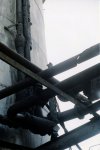
Most of the pipework up to the top of the tower was still there. Note the lagging to prevent freezing.
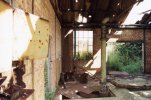
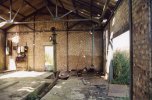
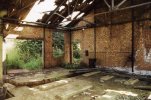
The shed was a steel-framed affair with single skin red brick infill. Windows, all smashed, were of the typical 1930s industrial steel frame sort. The roof was corrugated asbestos. While the shell was more or less intact, it was obvious most of the internal equipment had been removed. Whether that was done by the railway when the place was decommissioned, or it was an enterprising scrap dealer, we may never know.
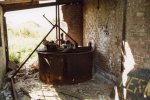
One vat remained. It appears to be something used to mix the water treatment chemicals into the water supply. You can see the outer wall here has been pushed in.
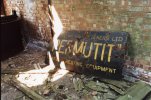
If there was one name in the UK associated with water treatment it was Permutit. The name still lingers on, although the founding companies have long since been absorbed and dissolved into other companies. You can see the company history, plus some fantastic period advertising, on this link. Despite the bullet holes and rust, the enamelled sign was quite a find. Sadly, we didn't feel strong enough to liberate it. Lugging it back over a mile of field on a boiling hot day was not to be entertained. I wonder if it survives anywhere.

A chunk of cast iron, branded Henry Pooley & Son Ltd, Birmingham, was presumably part of a weighing scales for the chemicals. Signs of other visitors in the form of an empty can of Diet Tango and packet of Benson & Hedges, lurk in the leaf litter and broken roof materials.
Part Two follows shortly.
One summer, in the mid-1990s, Best Beloved and I stayed in Stony Stratford, near Milton Keynes, with a good friend. We did this most summers, until our friend passed away. Best Beloved had grown up in the Wolverton, North Bucks, area, and we both delighted in seeking out the remains of the Old Railway in the area. We walked the length of the Newport Pagnell Branch, now a foot and cycle path. We explored what was left of Wolverton Works, and the back streets of the town itself. We went to Northampton by train, to photograph the station and environs, only to be moved on by an officious constable because someone called the Princess of Wales was arriving shortly.
I think it was on one of our little jaunts into the countryside around the West Coast Main Line at Castlethorpe when we spotted something next to the line that looked intriguing. It appeared to be a grain silo from far off, but we realised it was actually the remains of the water tower and treatment works for the Castlethorpe water troughs. This was worth investigating further.
For an explanation of water troughs and how they were used, visit the Wikipedia page.
We parked the car in Castlethorpe, and wandered around to see if we could find a way to the tower. It appears to be a proper footpath these days, but can't recall if it was clearly marked back then. With the fields freshly harvested, we didn't think the local farmer would mind if we tramped across his land.
As you can see, it was quite an imposing structure. The tower, while suffering some three decades of neglect by this stage, was still pretty solid.
The whole structure, aside from the attached shed, was surprisingly intact. There was, however, no way either of us was climbing that ladder!
Most of the pipework up to the top of the tower was still there. Note the lagging to prevent freezing.
The shed was a steel-framed affair with single skin red brick infill. Windows, all smashed, were of the typical 1930s industrial steel frame sort. The roof was corrugated asbestos. While the shell was more or less intact, it was obvious most of the internal equipment had been removed. Whether that was done by the railway when the place was decommissioned, or it was an enterprising scrap dealer, we may never know.
One vat remained. It appears to be something used to mix the water treatment chemicals into the water supply. You can see the outer wall here has been pushed in.
If there was one name in the UK associated with water treatment it was Permutit. The name still lingers on, although the founding companies have long since been absorbed and dissolved into other companies. You can see the company history, plus some fantastic period advertising, on this link. Despite the bullet holes and rust, the enamelled sign was quite a find. Sadly, we didn't feel strong enough to liberate it. Lugging it back over a mile of field on a boiling hot day was not to be entertained. I wonder if it survives anywhere.
A chunk of cast iron, branded Henry Pooley & Son Ltd, Birmingham, was presumably part of a weighing scales for the chemicals. Signs of other visitors in the form of an empty can of Diet Tango and packet of Benson & Hedges, lurk in the leaf litter and broken roof materials.
Part Two follows shortly.