4mm Branch Lines to Mucklemouth - Late Victorian Norfolk

Herb Garden

Western Thunderer
IMG-20230508-WA0000.jpg
Well(s) here's a picture for you. A misty harbour in Victorian England. And also the inspiration for starting out on a layout project.

The first question you will be asking is: Why the separate thread?

Well, I've been building model Locomotives for an number of years and slowly growing with confidence and skill to a point that I am comfortable with the results and I've shared my most recent adventures in this field on my thread Canary Sidings

however with layouts I'm much more the novice having only built 2 since the age of 18 and both failures. So just as one sets up a separate legal entity for a risky venture so I've set up a separate thread for mine .... As due to circumstances beyond my control I may never finish.... It is always a risk. Also I'm probably going to need a lot of help .... And I mean a lot ....

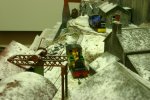
Beyond the oval of track at the age of 4 and the GWR BLT I built in my parents loft in my teens layouts started (and almost ended) with Ryad. A cute cliche ridden 009 welsh slate railway covered in snow to hide all the terrible senics
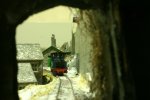
CRW_1019_RJ.JPG
CRW_1020_RJ.JPG

Well the baseboard we're flexible the wiring and controller shorted out in the second exhibition and the running quality was terrible even before the track fell to bits at the end of exhibition number 3. It was quietly retired after that and I vowed never to go anywhere 009.

The second layout was built during the first lockdown... After years of trying to not build bad locos. I had time on my hands to do something and Skeetsmere was the result. A light railway terminus set in rural Suffolk came into being in OO .... Hand built track and all... And after time spent working in robotics the control was excellent. It featured in the GERS virtual exhibition in 2021 and that detail can be found here:

Skeetsmere

But then the rot set in... My track work left something to be desired.... And then the steel rail started to rust and when it did it never stopped.... Also I found it is really hard to work in finescale OO as everyone interpretates it differently.... Then came the move to EM gauge and soon after that we had to demolish the lean too on our house which contained the kitchen (it would have fell down of its own accord) and all hell broke loose. Skeetsmere was dismantled and the baseboards are being used as a storage unit a year later. This is also when I started building #73 but that's another story.

That brings us up to the present day. With the building works finally comming to an end for now and a move into the dedicated office room imminent my thoughts have turned to having a layout. 3rd time luck eh?

So the brief is as follows:

1 must fit on a shelf like Skeetsmere 1'6" deep max
2 must reuse the Skeetsmere baseboards currently 8' but this can now be extended to 10'
3 provide a home for my slowly growing Victorian GER fleet
4 portable must fit in boot of 57 plate honda jazz that is still going strong unbelievably

So that's the plan for now.... It's not going to be easy and any help and advice along the way would be most appreciated

For now I will leave you with the two locations that started the inspiration for Mucklemouth. Wells and Hadleigh

IMG_20230425_145342897_HDR.jpg

IMG_20230509_063414541.jpg
 

Joe's Garage

Western Thunderer
Nice ideas... especially GE!! And of course with the pending Buckjumper model from Accurailscale next year.
Look forward to this one
All the best
Julian
 

Herb Garden

Western Thunderer
Nice ideas... especially GE!! And of course with the pending Buckjumper model from Accurailscale next year.
Look forward to this one
All the best
Julian
Hi Julian

Glad someone is excited about this I'm really scared at making a pigs ear of things yet again.... Luckily there are plenty of pig farms in Norfolk :D

For a couple of reasons I doubt we will see an accurascale buckjumper on Mucklemouth (if I succeed in making it work.....)

In the Victorian era, in which this layout will be set, new Locomotives tended to be shedded at the southern end of the system and as they were superceded by new models they were steadily moved northwards until they ended up at places like wells and heacham. So when James Holden brought out the first of the R24s (LNER J67s) in the 1890s trains in north Norfolk were being run by Sinclair Y class locos and the like from the late 1850s!

The other reason is that I have a few wills/SEFC/rice/connisuer buckjumpers to build first!

Herbie
 

David Waite

Western Thunderer
Hi Herbie
Best of luck with your new layout,
In the last photo that you posted can you tell me, what is the item at the rear of the buffer stop?
David.
 

simond

Western Thunderer
I’ll hazard a guess that it’s coke raves. A two plank removable extension of a wagon body.
 

Herb Garden

Western Thunderer
I think Simon is right that it's a removable body but I think it's for the plate layers trolley that usually sat down the headshunt at Hadleigh you can just see it ahead of the buffers.... But there is also one down the bank to the right of the main line as well.....
 

RichardG

Western Thunderer
All best wishes with the new layout. The thing I am trying the most with my own project is to recreate a prototype (albeit a fictional one), I spent far too long in this hobby making models of other people's models. Choosing a late Victorian setting does help to force the issue.

My Dad's final car was an 04 plate Jazz, this is still on the road and the MOT records show it has passed 145,000 miles. They don't seem to go wrong - I knew of another one used for frequent South Wales to Dumfries runs, eventually every part wore out at much the same time and repair wasn't really possible without building a new car.
 

Herb Garden

Western Thunderer
So I should probably elaborate on the plan a bit more....

Mucklemouth is in theory a fictional place on the north Norfolk coast somewhere near to blakeney/Cley/wells etc..... A part of the world that holds strong links with me despite living miles away in the north of England

The era is somewhere loosely between 1880-1899 although a big era very little change at that time bar the trains running of the railway. This was also the most varied period for the number of different classes of locomotive alone that were in service. In its early years the GER had more loco engineers than it knew what to do with.

Obviously my inspiration was sparked particularly by Wells next the Sea. The geography, vernacular architecture and that gorgeous harbour branch.

IMG_20230510_215154208.jpg

The station is another matter.... Although in Victorian days it had this marvelous multiple arch overall roof it is not a station that fitted well into a long thin shelf layout

IMG_20230510_215112614.jpg
And aesthetically and Ballance wise all the buildings (volume) is at one end and all the activity also. How many times have you got stuck looking at the boring fiddle yard end of an exhibition layout when everything is going on at the station end? I want to do something different in this respect and have a Ballance of interest spread evenly along the layout. This probably means bending reality a bit.

The other issues with this trackplan are the 3 roads leaving the layout in different directions. The baseboards are very narrow so that won't work well. And the harbour is miles away. So the design needed to take inspiration from elsewhere......

To be continued.....
 

James Spooner

Western Thunderer
I guess this is one of those areas where rule 1 applies. You have a made up name, so you can have a made up track plan drawing bits you like from different GER termini to create a believable and interesting model. A bit like East Lynn in some respects…

Nigel
 

Herb Garden

Western Thunderer
I guess this is one of those areas where rule 1 applies. You have a made up name, so you can have a made up track plan drawing bits you like from different GER termini to create a believable and interesting model. A bit like East Lynn in some respects…

Nigel
Exactly!

What one might call a greatest hits layout.

And as for east Lynn.... Twas the layout that clinched modelling the pregrouping era of the GER for me.... After that there was no turning back
 

Tim Birch

Western Thunderer
Elements of Cromer (GER) especially before a second platform was built could make for interesting operation, including through carriages from the LNWR. There are lots of enticing views on the Disused Stations website.
 

Herb Garden

Western Thunderer
Elements of Cromer (GER) especially before a second platform was built could make for interesting operation, including through carriages from the LNWR. There are lots of enticing views on the Disused Stations website.
That's a good thought Tim!
 

AJC

Western Thunderer
Elements of Cromer (GER) especially before a second platform was built could make for interesting operation, including through carriages from the LNWR. There are lots of enticing views on the Disused Stations website.

Yes, quite a good 'bitsa' flavour of that early Cromer station could be achieved by viewing from what (in reality) would be on the steps of the good shed, though I'd be tempted to GER-ise Swanage as perhaps the only truly compact seaside terminus anywhere!

Adam
 

Herb Garden

Western Thunderer
Yes, quite a good 'bitsa' flavour of that early Cromer station could be achieved by viewing from what (in reality) would be on the steps of the good shed, though I'd be tempted to GER-ise Swanage as perhaps the only truly compact seaside terminus anywhere!

Adam
Having had a quick look at what books are above the desk (oh the joys of WFH Fridays!) I know what you mean..... Im a big fan of the cameo layout style and really like those bitsa views. Where would we be now if it were not for the legacy of the great Iain Rice?

On the note of Swanage I know very little about it.... Being off my territory as it were. Can you point me in a direction of more info?

Herbie
 

AJC

Western Thunderer
Having had a quick look at what books are above the desk (oh the joys of WFH Fridays!) I know what you mean..... Im a big fan of the cameo layout style and really like those bitsa views. Where would we be now if it were not for the legacy of the great Iain Rice?

On the note of Swanage I know very little about it.... Being off my territory as it were. Can you point me in a direction of more info?

Herbie

The joy of Swanage is that most of it is still there, of course. Here's what it looked like in the '30s from the convenient overbridge:

FtmGljPXgAIK-hJ?format=jpg&name=4096x4096.jpg

If you go and look at the NLS scans of the OS you get a more detailed picture: View map: Ordnance Survey, Dorset LVII.9 & 10 (Swanage) - Ordnance Survey 25 inch England and Wales, 1841-1952

The goods facilities to the east and west of the station were lost later, but it's an interesting, extendable and compressible sort of plan.

Adam
 

Tim Birch

Western Thunderer
Is it worth looking to identify what could be typical design elements of a GER station and termini in particular? Sometimes it is possible to have an idea of the owning company from the track layout or disposition of different functions. I know that, for example, the LSWR liked to use double slips, the LYR didn't use bay platforms if possible (but did have double track lines often ending in a single platform) and the NER seemed to have tracks in all directions! Also things could change over time. Going back to the Cromer suggestion, the station as it was in the early 20th century looks more 'modern' than the late 19th century one. As Adam suggests above, the NLS maps are your friend in this as termini from all over England, Scotland and wales can be viewed.
 

Herb Garden

Western Thunderer
Is it worth looking to identify what could be typical design elements of a GER station and termini in particular? Sometimes it is possible to have an idea of the owning company from the track layout or disposition of different functions. I know that, for example, the LSWR liked to use double slips, the LYR didn't use bay platforms if possible (but did have double track lines often ending in a single platform) and the NER seemed to have tracks in all directions! Also things could change over time. Going back to the Cromer suggestion, the station as it was in the early 20th century looks more 'modern' than the late 19th century one. As Adam suggests above, the NLS maps are your friend in this as termini from all over England, Scotland and wales can be viewed.
It shows great minds think alike.... When I started this project that's exactly what I thought to do so I went looking and really came unstuck....

The problem is that there aren't typical GER branch line termini particularly in Norfolk.

When you rule out Yarmouth, Norwich, Lynn, Hunstanton on the basis of being too big.... What's left? Cromer and Wells both still quite large in Thier own way.

If you travel south into Sufolk you get a few more and inspiration can be taken from Aldeburgh, Fram, Snape, Felixstowe and Hadleigh. And that is were I went to get inspiration. But even then taking inspiration is risky because most of the branch lines were built by the multitude of predecessor companies before the GER was even a twinkle in the ECRs eye.... This led to quite a diversity of styles and operating procedures

For example did you know that at wells before the LNER put in a run round the train was stopped on the gradient on the outskirts of the station the loco detached and run forward into a siding then the train was run under gravity into the single platform.

The only typical GER style came in 1865 with the opening of some of the London extension ls to the suburban network and the stour valley line. A good example of this style of station is the wonderful Elmham Market by fellow WT @James Spooner. But there were no termini in this style that suit unfortunately...

I think I have got a working track plan coming together so watch this space.....
 

RichardG

Western Thunderer
Not wishing to distract unecessarily, but given you like making engines perhaps you should start with the sheds and work outwards? The book "Great Eastern Railway Engine Sheds, Part 2 - Ipswich and Cambridge Districts" by C Hawkins and G Reeve includes lots of station track diagrams.
 

Herb Garden

Western Thunderer
Not wishing to distract unecessarily, but given you like making engines perhaps you should start with the sheds and work outwards? The book "Great Eastern Railway Engine Sheds, Part 2 - Ipswich and Cambridge Districts" by C Hawkins and G Reeve includes lots of station track diagrams.
It's a good suggestion Richard. Problem is an engine shed layout should be quite boring operationally after all all your locos should be off working making money and not on shed ....

Also I've allready Bukit the engine shed for this layout..... Or rather for Skeetsmere.... Which I want to use...IMG_20230330_064902951.jpg

Or rather finish then use..... That planking took me so long to do I really must use it....
 
Top