
You are using an out of date browser. It may not display this or other websites correctly.
You should upgrade or use an alternative browser.
You should upgrade or use an alternative browser.
A speeder - finescale of a sort!
- Thread starter Peter Insole
- Start date


Tim Watson
Western Thunderer
Well we’re all due some sunshine & warm weather. So glad you’re back.
Tim
Tim


timbowales
Western Thunderer
As I look out of my window in South West Wales guess what, it’s raining!Well we’re all due some sunshine & warm weather. So glad you’re back.
Tim
Ho hum,
Tim T

 )
)

richard carr
Western Thunderer
Great to have you back Pete


Peter Insole
Western Thunderer
Thank you everyone for your great kindness, I really do appreciate it.
There will hopefully be some more news to come on the "Speeder" front soon... but I am just waiting for the postie to turn up on my doorstep with a distinctly heavy parcel!
Pete.
There will hopefully be some more news to come on the "Speeder" front soon... but I am just waiting for the postie to turn up on my doorstep with a distinctly heavy parcel!
Pete.

Tom Insole
Western Thunderer
Adding in from the weekend that brought hours of fun last weekend a video dad has been looping over and over on our photos thread where the family shares all the antics and updates this one was one that we can all agree sums up the perfect loop round on the line...
I don't think we need to explain any more but just to say... enjoy the ride folks!
Tom.
I don't think we need to explain any more but just to say... enjoy the ride folks!
Tom.
Peter Insole
Western Thunderer
As the report involves the little speeder, I thought it would be appropriate to wish everyone a "happy new year" on this thread!
It has become something of a boxing day tradition to gather as many family members as possible together at my brother-in-law's capacious flat in Cambridge. He is the full time caretaker of an established private school, and not only lives on the premises, but during the holidays has access to the large assembly hall there. It is an ideal space to allow the children a safe, dry and warm place to thoroughly "let rip" - and hopefully tire themselves out while the grownups relax?!
I was invited to take the train there this year... literally!

It is on occasions such as this that the portable, plastic track system is absolutely ideal - for when set up on a firm, smooth floor it is not only strong enough to support adult riders, but at the same time being fairly resilient, is pretty much guaranteed to leave no impressions or other evidential marks behind!
I could wish that the curves were a tad more generous... but the kids don't seem to care too much about that!
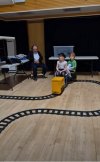
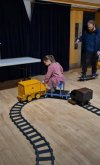
While I did take my camera, I was so preoccupied by all the fun going on that I quite forgot to take any pictures... so have had to "borrow" some images from the folks... and apologise for the previous two, only being low-resolution screen-grabs!
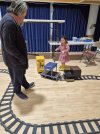
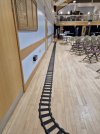
I maybe should try and get some more (reasonably comfortable?) passenger stock constructed for next season though!
Pete.
It has become something of a boxing day tradition to gather as many family members as possible together at my brother-in-law's capacious flat in Cambridge. He is the full time caretaker of an established private school, and not only lives on the premises, but during the holidays has access to the large assembly hall there. It is an ideal space to allow the children a safe, dry and warm place to thoroughly "let rip" - and hopefully tire themselves out while the grownups relax?!
I was invited to take the train there this year... literally!
It is on occasions such as this that the portable, plastic track system is absolutely ideal - for when set up on a firm, smooth floor it is not only strong enough to support adult riders, but at the same time being fairly resilient, is pretty much guaranteed to leave no impressions or other evidential marks behind!
I could wish that the curves were a tad more generous... but the kids don't seem to care too much about that!
While I did take my camera, I was so preoccupied by all the fun going on that I quite forgot to take any pictures... so have had to "borrow" some images from the folks... and apologise for the previous two, only being low-resolution screen-grabs!
I maybe should try and get some more (reasonably comfortable?) passenger stock constructed for next season though!
Pete.

Peter Insole
Western Thunderer
Ah, sadly, I'm afraid not Ovener! - Once upon a time I might have been brave enough to have a go - but I'm not quite so steady on my natural perambulation equipment these days, so putting free-running, unguided wheels underneath might be a recipe for disaster?!
Pete.
Pete.
Probably wise... I too am not a skateboady sort of person. They always seem like a lot of effort for not much reward; a bit like a pannier tank on the Cheltenham Flyer...Ah, sadly, I'm afraid not Ovener! - Once upon a time I might have been brave enough to have a go - but I'm not quite so steady on my natural perambulation equipment these days, so putting free-running, unguided wheels underneath might be a recipe for disaster?!
Pete.
 Meanwhile back to the workbench and my linked L shaped shunting plank layout of a sort..
Richard
Peter Insole
Western Thunderer
I haven't posted on this particular thread for a very long time as there have been so many other things going on with the railway. The little "Speeder" has repeatedly featured elsewhere, and although technically unfinished, it has become a (mostly) reliable stalwart of services on the line!
Admittedly, the engine is now running on it's second PWM control unit, and has a frequent issue with chain sprockets slipping - and particularly for some reason on the leading axle? I confess a tendency to forget to tip the loco up from time to time in order to check all the bearings, collars and grub screws... it only becoming apparent that something has shaken, or otherwise worked loose after the event! Another problem that is really starting to impact it's reliability is the original polypropylene wheelsets...
I know we have discussed this subject before, but I had fully expected the treads and flanges to suffer from severe grooving as a result of working so regularly over (abrasive) aluminium rail and our awfully sharp curves, but the wear is surprisingly negligible in that respect. The problem is however rather more subtle; for whilst there appears to be many more years of potential service in them, the running surfaces have become finely abraded all over, and the plain, leading wheels have almost completely lost the ability to "creep" on any degree of curve. Oddly, there is now a bit too much traction!
Over on another thread I had quite a while ago mentioned acquiring a set of four steel wheels... with the primary intention of applying them to the "Horwich" engine, but since then I had not been quite able to make up my mind how to go about it. What concerned me most was that although the tread diameter was ironically identical, (at 4 inches) to the plastic originals... they were somewhat undersize by comparison with the prototype. The recent delivery of another set... this time the long hoped for, brand new and off the shelf batch of SMR Engineering, 4 1/2 inch wheels are absolutely spot on for scale!
Using that earlier set as direct replacements on the "speeder" is now not only possible... but indeed is becoming imperative!
To that end, I have made a start by preparing an initial drawing:

These wheels were apparently a "shelf-clearance" lot, and as such were sold at a bargain price. One thing that has since struck me is that they are at an oddly oversize 1 1/4 inches thick, as apposed to the correct "standard" of 1 1/8, that could have been an issue on the "Horwich" engine with the already tight clearances of the existing outside motion, but there will be no such problem with the speeder!
Another advantage of having the new wheels of the same diameter as the original sets is that it should not affect the already well proven gear ratios!
One significant requirement however will be setting up the sets with reducing collars to allow the wheels to be removed from the axles in order to maintain the internal, pillow block bearings. I need to produce an accurate drawing for these... and especially to establish the precise back to back measurements for yet another variety of flange and tyre profiles!
By yet another one of those quirks of fate, I happened to have a length of 3/4 inch, thin walled tube, (I've no idea where that came from - or indeed what it was originally for?) that wont be any good for the permanent collars, but was thoroughly ideal for testing purposes!
I wanted to be able to see how a paired set performed, particularly through the pointwork, and at the maximum loco wheelbase of nine inches:
Thanks to the discovery that the bulged section of a particular sized Nyloc nuts was a really snug fit inside the tube, allowed me to set temporary axles in a simple, lash-up frame:

Despite having no bearings of any sort... with bare threaded rod running in fairly close fitting, plain timber holes... the rig nonetheless flew along... and once rolling; at times I had much trouble keeping up with it!!
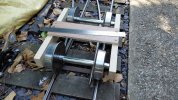
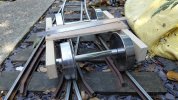

I have now joyfully established that a back-to-back of 125mm sails sweetly through both of our ("universal") points, crossings and check rails without problems... and that with a skim of 1/16th of an inch off the larger, "Horwich" wheels will also bring them perfectly within existing tolerances!
Yippee wahoo!
When these are all done, we should then have something that will be even more reliable... and hopefully guaranteed to last for a good many miles per year of pleasure to come?!
Pete.
Admittedly, the engine is now running on it's second PWM control unit, and has a frequent issue with chain sprockets slipping - and particularly for some reason on the leading axle? I confess a tendency to forget to tip the loco up from time to time in order to check all the bearings, collars and grub screws... it only becoming apparent that something has shaken, or otherwise worked loose after the event! Another problem that is really starting to impact it's reliability is the original polypropylene wheelsets...
I know we have discussed this subject before, but I had fully expected the treads and flanges to suffer from severe grooving as a result of working so regularly over (abrasive) aluminium rail and our awfully sharp curves, but the wear is surprisingly negligible in that respect. The problem is however rather more subtle; for whilst there appears to be many more years of potential service in them, the running surfaces have become finely abraded all over, and the plain, leading wheels have almost completely lost the ability to "creep" on any degree of curve. Oddly, there is now a bit too much traction!
Over on another thread I had quite a while ago mentioned acquiring a set of four steel wheels... with the primary intention of applying them to the "Horwich" engine, but since then I had not been quite able to make up my mind how to go about it. What concerned me most was that although the tread diameter was ironically identical, (at 4 inches) to the plastic originals... they were somewhat undersize by comparison with the prototype. The recent delivery of another set... this time the long hoped for, brand new and off the shelf batch of SMR Engineering, 4 1/2 inch wheels are absolutely spot on for scale!
Using that earlier set as direct replacements on the "speeder" is now not only possible... but indeed is becoming imperative!
To that end, I have made a start by preparing an initial drawing:
These wheels were apparently a "shelf-clearance" lot, and as such were sold at a bargain price. One thing that has since struck me is that they are at an oddly oversize 1 1/4 inches thick, as apposed to the correct "standard" of 1 1/8, that could have been an issue on the "Horwich" engine with the already tight clearances of the existing outside motion, but there will be no such problem with the speeder!
Another advantage of having the new wheels of the same diameter as the original sets is that it should not affect the already well proven gear ratios!
One significant requirement however will be setting up the sets with reducing collars to allow the wheels to be removed from the axles in order to maintain the internal, pillow block bearings. I need to produce an accurate drawing for these... and especially to establish the precise back to back measurements for yet another variety of flange and tyre profiles!
By yet another one of those quirks of fate, I happened to have a length of 3/4 inch, thin walled tube, (I've no idea where that came from - or indeed what it was originally for?) that wont be any good for the permanent collars, but was thoroughly ideal for testing purposes!
I wanted to be able to see how a paired set performed, particularly through the pointwork, and at the maximum loco wheelbase of nine inches:
Thanks to the discovery that the bulged section of a particular sized Nyloc nuts was a really snug fit inside the tube, allowed me to set temporary axles in a simple, lash-up frame:
Despite having no bearings of any sort... with bare threaded rod running in fairly close fitting, plain timber holes... the rig nonetheless flew along... and once rolling; at times I had much trouble keeping up with it!!
I have now joyfully established that a back-to-back of 125mm sails sweetly through both of our ("universal") points, crossings and check rails without problems... and that with a skim of 1/16th of an inch off the larger, "Horwich" wheels will also bring them perfectly within existing tolerances!
Yippee wahoo!
When these are all done, we should then have something that will be even more reliable... and hopefully guaranteed to last for a good many miles per year of pleasure to come?!
Pete.
Last edited: