7mm On Heather's Workbench - small and perfectly formed

Steph Dale

Western Thunderer
Heather,
Do you even need the tube? Short lengths of wire down from the corners of the cab roof would happily provide a clip in to the corners of the cab. Mind you I don't even do that, a few blobs of PVA or crystal clear after final painting and assembly tend to be enough for me.
Steph
 

Heather Kay

Western Thunderer
As the cab back is visible, I felt something to stop the roof sliding backwards would be useful. The back of the roof will have a different style of clip. As you say, blobs of PVA would achieve a similar result.
 

Heather Kay

Western Thunderer
Time to ask the gurus again. How am I supposed to fix the resin boiler assembly to the footplate? There are etched holes that would suitable for screws or bolts, but is the resin strong enough to be tapped to take one of the supplied 10BA bolts? Has anyone used self-tapping wood screws?

Funnily enough, this isn't covered by the instructions at all. :rant:
 

taliesin

Western Thunderer
Some resin's are harder than others Heather but you will not get much grip with 10BA, as for self tappers, probably ok as a one shot but not if you envisage it coming apart many times.
Looks like Slater's instruction writer has been moonlighting :D, cheers Rob.
p.s, is it possible to bore the hole out and super glue in a brass insert tapped 10BA ?
 

Heather Kay

Western Thunderer
If you don't have a lathe Heather, i can chuck up some brass rod, drill and tap it for you

I do have access to a lathe, Rob. You've reminded me I need to make some time to reacquaint myself with it.

or do it the other way around and epoxy the bolt in the hole so that it protrudes through the etched hole in the cabsheet and then run a nut down onto a washer?

Mike, I am liking that idea. :thumbs:
 

Heather Kay

Western Thunderer
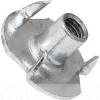
Is there such a contraption as a miniature tee-nut?

images?q=tbn:ANd9GcS4iIFYzCE0Bprd5cWUa65LoV7DO2XBQCTwTOeuoLyjc6CCaiLt.jpg

Ouch! I think that might be pushing the boundaries of scale a little! I may compile a list of "enhancements" for JLTRT to consider with this and similar kits. There are some gaping holes in the instructions that the average builder might find hard to cross.
 

OzzyO

Western Thunderer
Hello Heather,

I just use self tappers for holding the resin boilers on. Then when I'm happy that the boiler will not have to come off again run some epoxy around the joint faces and tighten the screws up.
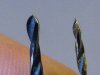
The blue resin knocks hell out of drills so don't use your best ones on it. This is how they end up after a few uses in the Dremel,
50033.JPG
 

alcazar

Guest
Good grief...might be time for carbide drills, like they use on pcb's?

What about epoxying in some threaded rod, or a bolt with the head cut off? Then putting a nut over it.
 

oldravendale

Western Thunderer
Good grief...might be time for carbide drills, like they use on pcb's?
I have a Rebuilt Royal Scot from the same source as yours, Heather, and have been advised to use solid carbide drills on the boiler. I've done a search and think that Squires can supply them for lots of £££££. Does anyone know of an alternative and less expensive source?

Brian
 

JimG

Western Thunderer
I have a Rebuilt Royal Scot from the same source as yours, Heather, and have been advised to use solid carbide drills on the boiler. I've done a search and think that Squires can supply them for lots of £££££. Does anyone know of an alternative and less expensive source?

I use this supplier for my carbide milling cutters. They do carbide jobbers drills

http://www.drill-service.co.uk/Product.asp?Parent=020080040000&Tool=389

Prices are round about £7 - 10 + VAT for our smaller sizes but their "Y" series drills are a fair bit cheaper and they look to be around about the Squires prices.

Note - carbide is very brittle so small diameter carbide drills being used hand held in a Dremel type tool are probably a sure-fire recipe for a broken drill. :)

Jim.
 

oldravendale

Western Thunderer
I use this supplier for my carbide milling cutters. They do carbide jobbers drills

http://www.drill-service.co.uk/Product.asp?Parent=020080040000&Tool=389

Prices are round about £7 - 10 + VAT for our smaller sizes but their "Y" series drills are a fair bit cheaper and they look to be around about the Squires prices.

Note - carbide is very brittle so small diameter carbide drills being used hand held in a Dremel type tool are probably a sure-fire recipe for a broken drill. :)

Jim.

Thanks Jim - and thanks for the warning about their use.

Brian
 

OzzyO

Western Thunderer
Hello all,

a carbide drill will snap like a carrot whereas a HSS drill will bend (give) a bit before it snaps.

I've use them two drills on about ten boilers now with no problems, cut to size or a bit tight. But I can't use them on anything else.

If you want to use carbide drills , holed the job so it can't move, a milling M/C would be good for this, with all its setting up and drill the hole.

HSS drills £1.50 carbide drills £7.00+ ?????????????????
 

Heather Kay

Western Thunderer
Coo, thanks for that chaps.

I have to say, all the holes I've drilled in this kit's resin have been by hand using HSS bits. I've not used any power tools, and found the material reasonably soft. I had been warned that it tends to blunt drills like nobody's business.
 

Heather Kay

Western Thunderer
I thought I'd better explain how I worked out the boiler fitting in the end.

As I said earlier, I wanted to keep the boiler/tanks removable for now to make it easier to paint. The obvious answer was to drill and tap holes in the boiler casting (two at the firebox and one at the smoke box), glue in suitable bolts and fix things with nuts later. Unfortunately, I had forgotten to take into account the chassis frame spacer under the firebox...

So, a variant followed.

image.jpg

The stud approach has been used for the smoke box end, because there is access to fit a nut. This doubles for holding the chassis in place, with its compatriot in the bunker. The holes in the firebox are drilled out for clearance.

image.jpg

A pair of 8BA bolts have been soldered to the footplate, the heads ground down to clear the frame spacer and frames themselves, and chopped down above the footplate, to act as location dowels. When painting is complete, the option is there to put a drop of epoxy on the dowels during final assembly.

In other news, I have been worrying away at the cab and cab roof fixing. I am pretty happy with the results, which have been refined from just the wire pins to include some brass angle to act as a fixing and light break if the roof becomes slightly dislodged. I don't plan to fix the roof permanently, in case something comes adrift in the cab one day that requires access.
 

Heather Kay

Western Thunderer
Progress today, but no photos worth the taking.

Buffer housings were fitted yesterday, but in the process I dislodged one of the beams. Before I did any more damage, I put things down and walked away. After a good think, I decided the best thing would be to remove the beams (planks, sorry Graham!) clean things up and fit the housings on the bench. Which is what I did this morning.

Having refitted the buffer planks, I set about fitting the boiler/tank casting to the footplate properly. Meanwhile, the new horn block springs arrived, so I fitted those, and decided it would be opportune to fit the motor and gearbox to check for clearances. A spot of whizzy disc grinding to the footplate and bottom of the cab front, and all seems good.

Final injector detailing has been done, and I hope to fit them properly tomorrow. With a fair wind, I'll fit the pickups so the loco can be self-powered at last. Then, attention can return to completing the brake gear and sundry pipework.
 

OzzyO

Western Thunderer
Hello Heather,

nice looking way of fitting the tank/boiler unit, I'm not that keen on using nuts to hold boilers etc. in place as getting the nut on the stud between frames can be a right P.I.T.A. So I tend to use Allen screws, magnetise the Allen key and the bolt stays in place.
On a County that I'm building to hold the boiler in place I'm using self tapping screws (3/16 or 1/4") at the firebox end and 1/2" long at the smokebox end. After I'm happy with the fit I'll also apply epoxy to the joint faces, belt and braces.
300 041.jpg OzzyO.

PS. if you have to remove any material from inside the firebox try using a drum sander in the Dremel. Quicker than by hand cheaper than using burrs.
 
Top